

Review by Simon Jenner, September 9 2025
★★(★)
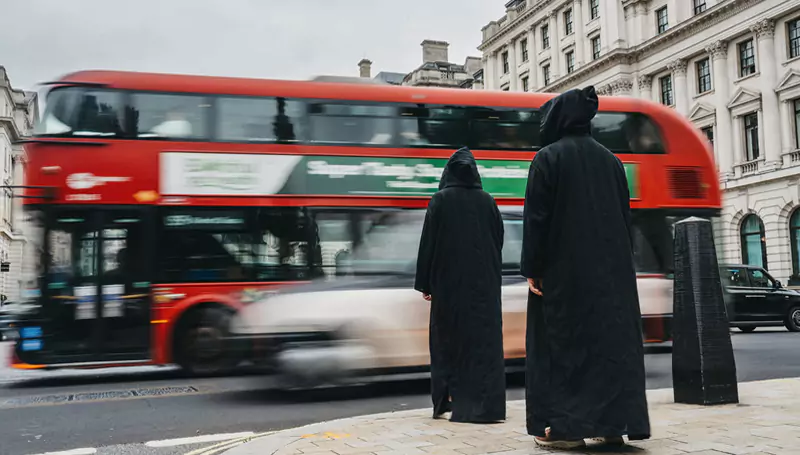
Beckett and Jermyn Street. This usually inspires a hush of satisfaction. Such attention and implicit passivity is broken open in this production of the scarcely-known radio play Cascando. Directed by Gavin Quinn of Pan Pan till September 13, it’s an experimental take on what is after all an auditory experience not designed for the stage. Nor is this production. It is designed for us, the audience, auditors or in a real sense players. Donning black cowled gowns, armed with headphones, we take to the streets for 35 minutes.
Written in 1961 and first heard in French then on the Third Programme in English in 1963, Cascando’s been rethought. And if not to be simply re-broadcast, that’s essential. Cascando though is one of the most refractive of Beckett radio dramas, early or late.
So black cowled and headphoned, all hear the play as they walk. Or in Harold Bloom’s sense, overhear themselves and their humanity. It’s as good and as pretentious as that. Then they’re led (and tailed) in a procession around Jermyn Street and St James environs. It’s choreographed for minimal traffic.
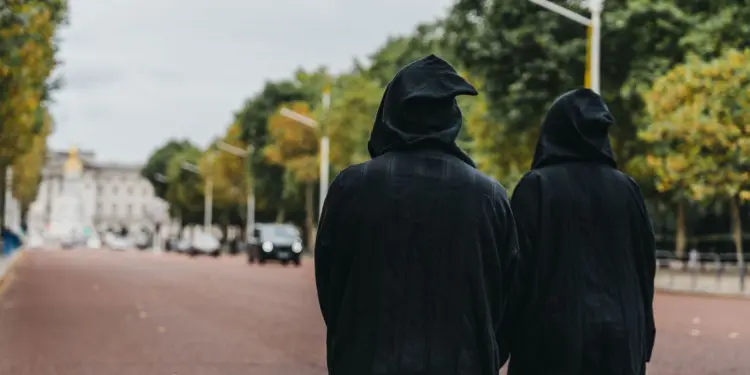
Photo Credit: Greta Zabulyte
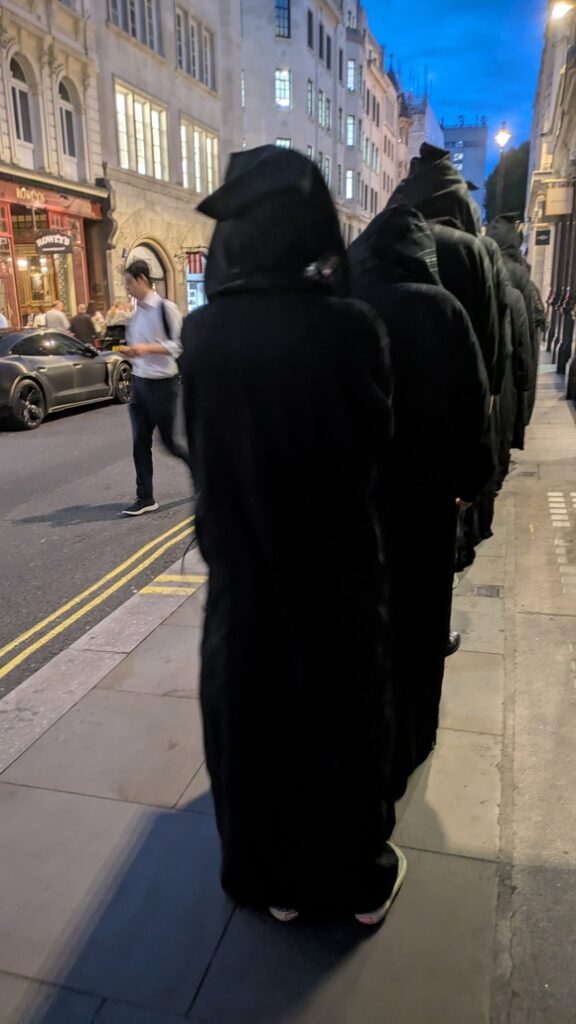
Like Quinn, Pan Pan’s co-founder Aedin Cosgrove, the designer, suggests a column of black cowled gowns might attract attention and that we are the observed. Alas only drunk people even stared and when one asked an insistent question, a Pan Pan padding behind us had to answer. Either way, it adds nothing.
With discreet and well thought-through attentiveness though, members of Pan Pan steer and attend to the crocodile of monks, head-down in Beckettian pose, listening as we peditate and allow the rhythms of walking to correlate with the discontinuous text. That is the key connection. It’s an excellent idea.
Amongst the locutions of Beckett’s blasted wordscapes, to put it vulgarly, Cascando is about the attempt to compose and the lessness as it were of hearing: a fining- down or literally, diminution in tone. There’s movement towards a completion as words themselves dip into inaudibility. Which isn’t always the point. Cascando contains three characters, two of whom speak, and a fourth, Woburn, who’s alluded to, always ahead, never appearing. He’s described as using boats and living in a shed. A sort of nautical Malloy (or Godot) tramp.
Jimmy Eadie conceives the sound envelope with Daniel Reardon as Opener and Andrew Bennett as Voice. They’re distinct though very soft and low. Too low. We take it for granted both deliver beautifully and are consummate. The third character ‘Music’ is created by Eadie.
Conceptually that works in vacuum of maximum attention. Though given the traffic (and this was the third later evening slot) and vaguely-aware mill of folk around, concentration was difficult.
Someone attached to the theatre witnessed that a Sunday afternoon run had attracted much attention and that’s surely true. Perhaps subsequent frequency of the spectacle, added to the late evening run, has dulled this. That and the fact that such sights are hardly uncommon. And I’m not sure anything is gained by being an object when you’re attempting to concentrate on the fractured text in itself.
Again, the re-membering of the text by the act of rhythmically assembling it whilst walking is an attractive esoteric idea; and should somehow be fulfilled. The audience bar a fair number of loyal Jermyn Street regulars will be self-selecting. That said, the exercise, designed to force us to concentrate on words as Buddhists focus on breath, is compellingly calming, alien and attentive to the state perhaps well-suited to the text.
The trouble is twofold. First the text as delivered whilst even minimally distracted by following the group of fellow cowled friars, isn’t so audible as to invite real engagement. Second, and this will be obvious, Beckett’s text is one of the most challenging to apprehend as a whole: except in litanic waves. Text bristles with lacunae, fractures and whatever Beckett said, inflected by new (from the late 1950s) French critical thinking. Full comprehension we take as not granted. Normally though Beckett isn’t that obscure.
Alternatives are limited. As a delivered text by an actor on stage, the intimacy of whisper, the very thing radio and headphones capture, is lost. Film too. Radio again might provide the medium Cascando is meant for. It does however seem gloriously of its time, in a heroically experimental phase of radio drama. One Radio 3 has just ditched after its entire existence championing it from 1946. And this piece, marooned, cries out – if its small mews night be permitted that – for an ambient treatment.
Ireland and France know how to seize Beckett and cheat the Estate of literalism. Conor Lovett and Theatre Gare St Lazare for instance delivering the whole Trilogy in an evening, and many other texts and shavings, attest to that. So does Lisa Dwon, that other greatest exponent of Beckett.
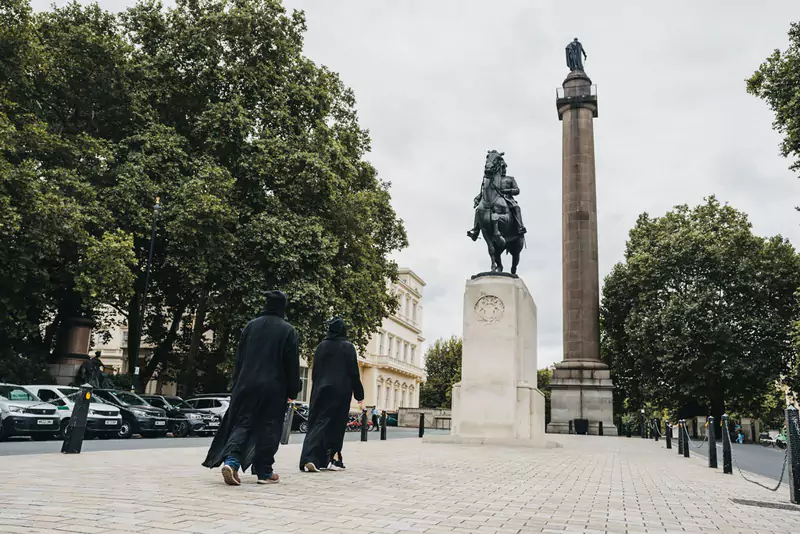
Photo Credit: Greta Zabulyte
Cascando was partly designed for Patrick Magee; his tones permeate the walls of the silent imagination. Most of the delivery’s undertaken by Bennett’s Voice. Additionally ‘Music’ is stipulated. Eadie’s is attractively poised in its ambivalent non-resolutions, and goes well enough with Reardon’s vocal imperatives “to open”.
Eadie’s music doesn’t intrude either. Music’s textually interwoven so you occasionally wonder if it should. Beckett’s almost notated it: he was a competent pianist. Eadie’s a fine successor to Marcel Mihalovici, the original composer. Later (with approval) came the 12-tone academic Humphrey Searle, who once composed a Hamlet opera which premiered in 1972 and traumatised a friend from opera for 30 years. Searle tried specific leitmotifs, or musical figures; possibly too precise.
What apart from a too-quickly suggested writers’ block does this signify? Trying to land something and trying to fine it down certainly. There’s also the repeat of “May” with the rider “for me” which twists us straight into subjectivity. There’s also the sense of “late May” casting shadows of generation and starting over. It’s is then past the cruellest month and before Bloomsday’s June 16. Optimism isn’t normally part of Beckett, or affirmation. But a puckish sense of something refreshed persists.
Quinn might have concluded with G.K. Chesterton that “if a thing’s worth doing, it’s worth doing badly”: probably the nearest the two writers came to each other. “Fail again. Fail better.” This is eminently worth trying but there must be some rethinking.
Spectacle might create for the (collective) cowled spectacle themselves a kind of self-alienation to receive better. The rest though is distraction. There must be a burial ground where auditors can walk round tethered to their director’s grave as it were. Fascinating, frustrating, worth experiencing. Perhaps platonically.
Photo Credit: Simon Jenner
3 comments
My next wardrobe purchase will probably be a used autumn jacket, but I am struggling to make a sensible shortlist. I can check measurements against a jacket I own, whereas comparing olive, brown, and blue from seller photos feels uncertain. Several sellers do not accept returns, so I would rather eliminate doubtful options before arranging a visit or paying postage. I mainly wear charcoal trousers and jeans, so a jacket that combines easily with those would have a clear purpose. I found a page about color analysis and would like to use the idea as a starting point for these comparisons. My concern is choosing a color for the photograph rather than for the ordinary combinations already available in my wardrobe. Is a daylight photo with a white object nearby helpful for comparing shades, or would you avoid relying on that? For an in-person visit, I could wear a familiar top and check the jacket beside something from my usual wardrobe. I would appreciate a short decision process for comparing jacket colors once condition, measurements, and price have passed the initial checks.
Fur eine knappe Woche in Andalusien uberlegen wir, welche Orte am Meer sich ohne Mietwagen gut kombinieren lassen. Wir reisen zu zweit und mochten nicht jeden zweiten Tag die Unterkunft wechseln. Ein Ort mit begehbarer Altstadt ware fur uns besonders reizvoll. Fur die Anreise bevorzugen wir Zugverbindungen. Ein kurzer Busabschnitt am Ende ware aber kein Problem. Mehrere komplizierte Anschlusse mochten wir vermeiden. Ein einzelner Abend je Ort ware uns zu kurz. Zum Meer darf es einen Spaziergang brauchen. Entfernungen auf der Karte sagen wenig uber angenehme Fu?wege aus. Bei der Suche habe ich andalusien schone orte am meer notiert. Welche zwei Orte wurdet ihr unter diesen Bedingungen auswahlen? Uns helfen Erfahrungen zu Bahnhofen, Wegen in die Altstadt und dem Zugang zum Strand mehr als eine lange Liste von Sehenswurdigkeiten. Auch Hinweise zu Gepack und zur Lage geeigneter Unterkunfte waren hilfreich. Wir mochten genug freie Zeit fur beide Orte behalten und die Reise nicht durch standiges Packen zerlegen.
На этот раз выбираю побережье с более прохладной погодой и рассматриваю север Испании. Думаю о поездке, в которой можно чередовать прогулки у моря, небольшие города и спокойные дни без плотной программы. Плавать каждый день необязательно, но иногда зайти в воду всё же хочется. Пытаюсь понять, лучше ли искать широкий пляж или укромный залив. На фотографиях оба варианта выглядят привлекательно, а вот ощущения при ветре и пасмурной погоде представить сложнее. Список районов составляю по материалам о местных городах. В частности, рассматриваю города на севере испании и выбираю поблизости варианты прогулок, если на берегу неуютно. Не стремлюсь объехать всё побережье за одну поездку. Лучше выбрать один район и спокойно изучить окрестности. Отдельно рассматриваю доступность магазинов и кафе, чтобы в дождливый день не зависеть от длительной поездки в другой город. Что посоветуете учитывать при таком сочетании моря и пеших прогулок? Интересуют личные наблюдения о ветре, подходах к берегу и жизни небольших курортов.