

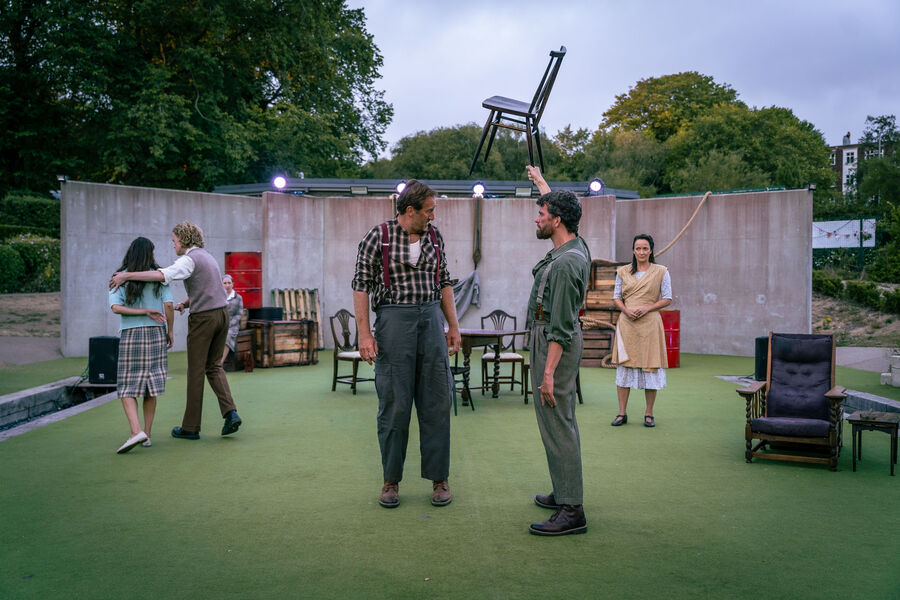
Review by Simon Jenner, August 5 2026
★ ★ ★ ★ ★
“I often think that behind that suspicious little nod of theirs lies three thousand years of distrust.” Thus Alfieri the lawyer muses on her clients, the mostly Sicilian-born families of longshoremen around Brooklyn Bridge. The Greeks occupied Sicily; and this is palpably a Greek tragedy. And if it’s Greek tragedy, especially in mid-century America, there’s one advocate over the past three years one thinks of on the south coast. Arthur Miller’s 1955 A View From the Bridge opens at Brighton Open Air Theatre directed by Conor Baum for the Conor Baum Company and BOAT, till August 8.
There’s a felicity in gender-flipping the lawyer. Alfieri’s insights around moral as well as legal issues; the actual career background (women lawyers could practice in Italy, where Alfieri is from, much earlier) all make for a compelling Mrs Alfieri. It’s just that Sharon Drain makes a riveting Alfieri without such considerations. Her gestures, deliberate in a steel-grey suit and skirt, measure both authority and occasionally vulnerability when up against a lowering client. Vocally Drain measures stark choric warnings like a sibyl: delivering adamantine warning. And she moves like one, gesturing in an almost hieratic, though natural manner. Quite a contradictory feat. Here, in the BOAT’s ampitheatre, slightly windblown on this evening, Drain hovers where she doesn’t participate.
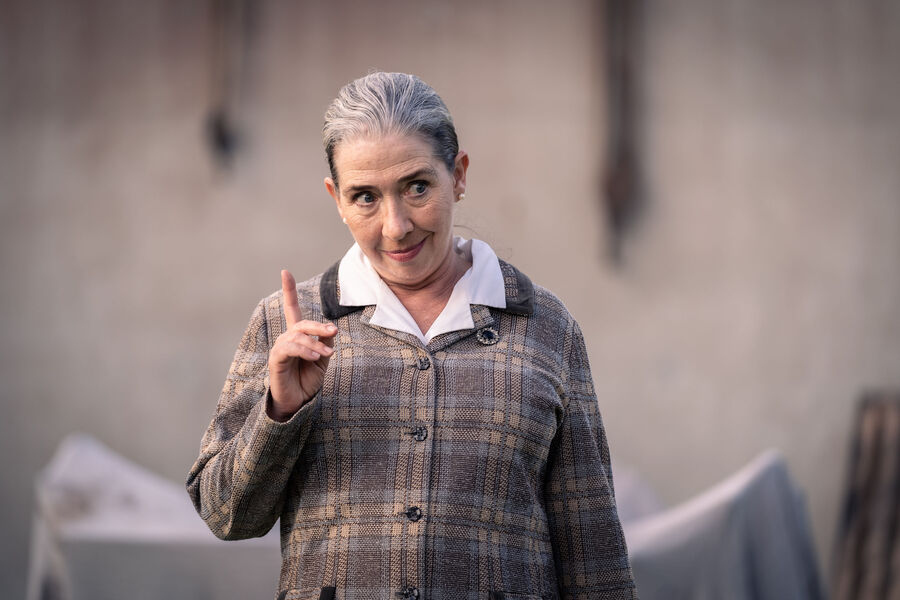
Sharon Drain as Alfieri. Photo Credit: Sam Cartwright
Eddie Carbone (Jamie Kenna) burls on with an assertion of ownership also slightly frayed. Both shiveringly over-warm, and knit-up with threat and barely-suppressed passions, Kenna’s Eddie is almost physically swayed: he should stand foursquare and has the presence. But this Eddie imperceptibly flinches out of what birthright he has.
It should be added all accents here almost knurl with Brooklyn authenticity (this writer’s uncle was from Brooklyn). Kenna, known for his TV work is also an original BOAT champion; like everyone here he knows how to sue the space – with grey dust-covered clumps of furniture, all the set needed, designed by Baum – and cuts through the occasional gusts. Costumes are a predominant brown/khaki, excepting Eddie’s dim Buffalo check shirt. Even Beatrice is white/Naples yellow, and Catherine gambols in slashes of blue and violet.
Kenna’s interactions with his anxious yet desiring wife Beatrice (Natalie Moon) are tense from the start. Eddie’s disdain for Beatrice is summarised sideways: “Most people aren’t real people.” Moon occasionally glows but already feels she can’t compete with her 17-year-old niece Catherine (Lucy Chamberlain), whom Eddie dotes far too much on. Moon’s rising anxiety and authority still has bounds too, especially in the chilling finale when Eddie refuses to let her leave and re-enter the house. At which point you lose all sympathy. Though Alfieri and Miller don’t.
Naive yet already growing into a woman as Beatrice points out (not without territorial anxiety), Catherine at first enjoys Eddie’s attentions and lights his cigar, kneeling on the ground in a clearly suggestive manner which garners uneasy laughter. Yet his admonition: “Don’t grow up” is blatantly self-contradictory. Chamberlain shifts from enthusiastic favourite girl to sudden awakenings. First, professionally, when her school fast-track her into a a stenographer’s job. Then her reaction to Rodolpho, at first just excited. Then deepening into realisation and commitment. Chamberlain’s interactions are sometimes most potent with Moon – but you think of Kenna too and her romance: Chamberlain displays an emerging variety of feelings. On the cusp of desire she still clings to her childhood affections.
Only Moon’s slighted Beatrice can tell Catherine she has left one forever, and ousted her in the process. It’s Moon’s explosive “you can’t have her” that gives one of the theatrical coups of this production. It finally centres Moon’s Beatrice in a way I’ve not seen before.
Themes introduced straight away. The Sicilian experience of permanent occupation has long enforced “omerta”, the silence to outsiders long before the mafia. That’s one of the springboards of the tragedy. The story of a 14-year-old snitch comes shortly before two cousins from Sicily arrive. There’s married Marco (a quiet, then seething Patrick McHugh), who brings both authority and fury to his role, especially in the close of the first act before the interval, and again at the end. Both in physical displays of strength. There’s a quiet, watchful affability that glints to anger.
Then there’s larky blond Rodolpho (a startling Joshua Hogan). Like McHugh, in a wholly different manner, Hogan raises traditional readings of Rodolpho to a new level. He really does seem to make everyone on stage laugh, which spreads easily to the audience; which is unusual. Hogan’s comic timing, his quickness – including his conciliatory moves towards Eddie who’s sexually jealous – uniquely energise the tread of Miller’s inexorable drama. Hogan’s comical. “Danes invade” he says off his hair. Then gives comedic impulse to his earlier life: “everything in that town they push.”
His “I have a nice face but no money” earns laughter. Significantly though Rodolfo kisses Catherine on their first meeting. Marco doesn’t.
Hogan’s Rodolpho also shows his honourable feelings for Catherine; each are calibrated within his character. In this production, Catherine’s assertions of knowingness pivots on her sudden admission she knows nothing. Her “teach me” comes with a frisson of sexual desire that overwhelms both. The lighting here, Bev Grover’s increasingly striking use in the second act – is striking, But that’s merely a prelude to two coups later.
The moments of tension, often beginning with warmth – like the song and dance with Catherine and Rodolpho – each ratchets more tension, leading to the end of Act One, but building from there too.
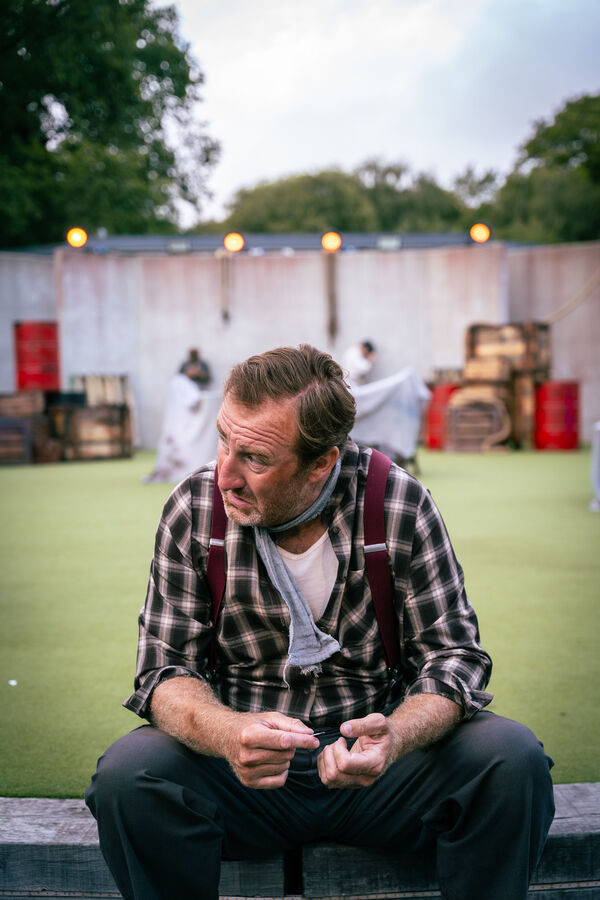
Jamie Kenna as Eddie. Photo Credit: Sam Cartwright
This production is cast from strength. Two regular company actors take small roles. Eddie’s friend Louis and stentorian First Immigration Officer (David Samson). Louis’ coeval Mike, Tony and the laconic Second Immigration Officer are taken by Benjamin Darlington whose weary enforcer’s rasp is palpable: you can hear them both cut through a crisp night.
Eddie’s contradictory attractions work themselves out first on Catherine – objecting to her job. Then on the cousins. His liking of manly Marco, safely married and wishing to return in two or three years to his family (and despite Eddie’s nasty chiding of extra children born whilst away). And the extraordinary moment when Eddie both kisses Catherine and then projects homoerotically on Rodolpho is one of the most astonishing moments of this drama. In 1955 it must have seemed even more transgressive. Baum’s team makes it shockingly fresh and spontaneous. Praise for Kim Wright’s intimacy co-ordination at all points here.
Alfieri’s scenes with Eddie begin as warning and end with threat – a new note as Alfieri has to hold her own, as Drain does against Kenna’s sudden threat. “That’s a tenor” Eddie talks of Rodolpho, as if code. Nevertheless in this pivotal scene is it Alfieri who inadvertently gifts Eddie the seeds of destruction: though declares Eddie is over-involved?
The startling lighting effects only heighten the drama. It’s a resonant use of the outdoor space. Gary Sefton’s sound too – from foghorns to eerie noises of through dance-music cuts through everything but never overpowers. It also avoids the tinniness sound-systems can suffer at this venue. Sefton’s also responsible for both movement and fight direction. These are exemplary: both visceral in fight-scenes and fluid in the use of space.
This is a near-perfect tragedy, and Baum’s strengths polish the work’s small cracks too. Miller bringing in Eddie proclaiming “my name” repeatedly is a flaw. Miller’s consummately realised that with John Proctor only two years previously. All Eddie has to do is keep with the analogous “respect” he demands. Miller clearly didn’t want to keep repeating this and maybe heighten the drama. It doesn’t quite work if we know The Crucible already; which many do.
The two hours 37 production enfolds both Greek tragedy and the pieta in one at the end, as Moon’s Beatrice and Chamberlain’s Catherine closes round Kenna’s Eddie. What closure can there be? Except for a righteous vengeance now sated in blood. A blood wedding? Outstanding.
Assistant Director/DSM Faith McNeill, Movement Fight Director Gary Sefton, Lighting Designer Bev Grover, Sound Designer Gary Sefton, Costume Supervisor Chully Mullock, Wardrobe Assistant Sue Stuart, Intimacy Coordinator Kim Wright.
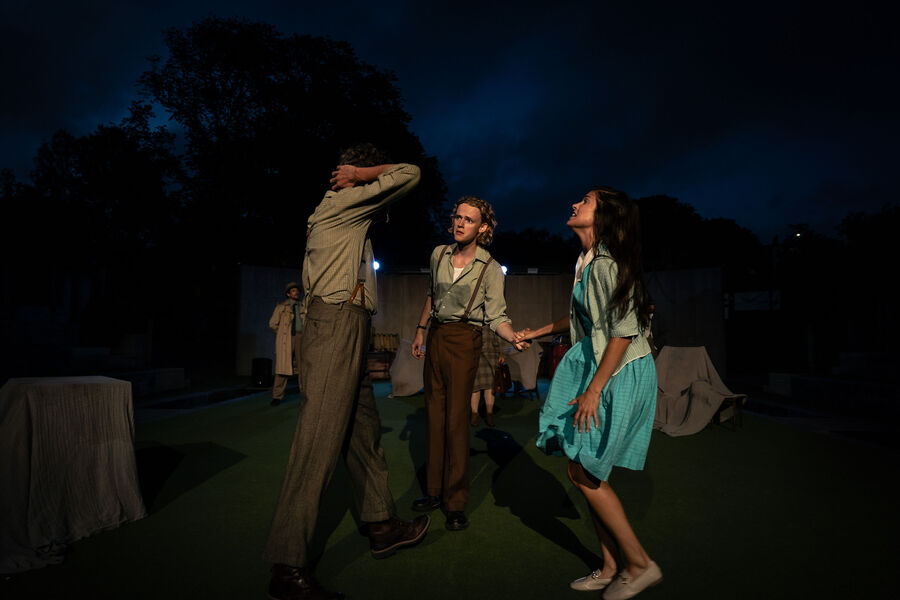
Jamie Kenna as Eddie, Joshua Hogan as Rodolpho and Lucy Chamberlain as Catherine. Photo Credit: Sam Cartwright