Review by Simon Jenner, August 5 2026
★ ★ ★ ★ (★)
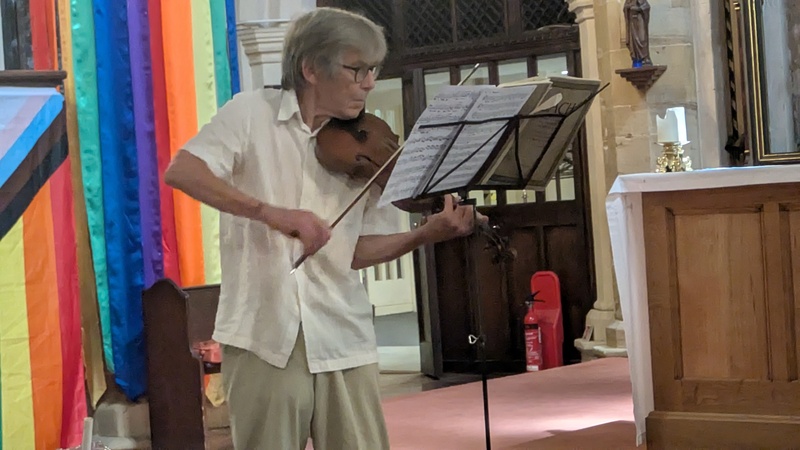
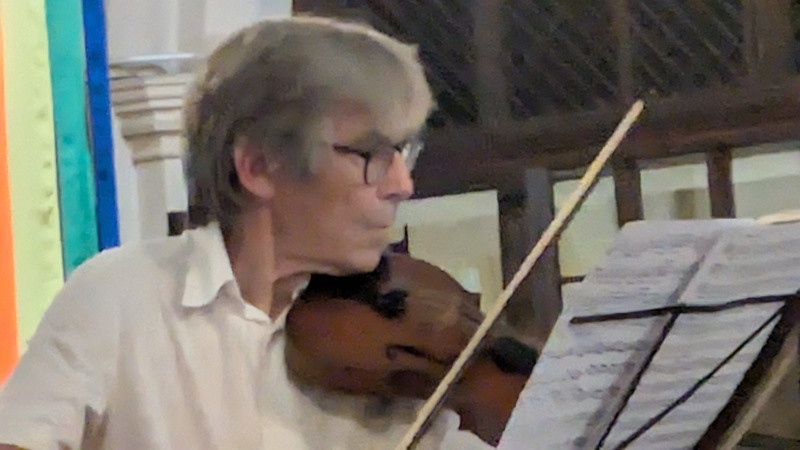
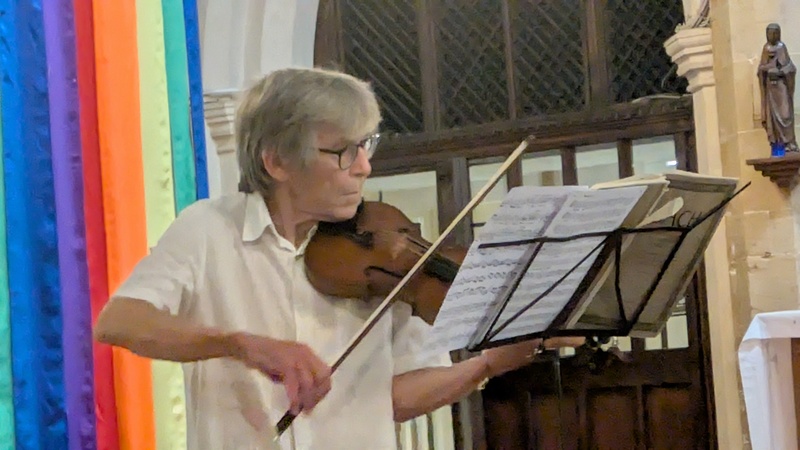
Stuart Deeks makes a welcome return to St Nicholas. Especially as he has to postpone due to a bicycle accident only a few weeks ago.
He takes a quote from a 1580 psalter by Louis Bourgeois. “Lift up your hearts and open your ears” whilst Bach and Biber form the pillars of this recital, the rest is wildly unpredictable.
One of these opens as an Introit. It’s a many-voiced “ancient Indian chant” which does open the ears to new nodes altogether. We should hear life like this, however brief and beguiling.
Bach’s G minor Villain Sonata written at Cothen in 1720 is very unusual too. Though featuring an opening Allegro as usual it doesn’t follow. The Allegro is multi-thewed setting up the prolonged Fuga that follows, Deeks patiently picking out strands and voices. It’s prolonged too, as usual these Siciliana that follows, a meditative andante-style movement.
Even the Presto finale isn’t lightweight. It’s a dance that continues the Siciliana lilt in its own accelerated way. A dark meditative piece written in the years of Bach’s first wife’s death. That tragic loss gave rise to the famous Passacaglia from the Partita No 2 in D minor.
Deeks reminds us Bach was as accomplished on the violin as he was on the organ. And remarked that Bach declared anyone with some musical talent and application might achieve the same standard…..
After this Deeks relates – with a cheerful introduction via Bach’s mode of writing on the kitchen table – the histories of Four Fiddle Tunes. Where he encourages participation in humming and quiet clapping.
‘The Mountains of Ballyhoura’ is a lilting relatively short piece preceding the earthier and equally anonymous ‘Rochdale Coconut Dance’ dating from the early 20th century. It sounds quite Irish. By 1934 Glasgow-bases J.R. Bannerman certainly intimates he knew the idiom in ‘Mairi’s Wedding’ which radiates a syncopated joy.
Finally the curiously named ‘Presbyterian Hornpipe’ (not a movement known for much music at this time) was published by Handel’s quasi-piratical publisher John Walsh in 1731. By which time he’d become more legitimate.
It’s a curious rough-edged and beguiling work too. There’s a rasp of the serious in its insouciance. All these are introduced at witty length by Deeks who plays everything on the violin from the later 16th century till now: sometimes solo, often in ensembles of varying sizes.
It perfectly precedes Heinrich Biber’s Passacaglia written in 1680. Biber (1644-1704) write masses and much else that’s being rediscovered. The finest Germanic violin composer before Bach, his 15 Rosary Sonatas are capped by this stunning Passacaglia, the ‘Guardian Angel’. Its hypnotic Passacaglia form unfolds with a searching chromaticism and single melody wrapping round a descending figure. This is reduced to a striking fall not far removed from Purcell’s Dido’s Lament.
Deeks talks of how audience attention feeds back into thee player to influence how the violin sounds subsequently. He also discussed the miraculous healing from his serious accident to several fingers: also healed simply from the radiance of audience appreciation. It helped two medics who treated him were violinists. But most of all he praises one member of the audience. Deeks manages all this entertainingly whilst keeping the music focused. It’s like a conversation too with a violin.
An Irish Reel ‘Over the Moors to Maggie’ embeds a feeling in the reel that seems as airborne as the wind and the flying man. It’s contrasted by a ‘Benediction’ as Deeks terms this: one set to a traditional Irish melody. We’re encouraged to join in. Deeks roams through the aisles playing himself and the concert out.
There’s something of the sacramental yet warmly participatory about Deeks’ concerts. They’re unique. CDs of this programme are on sale for a mere £5. The cancelled programme – a different one – will return next year.
Photo Credits: Simon Jenner