

Review by Simon Jenner, August 7 30 2026
★ ★ ★ ★ (★)
Electric Schoenberg? Kevin Rodgers is a singularly unusual opera composer. For 25 years he’s been a leading figure in the finance world, but has also been singing roles in Southgate Opera, the company who bring a double bill. Schoenberg’s 35-minute Ewartung is followed by Rodgers’ 50-minute The Murderous Delusions of Gavrilo K. They play at the Arcola’s Grimeborn Festival, Hackney Studio 1 till August 8 directed by Valeria Perboni. Lasting just under two hours, it feels epic but never long.
Would you kill one man to save a billion others? Actually for many of us that might be a horribly easy question. But it’s provocatively at the heart of the second piece of tonight’s double-bill: curated one might say by the composer of the second whose electro-acoustic scoring extends to the Schoenberg.
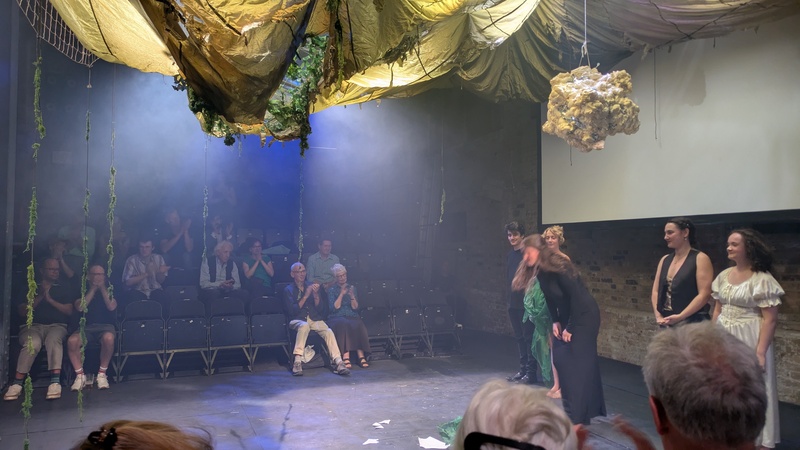
Fabia Martin designs a set, more elaborate for the Ewartung, more projections for Delusions. Kames Levy’s lighting is particularly playful in the first, with colours: and black-and-white dramatic in the second.
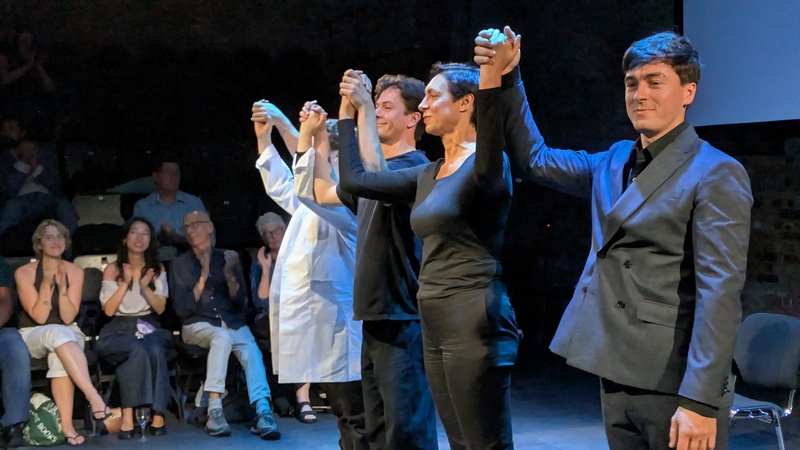
Ewartung. Photo Credit: Simon Jenner
Schoenberg Ewartung
The Ewartung libretto by Marie Pappenheim, 117 years on, still pushes the bounds of expressionism as much as it inspired Schoenberg to push them further still. Schoenberg had actually requested Pappenheim – who moved in Freud’s circles – to write the libretto, which he himself set in just 17 days in 1909.
Meaning “expectation” Ewartung revolves around a woman stumbling through a forest, palpably one of her imagination. She’s searching for her lover. At times she sees him dead, but ultimately he never appears.
Schoenberg is here on the cusp of atonality: it audibly untethers in this work. It’s like an emotional laboratory, and given the state of his own marriage (to Mathilde Zemlinsky) it wasn’t musical logic which impelled the composer. Sister of Schoenberg’s friend composer Alexander, Mathilde’s affair with painter Richard Gerstl – who taught Schoenberg to paint then killed himself in 1908 – was raw. Schoenberg wrote Ewartung and straight afterwards Die glückliche Hand. Also inspired by these events. Zemlinsky wrote his opera A Florentine Tragedy (1914) and Schoenberg’s disciple Alban Berg his 1925 Chamber Symphony around it too.
Scored for over 100 instruments and an at-times purposely-overwhelmed single voice, Ewartung is not often performed for obvious reasons. Rodgers’ score in fact “does the job” as composer Kevin Allen (who plays Schoenberg) remarked: whilst outlining to this writer the four flutes, 18 first violins and the frankly bonkers-sized orchestra Schoenberg actually demanded.
If Rodgers’ soundscape lacks the heft and scope it doesn’t lack detail or overall wash: and crucially it doesn’t overwhelm Anna Marmion’s Die Frau. She sings from a corner of the stage, set this time in a horse-shoe. Taking the stage proper are actors Eddie Boyce, Maisie Fawcett, Lydia Swift, Anna Toogood. Boyce continually strips pieces of greenery from Toogood as she twirls in choreographed distress. The frondish strips seem endless, teetering nearer postwar Weimar than an expiring Austro-Hungarian empire. Actors move as a flickering quartet of gestures to semaphore sung words.
Marmion, delivering her coloratura soprano role with commitment and focus has her words projected and translated on a screen. These fall bright and sharp: and convey the drama far more than glaucous keywords designed for the later opera. Even at 35 minutes, it’s difficult to absorb verbal patterns that swallow themselves. Marmion’s singing though is exemplary. It’s a necessary work, one to hear at least. I’m glad I experienced it too.
A minor challenge emerges in feeling at one remove from the action – partly the nature of the internal dramaturgy. It’s a fragmentary, aleatory series of phrases, circling the absence or possible death of the lover. There is really no development: just an endless phrasal circuit, with virtually nothing of a resolution.
Perhaps that comes with the full-fat version that must be stupefying -and exhausting – for performers and audience. Nothing can quite replace the wild heft of Schoenberg’s orchestration, though Rodgers has certainly brought the feel and accuracy of the original. Atmosphere though is supplied by white-greenish, woolly clouds suspended from the flies, and hard-working actors; above all Marmion herself.
This is probably the only way we’ll ever experience it. The Proms in 2024 might have made a better stab at Schoenberg’s 150th, but didn’t. So we’re in the debt of Southgate Opera and above all Rodgers.
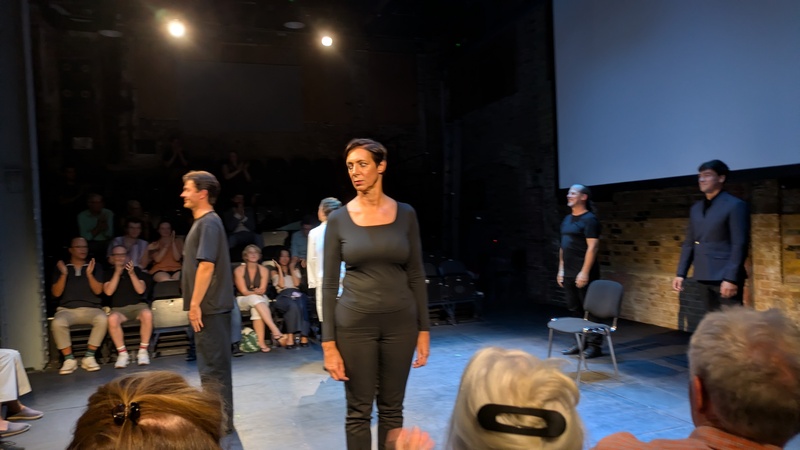
The Murderous Delusions of Gavrilo K. Photo Credit: Simon Jenner
Kevin Rodgers The Murderous Delusions of Gavrilo K
Here we’re in a starker world. The set of Murderous Delusions is built by Thomas Bugg; where the same large screen uses keywords and at various points one singer’s handheld camera projection of singers in front of them, is thrown on the backdrop.
The key action has already happened. Gavrilo K (Quito Clothier) has been arrested for killing the “beloved president”. So that rhetorical question about killing a man to save a billion others, is more a moral justification. The title – “murderous delusions” – might be fruitful. Action now revolves around whether Gavrilo K is sane (thus condemned to death) or insane (thus incarcerated). Clearly there’s a nod to Gavrilo Princip who killed 50 million by killing Franz Ferdinand in 1914.
However, other names suggest an Anglophone world and as the action progresses, the delusions seem more a question of what top state psychiatrist Dr Sunderland (Elisabeth Marshall) decides, than the brilliant murkiness of delusion itself. Perhaps it’s something of a smokescreen against accusations of justifying a presidential killing: since what unfolds seems far from delusory and closer to the divine.
Rodgers, who began his musical career as a post-punk drummer, is a Masters graduate of Guildhall and later enjoyed a composition fellowship there. He’s moved into a niche world of “neo-verismo electronic opera and venue-specific installations”. He shows assurance and melodic memorability in his vocal settings – as you might expect – but also a melodic world closest to American contemporary operatic composers. There’s nothing harshly dissonant, though plenty of chromatic thew and the occasional melodic crunch.
For those who know the British contemporary opera scene there’s a melodic world not so removed from the tonality of Judith Weir, Jonathan Dove, perhaps Mark-Anthony Turnage. But it lacks their biting humour, which has no place here. It would swerve solemn, and (given the suggestive scenario), suitably American themes. Those seen in recently-commissioned Metropolitan operas.
There’s a distant echo of John Adams, but more of more darkly accessible composers who’ve been broadcast on Radio 3’s Met seasons. Like jazz-inflected Terence Blanchard (who’s had two operas at the Met, principally Fire Shut Up in My Bones), Jake Heggie (Dead Man Walking. Moby-Dick, Great Scott), Jeanine Tesori (Grounded, Blue): rather than the more adventurous Missy Mazzoli.
Clothier is a ringing tenor, head held literally high. He’s incisive and formidable. The principal act is a duet, between him and Marshall, whose ringing top-notes don’t usually mask what’s said. As indicated the play of camera images – crafting a black-and-white cinematograph of current events – allows only keywords to flash up on the screen behind. To be honest we could dispense with that and enjoy a clean delivery of surtitles, since not every word sung is ideally clear. It very rarely is – there’s no reflection on the singers.
Gavrilo is unnervingly clear. He sees through Sunderland’s impartial stance; and pronounces she’s not only lover of Olekseii Zasaidko Institute Director, (later Vision 1 and Judge) – which we’ve just seen in a brief duet – but has terminated her pregnancy. Something that would disgrace her at least were it to come out. Few guesses where this is set then. Gavrilo, who talks of the voices of his vision (schizo-affective disorder versus Joan of Arc) taunts Dr Sunderland with the safest option: find him sane and have him executed next morning.
Sunderland’s initial warmth – despite her lover’s warning – gives way to alarm. Their duet becomes increasingly fraught till Sunderland terminates the interview. How can someone insane see through her deepest secret? What does this preternatural accuracy say about his visions, or his action?
Nevertheless Sunderland has a conscience. Zasaidko, with a similar baritonal warmth, shows some nuance as Judge, refusing easy options. And Sunderland too is scrupulous enough to remove hers fears from the picture. For now. This despite Anna Loveday – minimally present as Nurse, Mother and Vision 2 – flourishes as a dark-voiced Prosecutor; demanding death. Jaymes Aaron’s role as State Functionary flickers in and out, though he’s under-used. There’s a fine climactic trio and apotheosis.
Left alone, blindfolded, Clothier enjoys another aria, one where his visions vanish. He’s alone. He does something remarkable. Afterwards, Marshall above all and Zasaidko contemplate the unexpected conclusion. Are higher powers at work?
Clothier is mesmerising, a perfect tightrope between saviour and psycho, with an eerie reach beyond either. He’s scaled against Marshall’s decent, ambivalent humanity. Zasaidko lends fine support, with Aaron as chorus.
The drama itself recalls less the contemporary opera scene and verismo: and more late romantic German mystical music-dramas. Franz Schreker, and specifically two: Strauss’s gloriously OTT 1919 Die Frau ohne Schatten (‘Woman Without a Shadow’) and particularly Korngold’s equally glorious overkill: the semi-fable Das Wunder der Heliane from 1927.
This is absorbing work, with its own memorable melodic profile and intriguing – possibly deeply subversive – plot. Together with the rarely-staged Ewartung, unmissable for those interested in the wilder shores of late Romanticism, once it’s staged again.
Assistant Director Xinyue (Sammi) Xing
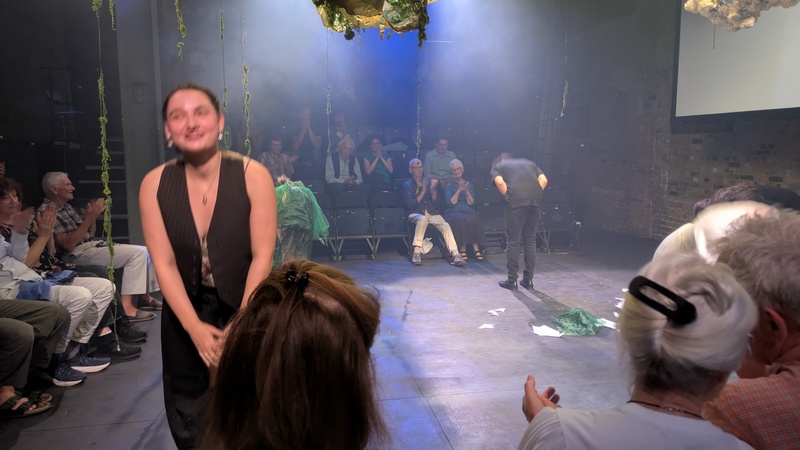
The Murderous Delusions of Gavrilo K. Photo Credit: Simon Jenner