

Review by Simon Jenner, August 13 2026
★ ★ ★ ★
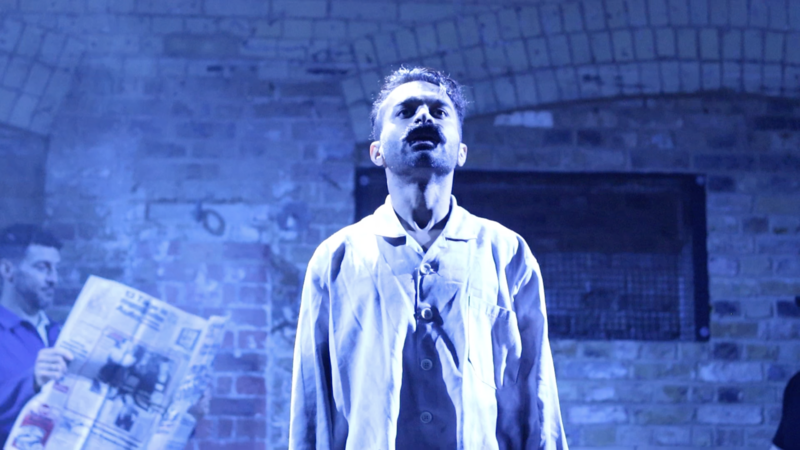
Ganz Unten speaks the wall at the Arcola’s Studio 1 in black and white. The Lowest of the Low. It’s the title of a famous 1985 exposé by journalist Günter Wallraff. The Arcola’s artistic director Mehmet Ergen, who wrote the libretto and interviewed Wallraff, collaborates with Vienna-based Turkish composer Tulug Turpan. They gave the world premiere of Ganz Unten at Kunstfest Weimar in August 2025. Now exactly a year later Ergen brings it to his own Arcola, translated into English. A co-production with Arcola Theatre and Yeni Opera, it’s directed by Ergen and musically by Tirpan – who plays piano in the piano trio line-up – it runs till August 15.
Working undercover Wallraff assumed the name of Ali. What he exposed – agencies human-trafficking migrant workers to certain death in exposed radiation sites for instance – sent 1980s Germany into a meltdown. And two million Germans into buying his volume in five months. Before it was translated worldwide.
Lowest of the Low. Photo Credit: Selin-Senkoken.
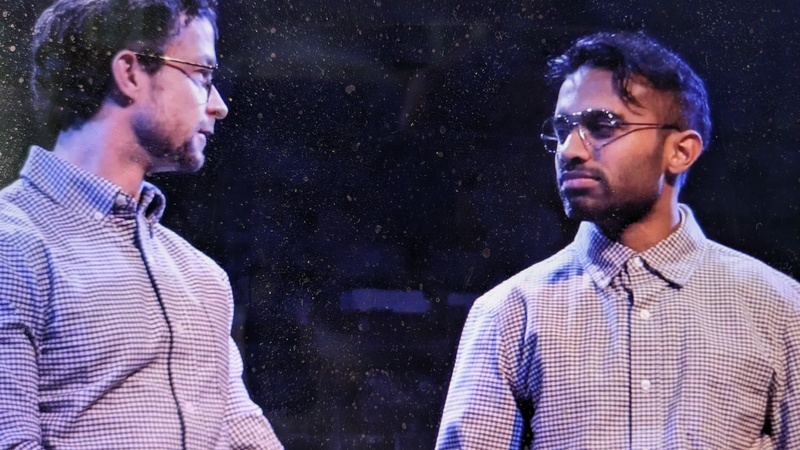
Ryan Wichert, who originated the role, is still narrator. His sung role of Günter and mostly Ali is now taken by Oscar Castellino as they lead a cast of six, all save Wichert singers. As they face each other across a table in the spartan set of Studio 1, the dopplegangar split to the first major part of the score also asks what it was tat drove Wallraff to live undercover two years. Castellino’s smouldering, watchful presence, vocal as well as acting, seems to interrogate alter-ego Wichert: both his motives and actions. Soon he’s donning “brown” contact lenses, against the optician’s advice. She asserts it makes him look far less attractive. Soprano Lou Strenger here adopts the first of several increasingly unsympathetic roles.
Tirpan’s score is haunting, sometimes powerfully choric, sometimes unobtrusive and feels as if it might grow in this hour-long score. Woukld a slightly larger instrumental line-up compromise it? Perhaps not. There’s nods to Turkish folk-melodies (which we normally only know via Fazil Say or refracted through Bartok-infused older composers like Ahmet Saygun). But really this sounds far more Germanic, and is meant to.
Tirpan invokes Brecht’s musical collaborators with the libretto’s Brechtian sweep. Olivia Ziano on violin, Cubby Howard on cello and Tirpan himself pick out a more Hans Eisler-like score accompanying the choruses. The strings warm to an opening more Weill-like melody in the first number “Who Am I” with its descending melodic thread and Weimar-inflected ironies. It’s Eisler though whose uncanny knack of channelling Brechtian choruses, to whom Tirpan pays a small homage to; refracted through his own idiom.
It’s a complex tale. Wallraff had first tried impersonating Ali in the early 1970s but has small gift for languages. He was himself abandoned to an orphanage. It’s not something progressives would condone now, but the response from migrant workers was overwhelmingly positive.
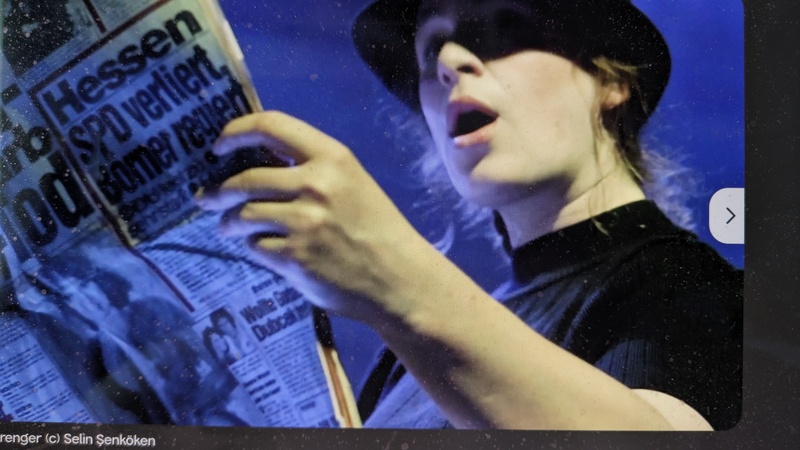
Wichert – whose spoken narrative dominates (another Eisler/Brecht motif) – and Castellini are joined by a fine quartet: Omer Cem Coltu, Owain Gwynfryn as smiling posh trafficker Adler, Talha Kaya (as a smiling icy priest) and Lou Strenger: whose memorably xenophobic and fascist characters are tossed over her shoulder as she suggests Hitler had been on the right track. All are exemplary, and though solos are rare, their ensemble is authoritative.
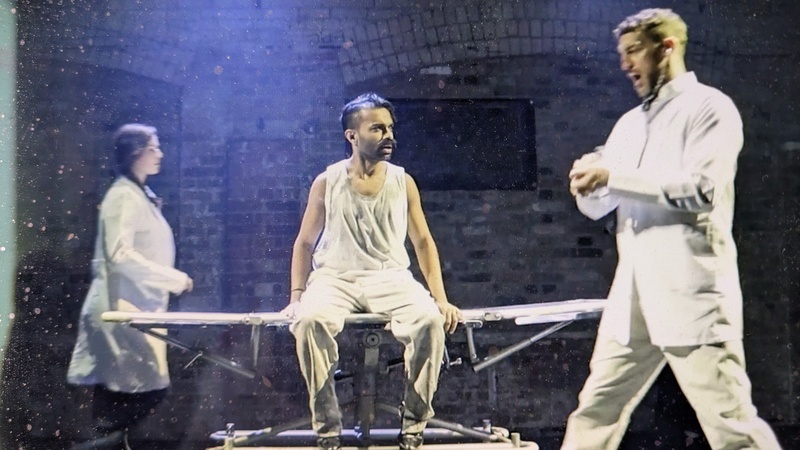
Lit by Richard Williamson with video designer Emir Gülerhan’s video projecting a few images but mostly the surtitles, the opera has few places to hide. That’s the point. Beyhan Murphy’s movement direction has been augmented by Seeta Indrani for this revival. The slow rituals, never hurried, are varied with the donning of ‘protective’ suits and other overalls: Defne Ozdogan’s unerring semse of the drab contrasting sharp suits. This as “Ali” joins fellow-workers to run through the gallimaufry of jobs he takes. Shovelling faeces down sewers, then the more agreeable promotion to clearing dust in mines.
Lowest of the Low. Photo Credit: Selin-Senkoken.
It’s at this point “Ali’ contacts a priest to ask for baptism as a Christian, proving he knows the bible to avoid deportation. Humanity however stops at the bishop. Who won’t do what Jesus might. Having scoured dust, “Ali” wonders if doctors can check his state of help. Then there’s a chillingly funny episode with a funeral director, a coffin brought on so “Ali” might sample his imminent death for himself. The banality of bureaucratic evil is brought out in a Flickr of vignettes: of church, state and capitalism.
“Ali” progresses through a few other jobs to the worst of all: one where the workers are required to be undocumented and bussed home to die as soon their brief job is done. It’s clear the site owners contacting Adler know the workers will soon sicken from radiation so their time must be short and their inducement to return home – to die in months – expedited. Away from Germany their deaths would be unaccountable, denied and diffused through individual families. This was a practice ongoing from 1975-94, so1985 is the epicentre of a practice that only came to an end when Germany abandoned nuclear power.
Incidentally if you google this, AI vehemently denies the foregoing and asserts workers were safer than the average and endured less cancer. Add “Wallraff” though and the picture drastically alters. A case of corporate misinformation?
Unlike his earlier time with journalists on the newspaper Bild, Wallraff experienced far more solidarity and friendship with Turkish fellow-workers: friendships have endured for life. This must be balanced against accusations of white tourism. Indeed a 2010 foray didn’t go well.
The gaunt chorales from the now long-dead, the incisive recitation and the nagging inquisitorial self-accusation will expand long after the opera. The best of the score is truly memorable. The point of its spartan scoring and 55-minute-long duration is not to indulge. Nevertheless, a little enrichment – extending the operatic, and punchy small-ensemble orchestration – wouldn’t harm the docu-opera reach of this singular work. Highly recommended.
Dramaturg Simon Reade, Translator Zeynep Anacan, Score Editor Deniz Dortok, Assistant Director Gus Hodgson, Stage Manager (on Book) Jamie Kubisch-Wiles, Costume Supervisor Bessy Mo, Design Pacement Yagmur Karabacak, Production Assistant Matt Pierce, Marketing Videographer Selin Senkoken. Photo Credit: Selin Senkoken.
Lowest of the Low. Photo Credit: Selin-Senkoken.