

Review by Simon Jenner, August 11 2026
★ ★ ★ ★
Famed for its comedies, the Restoration’s greatest drama wasn’t even written by its principal tragedian Otway, but versatile Nahum Tate, first in the line of Anglo-Irish and Irish dramatists who’d dominate British drama for over 200 years. It wasn’t Tate though but Purcell whose music created an overwhelming if brief masterpiece. An Ensemble OrQuesta production, Purcell’s Dido and Aeneas is co-directed and conducted by Predrag Costa on harpsichord, at the Arcola’s Grimeborn Festival Studio 2 till August 15.
A production heralding the return of regulars Ensemble OrQuesta, the production’s again helmed by Marcio da Silva as both Aeneas and stage director. Though who the soprano lead is, is up to you.
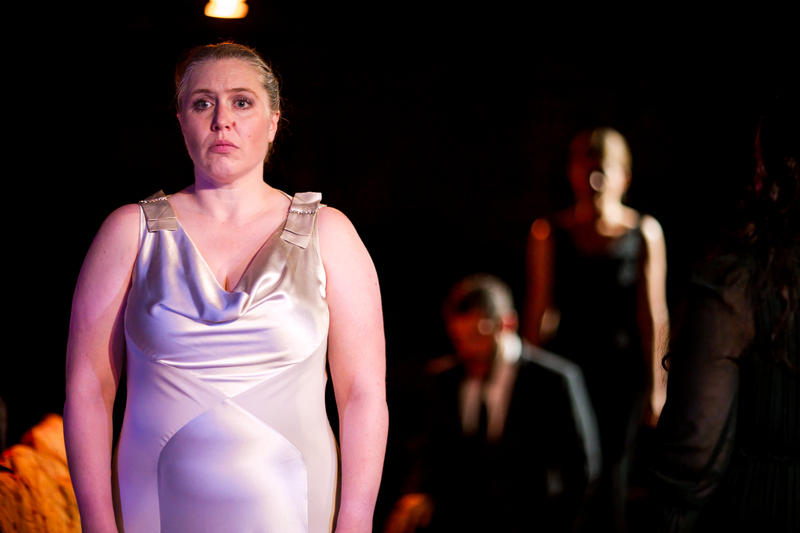
Rosemary Carlton-Willis. Dido and Aeneas. Photo Credit: George Veys
Though OrQuesta regularly feature Mozart – their triumphant Don Giovanni last year will be followed this year by The Magic Flute in two weeks’ time – their focus is on (often rare) baroque opera.
Their Purcell was first performed here in 2016, with its then Dido Rosemary Carlton-Willis (who impressed as Donna Anna last year).
Now though she’s up against s up against soprano Helen May. Prior to the performance, you’re asked to vote for which plays Dido, and thus which is Sorceress, in a role which shadows Dido. Since most won’t know the qualities of either singer, this seems frankly silly. On the opening night May won 34-32.
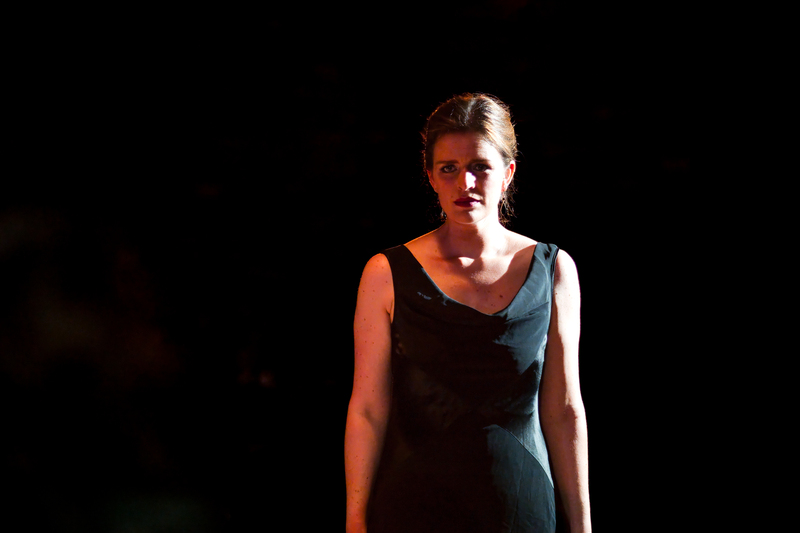
Da Silva takes a through-line from Tate’s drama, and the production is lucid and remorseless. Tate’s tale embellishes Virgil’s Aeneid tale of abandonment of Dido; as wimpish Aeneas is required to head north. Here, Tate introduces a Sorceress whose overthrow of Dido is her one aim, aided by two Witches. In Da Silva’s realisation Carlton-Willis is literally May’s shadow: a darker self or someone who’ll move in to take Dido’s space. A white sheet is deployed figuratively throughout, like an M.R. James shroud that at one point masks Aeneas as if he’s indeed an apparition but also severed from Dido. Finally it wraps itself around Dido, or is wrapped. A tangerine throw on a raised platform is the only other prop.
Carlton-Willis too has some incisive lines, and her soprano cuts through with memorable venom. Like Da Silva her words are spinto-clear and her slow command over this Dido is serpentine, each word a bite. Her lucidity slices through and Da Silva makes a more brooding, macho Aeneas than the slightly whiny complainer he can be. An ambiguous hero of substance and heft as well as magnetic. stage presence. There’s memories of his 2025 Don Giovanni here.
May brings a special tragic nimbus of her own to Dido. A reflective, never wholly joyous role, May scores with premonitions, not wanting to give in, after the reconstructed orchestral opening (a witty adoption of La Folia here too, to point up love-madness). Her final “When I am laid in earth” aches with a halo of resignation, and is deeply affecting.
Sofia Galvao’s slinky Belinda is all for enjoying her mistress’ love-affair vicariously: an earthier Restoration Charmian who wants the best, though (being a pragmatic Restoration woman) won’t be joining the funeral pyre. Galvao’s projection is strong, and she’s shadowed too by Cecilia Zhang’s warm Second Woman, also doubling as Spirit. There’s neat duetting too between Emma Humann and Priscilla Fong as First and Second Witches.
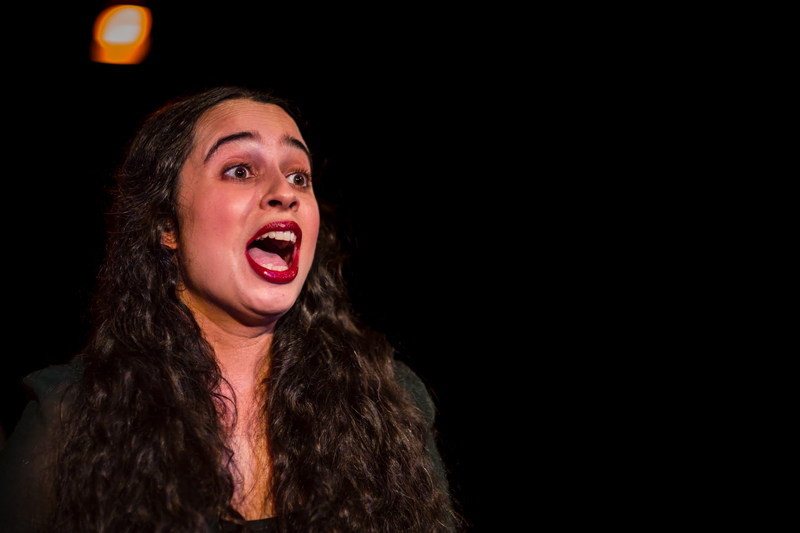
Sofia Galvao. Dido and Aeneas. Photo Credit: George Veys
Ensemble OrQuesta Baroque’s line-up features Costa on a nicely-blended harpsichord. Michael Fields scores on a memorable plucked theorbo, as well as lute and guitar; Matthew Milkey and Amber Emson on violins, Hinki Suen on viola, Santi Lowe cello and Paul Jenkins who not only plays recorder but is a roiling (if brief) First Sailor, with the famous “Come Away” with its “take a boozy last leave of your nymphs on the shore” with its arch cynicism underscoring the abandonment motif.
Though Purcell took hints from the earlier Francesco Cavalli’s Didione, and Italian baroque opera in general, the dramatic intensity – and salty comedy, straight out of his catches – is his own.
The playing’s exemplary: every slide of Purcell’s chromaticism, his unique word-painting, the dovetailing of intimacy and projection in this instrumental line-up lands with pluck, resonance and detail.
Inevitably, there’s discussion of the work’s allegorical meaning: principally James II being seduced away by Catholic sorcery from his true love Dido or Britain. Dating from no later than December 1687 there’s a possibility Dido was written around 1684. So this wonderful opera might be akin to Dryden’s 1681 masterpiece Absalom and Achitophel: another political masterpiece warning of seduction (that one about Protestant extremism).
The production’s always been minimal, which is as well. The somewhat cramped Studio 2 could have sold triple: the opera was sold out instantly. Its placement there also meant no room for surtitles; though this is sung in English, there’s places where we could have done with them. Studio 1 is meanwhile taken by a contemporary opera.
No wonder this was packed. I’d love to see this in Studio 1, but that’s the only complaint, bar the slight lack of verbal clarity in some singers. Vocally and dramatically though this s first class. Dido might be sold out (always worth checking for returns) but Ensemble OrQuesta should be tracked down, and The Magic Flute queued for.
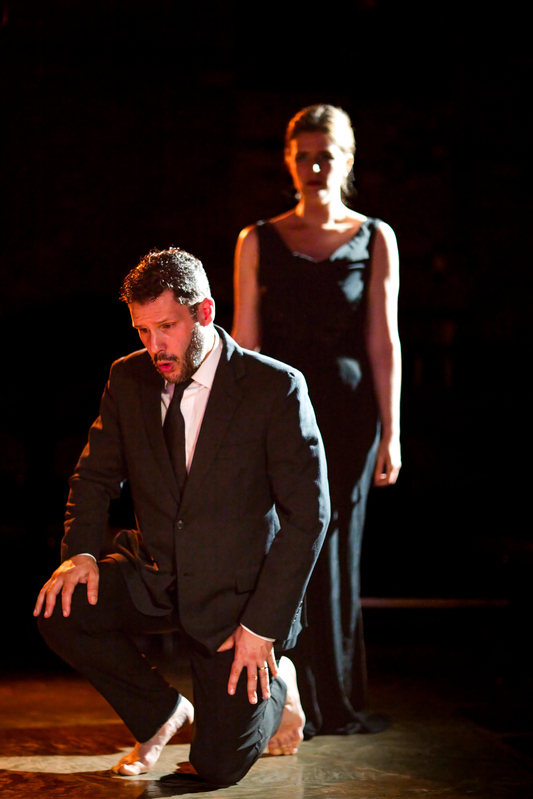
Marcio Da Silva and Helen May. Dido and Aeneas. Photo Credit: George Veys