Review by Simon Jenner, November 18 2026
★ ★ ★ ★ (★)
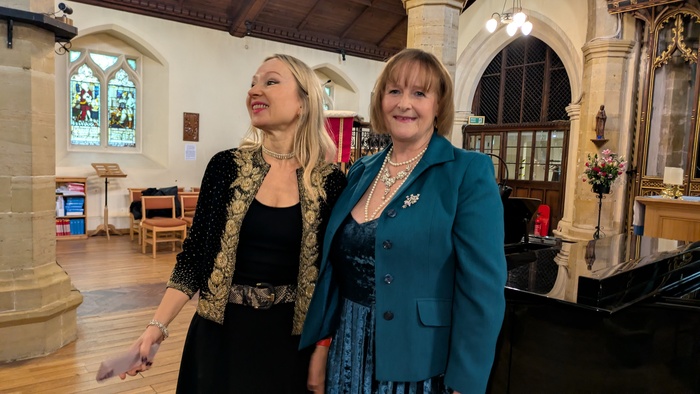
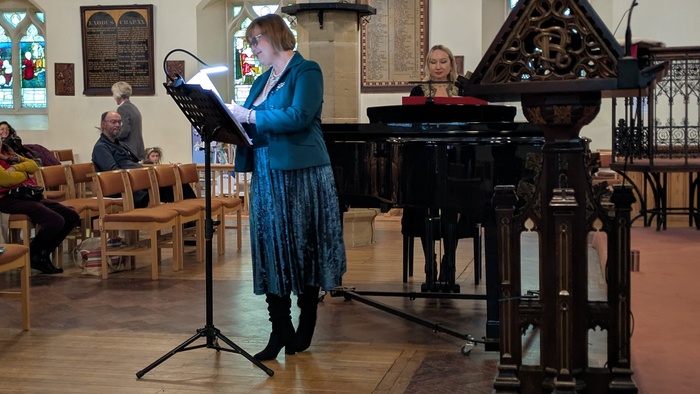
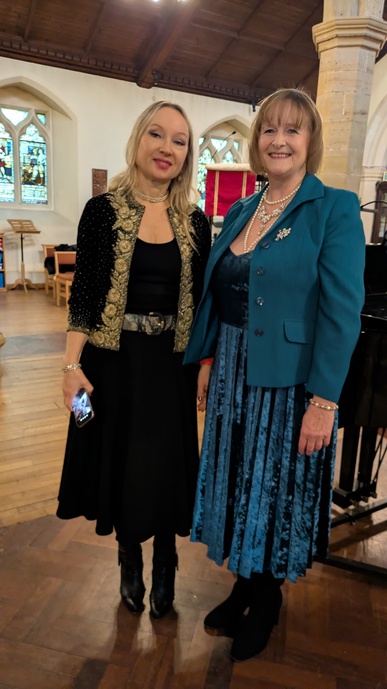
Soprano Caroline Goodwin and pianist Zhanna Kemp make a welcome return with a revelatory recital if women composers. Goodwin’s lyric soprano range can really soar and Kemp as ever proves the ideal accompanist to any instrument – particularly vocal.
Francesca Caccini (1587-1641/45) daughter if the composer usually associated with that name is now garnering as much attention. Working in Florence as a composer, lutenist, teacher in the Medici Court, she also followed her father in becoming the highest-paid musician there. Her ‘Per la piu e Bella’ is wonderfully packed with Baroque lyricism and decoration. There’s an arch playfulness you can imagine Emma Kirkby delighting in. Goodwin brings a bright airborne quality here, different in timbre to some of her other performances later. A gem of compression and wonder.
Avril (Gwendoline) Coleridge-Taylor (1903-98) daughter of the marvellous composer Samuel Coleridge-Taylor, is herself a far bigger composer than any of us guessed; some of us first heard her work in 2018 at Norman Jacobs’ concert celebrating 100 years of (some) women getting the vote. Her very early ‘Mr Sun’ was one of them, written by Coleridge-Taylor in her teens. It’s fast becoming a repertoire standard with its shrouded – high but potent – lyric line and melodic depth. It’s a trance-like, unsettling piece, difficult to place, despite its attractive even conventional melodic contours: something else breaks out. Lyricist Kathleen Easmon (a friend of Avril’s’ father Samuel who also set her) was a young Black artist and poet, who died tragically young. Coleridge-Taylor brings something unique; to be savoured in her orchestral works like Sussex Landscape from 1940. No pastoral idyll but one threaded – and threatened – with bombers. Later Coleridge-Taylor wrote an exuberant piece about flying on the first jet passenger plane, Comet, in 1952.
May Sabeston Walker (c.1910-?) is a name wholly unknown to me. It’s worth telling what we know. Blind from birth, she studied at the Royal Academy of Music and won the Ruston Soprano prize in 1934, and the highest awards for piano, aural training and harmony. She swiftly won a reputation for songs, chamber and instrumental music. Using braille she then moved to dictating in conventional notation. Her Violin Sonata in F# minor was broadcast by the BBC and her String Quartet was taken up. Piano music was performed, including a Variations on a Folk-Song From Normandy. Songs including orchestral ones still need to be unearthed. Most of her compositions date from the 1930s. She performed in opera (a revival of Sir Alexander Mackenzie’s The Cricket on the Hearth), and elsewhere. After moving to Chelmsford and gaining prominence up to 1941, her name gradually disappeared: though active in the 1950s-1960s. Her place and date of death is unknown.
Three songs setting Alex Carlisle are bracing and ushering in a very different age. ‘ Get Up, Woah’ is headlong and major-keyed partying, with elements imported from jazz. ‘I did not know’ is much more reflective and shot through with melodic doubt.
The equally elusive but again overlooked (on this evidence) American sacred song composer Jeanne Alden Joy is another discovery. Known for about a dozen works, including settings of Christian Science founder Mary Baker Eddy around 1947, her son Jerry Joy has preserved recordings and legacy. That’s it. Joy’s ‘Feed my sheep’ brings out a kind of rondo feel to the preceding with its quiet if religious exuberance; as if we were hearing a kind of vocal concerto. We need more Joy to get a sense of who this composer is; and how we yet again overlook women composers.
Carolina Bellavittoria’s setting of Psalm 23 is fascinating because it introduced something familiar quite slant. Another baroque nun? One has to admit the composer is here before us! Yes, Goodwin herself. She hails from a different tradition. It’s of course at an angle to everything else here and Goodwin and Kemp find a different sonority, a rapt, elevated and steady rapture. Goodwin and Kemp needs to record Bellavittoria!
Chichester-based Zoe Rahman (b. 1971) hardly needs to emerge from the shadows – and her exuberant jazz piano music makes her as one headline puts it “one of the brightest stars on the contemporary scene”. Her jazz-and-minimal-and pop-inflected ‘The Bounce’ is a piano solo winningly dispatched by Kemp. Rahman also reminds us of a long line of women composers for the piano who emerged in thec1910s and adorned the jazz age.
Teresa Del Rego is another composer we know by name at least. Her ‘Homing’ is a gem of condensed feelings and thematic economy. Goodwin relishes this.
Amy Woodford Finden (1860-1919) is famed for setting the Four Kashmiri love songs written by colonially-based poet Lawrence Hope, a non-de-plume of Adele Florence Nicolson (1865-1904). More recently upbraided for colonialism they can be enjoyed as the memorable – indeed passionate – songs they are. Before she died Nicolson became one of the most popular poets of her generation. But, prone to depression, Nicolson came to a tragic end after her husband’s death, committing suicide rather than being parted from him: the kind of death her songs eerily prefigure. “Useless my love—as vain as this regret/That pours my hopeless life across thy grave.” Woodford Finden, an American-born child of the American Consul for Chile, was also married to a much older English colonel. Her settings though have kept both herself and Hope alive as it were. A soaring, superior popular song, it’s instantly recognizable, especially as Goodwin articulates “down by the Shalimar”. You won’t forget it, because you’ll know it anyway.
Madeleine Dring (1923-77) is one of the brightest composers of her generation. Studying violin, piano, voice and composition she was also an actress; and always prone to riotous good fun. There’s a sliding, slinky melodic distinction about Dring, a jazzy nightclub drawl through a French cigarette that might have passed from the lips of Reynaldo Hahn or more likely, Poulenc. Dring sounds like no-one else and you can hum quite a few of her songs all day; but watch as it slithers away from you. Her wickedly funny early 1950s murder opera Cupboard Love is a case in point. Recently revived at the Arcola’s Grimeborn Festival (in August this year) it was a revelation.
Dring’s 1951 Festival Scherzo for piano and orchestra, and 1968 Trio for flute oboe and piano for instance (her husband Jack Lord was an oboist) often get played. Dring made oboe jokes and declared she came slant from the moon. But. Beyond these are her often haunting yet comedic songs. Her 1949 ‘It Was a Lover and His Lass’ that Goodwin dispatches with a wink and (platonic at least) whoop. Lusty and joyous with coloratura whips almost built in to it, it’s memorable and pithy. The lass is about to embark on several hey nonnys in the hay, with melodic leaps to prove it. Even greater songs lay ahead, particularly Dring’s dark Betjeman settings. ‘The Night Hostess’s Song’ might be jazz-infused, but ends: “I’m dying now and done for… I’m old, ill, terrified.. and tight.” Dring died young. Do explore her works.
Now famous, Amy Beach (1867-1944) married at 18 a much older doctor who forbade her to perform publicly as a virtuoso so she composed instead. Then did both after 1910 when he died.
Now that most prominent of the Boston Composers circle, the most significant ones before Charles Ives, Beach gets more airing even than Edward McDowell. Her 1899 Piano Concerto in C# minor, a powerful post-Brahmsian Piano Quintet in F# minor Op 67 (1907), and haunting late Piano Trio in A minor Op 150 from 1938 and Celtic Symphony in e minor Op 32 from 1896 have entered the repertoire. I do urge everyone to explore her works too. Beach ended her days on the Macdowell colony, forming several close attachments to women. One only wishes she hadn’t been obliged to marry at all. At 18, it was pretty well coercive abuse.
Beach’s piano music has been championed for some tine, and her violin and piano works too. Finally her songs are now being rediscovered. ‘Fairy Lullaby’s is a delight of filigree and fin de siecle sentiment. It’s popular a d attractive. More powerful is her ‘Ah love, but a day’ allows Goodwin to soar above the stave, yet drift down like a feather in this nailing song of passion and (palpable) desire.
As Encore Lilian Ray (1876-1949) is an imposter. Really a man, John Neats, Ray published 54 songs under this name. ‘The Sunshine in your Smile’ from 1913 was a No 1 hit and recorded for over 60 years. A great popular song it really works as an encore allowing Goodwin both grace and reach as her soprano ranges to the church rafters.
A thrilling rediscovery with sovereign guides.
Photo Credits: Simon Jenner