

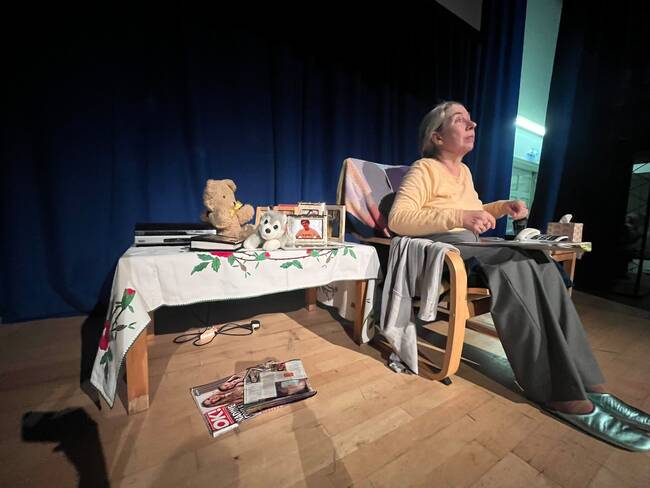
Sharon Drain as Dot in The Year Dot. Photo Credit: Tijana Topalovic
★ ★ (★ ★)
Review by Simon Jenner, November 21 2026
Eight recorded actors, three live actors, three plays, two writers, and a theme. Good Grief! features “Three Plays of Love & Age”, performed at the Brighthelm Centre, Brighton November 21 and again on December 12. Each is directed by the playwright: the first two short works by Saskia Wesnigk-Wood; the last, a little over three times as long as the first two, by Eva Marie Wilshere.
Themes of age, illness and isolation – as well as past joys – stamp a remarkable enterprise. It’s also a brave, unflinching look at what Philip Larkin summarises as: “Age, and then the only end of age”, in his 1963 poem ‘Dockery and Son’.
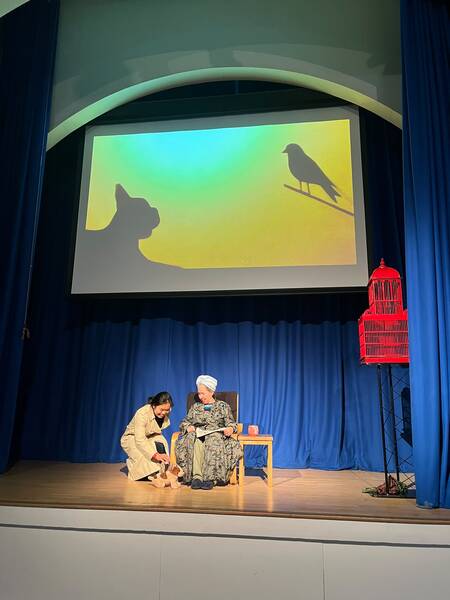
Lorraine Yu as Nurse Franklin and Sharon Drain as Brenda and Rosebud & Milord. Photo Credit: Tijana Topalovic
Rosebud & Milord
Rosebud & Milord is the first of two plays written and directed by Saskia Wesnigk-Wood. Like its successor, it lasts 15 minutes. It’s performed by Sharon Drain as Brenda, with Lorraine Yu as Nurse Franklin in a mainly supporting role. Unexpectedly there’s also the voices of Mark Tournoff as Milord, and Catherine Gillison as Rosebud. So who on earth are they? A dog, and a bird in a visible red cage. Sound designer Eloise Cummins, with Wilshere and Kimi Talib, has crafted some clever envelopes for these two artists to inhabit their animal selves. Tournoff and Cummins delight in quirky performances that remain truthful, never guying their roles.
Brenda’s solitary widowhood introduces a theme for all three plays: the one who’s left. Each protagonist too is also resistant to change, including the help of qualified carers to come and make any difference to their world. Brenda herself, as portrayed by the consummate Drain, is both mordantly funny yet also spectral. Drain brings an understated elegance, an expert sense of fade and diminuendo to a character once sophisticated and – just a little – entitled. Drain’s Brenda is probably irked at her name, and solace hangs in wispy muslin shreds about her, as she summons her dignity like courtiers.
Brenda’s pets are by turns her familiars yet also guardians. In a remarkable surreal moment their avatars, as it were, are projected onscreen above Onion Ulrich’s flexible set in Cummins, Wilshere and Talib’s video design. It’s one that makes adept use of the screen above whilst rendering the set relatable in a large space. It also allows the animals to craft a duologue above Brenda’s head. Puppetry too with Talib, Cat Gillison, Sienna Pallat, Ulrich and Laurence Tonkyn is sometimes inspired.
It’s the animals in fact who force a denouement. Naturally, you’d expect these imaginaries to be heard by Brenda alone, if anyone. But. An intriguing yet poignantly funny work, Rosebud & Milord deserves extending. It makes you wonder what life, not just Wesnigk-Wood, will do with Brenda and her guardians.
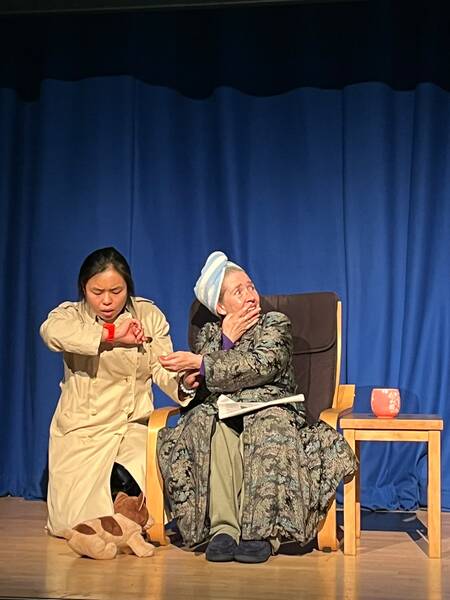
Lorraine Yu as Nurse Franklin and Sharon Drain as Brenda and Rosebud & Milord. Photo Credit: Tijana Topalovic
.
Jack’s Blanket
Jack’s Blanket, again written and directed by Saskia Wesnigk-Wood also lasts 15 minutes. It’s performed by Julian McDowell. This though is a sombre piece. No alleviating canine or aviatrix ex machina emerges. Simply Yu as the long-suffering cleaner, dismissed as doing women’s work. Jack, a widower recalling his sexual love for his wife on the very blanket that covers him, is unrepentant. He skirls with sexist dismissals. Jack blandly balances desires for young women, not those of his own age; and women’s roles. That blanket has lived through picnics, lovemaking, hosting children, and now keeps out the cold on ancient limbs. Jack’s also had a stroke and doesn’t know where his legs are.
Both McDowell in sovereign voice and Wesnigk-Wood, have between them consummate knowledge of how strokes impact people. Both are on superb form here. McDowell swerves between gnarly lyricism remembering Jack’s (doubtless long-suffering) wife, swivelling savage self-justification on his extra-marital affairs as “urges”, and cursing interference. Jack both needs the cleaner and despises her. Even though she does adhere to what Jack would assign her to: her proper sphere of servitude and sexual admiration. In contrast to both the women protagonists, he allows a cleaner in, because men of his ilk actually expect to be serviced. It’s a subtle distinction. Just don’t expect gratitude. McDowell can both wheedle and splutter, skirl and condemn, soar and smirk, cut the air with a lyrical arc of desire remembered, and crash to savage appraisal. His voice beats into the dark approaching Jack.
Unlike Rosebud & Milord, Jack’s Blanket doesn’t twist on a brilliant plot-point at the end. It simply fades rounded with a sleep. A slice of utter authenticity, it’s a small gem.
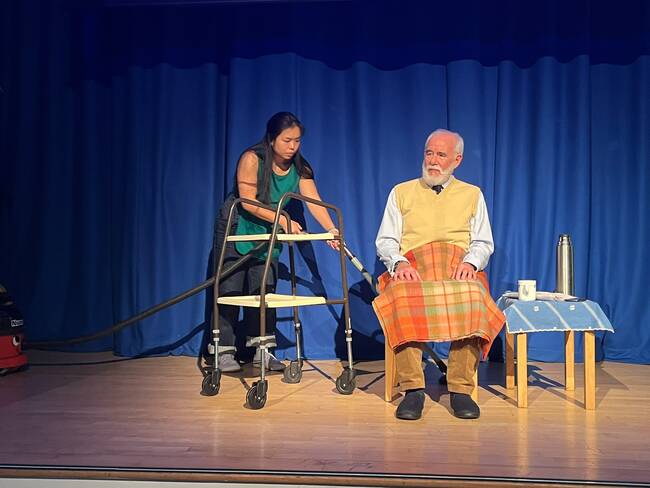
Lorraine Yu as Cleaner and Julian Howard McDowell as Jack in Jack’s Blanket. Photo Credit: Tijana Topalovic
The Year Dot
This 45-minute work (which has an interval) is written and directed by Eva Marie Wilshere with the aid of her mentor Wesnigk-Wood. Wilshere, a creative in theatre and the arts for over a decade has recently emerged with a Distinction at Falmouth University in script-writing.
The Year Dot is again performed by Sharon Drain as Dot herself, ill and trying to connect with her far-flung family. With them in person she wishes to throw one last party with her friend Ethel, who on the phone laments her friend’s no longer being able to come to dance nights with her. It’s poignant too: Dot recalls her dancing years with dead husband George.
More immediately though, her family aren’t that interested. Yet Dot has a compelling reason to want to see them all face to face. Kate her daughter is fraught and ill, her granddaughter Mary is warm yet distracted with university. Her other daughter Liv, married and in Canada, is a long hop away. And son Miles is supervising an archaeological dig in Cambodia. They send her teddy bears as consolation prizes for family. And just sometimes, the bears talk back. I’d like to have seen more of this.
Lorraine Yu, Dot’s carer, appears only latterly. Before that Yu’s partially offstage as a series of rejected social workers (also varied with voiceovers) and parcel deliverers. As calls to and from everyone intensify, we live a year of Dot: March to March, emblazoned on a helpful surtitle.
The onstage actors are joined by an original film-cast recording of the Christmas zoom meeting – a theatrical highlight; the most energised, entertaining part of the play. Otherwise and for most of the time there’s the recorded voices of Carrie Cohen as Ethel Grey, Lesley-Anne Webb as fraught daughter Kate, Moya Allen as other daughter Liv and Liv-the-Bear, Kayley-Anne Rainton as Mary and Mini-Mary, Blair Plant as Miles and Miles-the-Dog, Mark Tournoff as George-the-Bear (deceased husband), and Jean Cameron as Canadian Bobby, Liv’s husband. All these Drain synchs with, in a relay of phone-calls.
This is a brave first play, tackling a bleak subject with empathy and immersion in a barren landscape. As such I was writing that it might work well as a TV film. Then I found in fact that’s exactly where it started: as a film short. There its even pace and, ritual, repetitive arc finds a variation in film angles, editing and atmosphere. Clearly with her abilities, Wilshere will develop finer dramatic instincts.
Here as yet, The Year Dot allows no place on stage for actors to hide, no pitch of drama. No theatre business can distract. Drain, in contrast to her sophisticated Brenda, finds in Dot a more raucous, palpably ill, distempered character; splenetic with her family’s evasions; briefly enraptured by the past or a teddy-bear. Someone still socially connected (particularly to Ethel), but vulnerable. Drain telegraphs how Dot fears not so much death but incompleteness: she wants to round out her own story.
Drain also works hard to articulate the shift in months: which work no outward change, no register of the feel of seasons. Indeed it’s months we’re invited to see unfolding before us in surtitles; but not in lighting cues and the beat of hot or cool days. That’s part of the point though: the unending monotony of partly living. But theatre of course must distil the feel whilst semaphoring it, not replicating it, especially at the length here (somewhere around 50 minutes). It must entertain like Godot. There, nothing happens: twice. Here, it happens thirteen times.
There are though funny moments (partly with Ethel, partly with carers, bears and Dot’s imaginaries generally). Most of all the Christmas zoom shows what Wilshere can do when let loose on a piece of tech and choreographed comedy. It’s excellent and shows real promise, showcasing her earlier expertise in filmmaking. In the play proper, as it were, Wilshere heroically strips away everything she might divert with. Including promisingly spooky moments when the teddies answer. We need more of that weirdness, more of that dark: its quiddity is where Wilshere’s originality lies: and with multiple voices. Drain is left exposed for too long with no preoccupation onstage bar the teddies. It’s almost wholly to Drain’s credit she humanises Dot. Yu’s appearance is very late too, and she can only make a brief, warm impression. With such a two-hander, balance – and support for Drain’s Dot – is essential.
It’s a huge, noble gambit for a first play, which also stretches further than thematic content allows. With a rewrite, compression, the influx of stage business Wilshere consummately allows in the zoom (wait for Ethel’s killer line) and firm direction, The Year Dot should return refreshed.
One director wondered if all three protagonists might intercut in a vibrant play. The first two structurally might work. The third is more deeply embedded in another narrative. It’s an intriguing idea though.
Overall this is an evening nearing Christmas where isolation, pathos and age are encapsulated in a moving assault on loneliness. It’s truly original. I look forward to its development.
Stage Management Tijana Topalovic (also Photographer), Cat Gillison, Saskia Wesnigk-Wood
Thanks to Ewan Hennelly of the Brighthelm Centre, Gladrags Costumes and FOH Mark Tournoff and Lorna Crease. And Lauence Tonkyn aka Mystery Selector for pre-show and interval music.