Review by Simon Jenner, August 19 2026
★ ★ ★ ★ ★
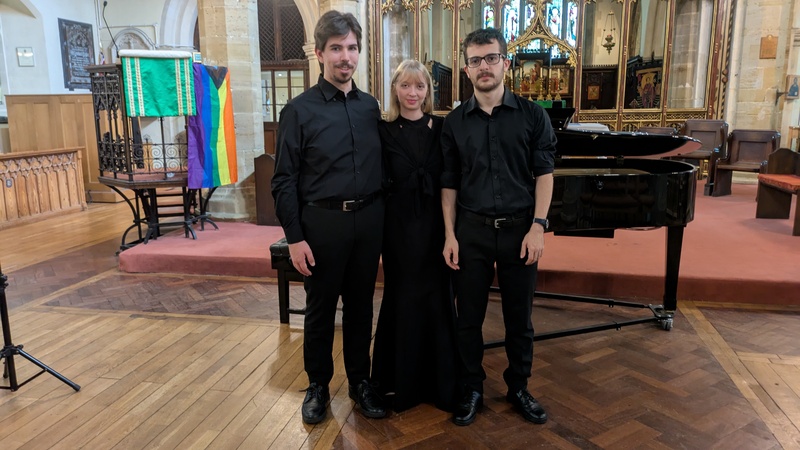
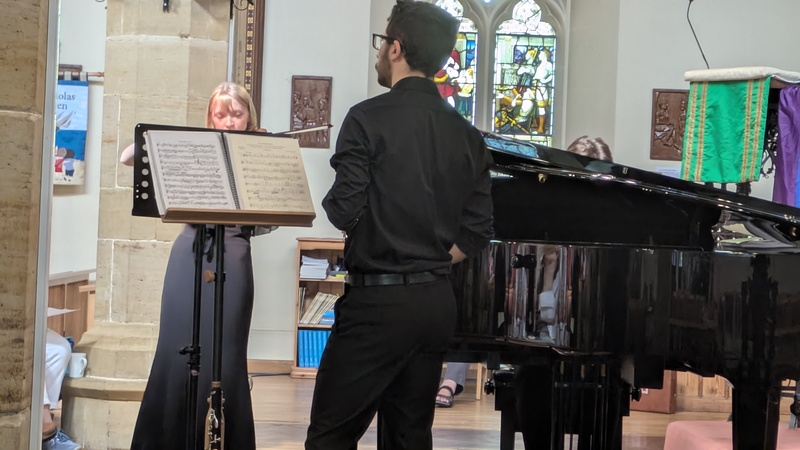
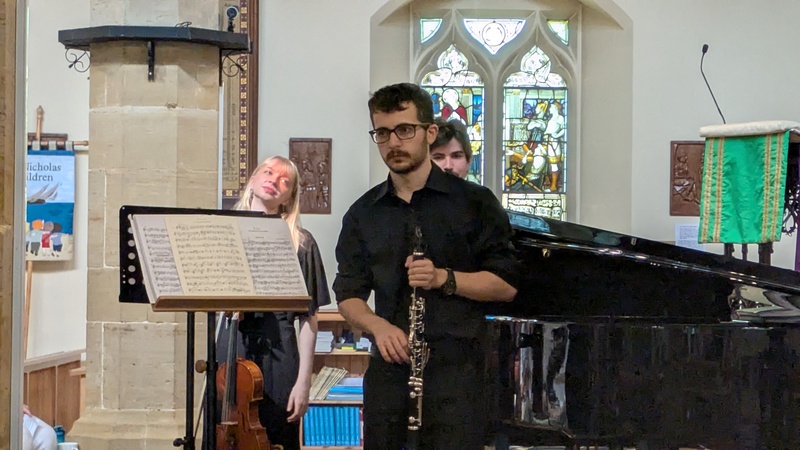
This wonderful Italian Trio Reinecke are a revelation. Bernardo Bertamini (clarinet) Elena Lorenzoni (viola) and Samuel Masera (piano) gave one of the outstanding recitals of the season at St Nicholas. Their CDs featuring Carl Reinecke (1824-1910) quickly sold after the concert. Apart from their Beethoven the repertoire and composers are completely unknown. Each of the trio is clearly exceptional in their own right. s
Rain slightly cooled the air on this latest St Nicholas concert, but the door was kept open through the much-needed breeze-in on a sultry afternoon. That’s what this Trio felt like too.
Beethoven’s “Gassenhauer” Clarinet Trio Op 11 for Clarinet, Viola and Piano in this arrangement is a work often played in arrangements. Here it’s given a wonderfully fresh direct and dramatic reading, memorable in the Allegro con brio, searching in the Adagio and particularly in the Allegretto con variatzione finale where the variations are placed in a forthright set of differentiations.
Cadence timbre and sound shift for all three movements and players. The clarinet is thrillingly in command but then so is the piano stealing cascades of glissandi when required, and the viola warmly inlaid so one doesn’t mis the original cello: just as Beethoven you feel might have done.
Swedish-born John Jacobsson (1835-1909) didn’t leave many works but this Trio for Clarinet Viola and Piano is a gem.
This Trio – known as Three Pieces Op 45 – follows in that mould and is memorable in its rising figures and yes Brahmsian mould of harmony. The first movement Reverie seems a fine Allegretto too.
The opening Phantasietucke: Allegro moderato is almost Mendelssohnian with Brahms soon darkening the palette. Two composers always casting a benign influence. Think of Fruhling’s superb Clarinet Trio Op 50 from 1900, a second Clarinet Trio Brahms could have written.
The second a Humoreske-Elegie is an intermezzo which turns wistful, and then a slightly spritelier finale a Dance Fantastique pursing some of the primary material. Individuality comes in trusts between viola and clarinet in the high register. It’s a delightful if brief work.
The final work by the “Russian Brahms” – not Nicolai Medtner but Paul Juon (1872-1940) – is another discovery. Juon was Swiss-heritage, born and trained in Russia, removed to Berlin 1897 where he flourished; and retired to Switzerland (doubtless because of the Nazis) in 1934. This work has one of those slightly clumsy Romantic titles Schumann slightly burdened the world with, when it wasn’t him writing them. The Trio Miniatures Op 18a and Op 24a are arrangements but work perfectly.
It starts we’re told with inflections from Debussy. Then continues more Brahmsian yet more Russian in the second and Viennese at the end. But that’s to believe the individuality there too. The opening Phantasiestuck is attractive and moody but it’s the folksong heft in the second Lyriches Intermezzo movement with its rustic skirt and dance rhythm that marks this out as different to any western sound of indeed any quite identifiable Russian one either. It’s pithy and brief.
The clarinet led slow movement is another heavily Russian piece., though marked Humoreske. With the viola drifting in before the clarinet returns this rises to a climax with the piano leading the striking ascent. We’re now in the realms of serious passionate music. As if led through degrees of depth to arrive at this point.
The finale is more gemachlich. Good-humoured and leisurely in the Brahmsian mode. More identifiable as from Vienna perhaps. But it owns a zing and tang as well and tunefulness of its own. The clarinet takes charge of the melodic profile and leads us home. Quite suddenly.
An outstanding and world-class recital. One can only hope the Trio Reinecke return with more rarities and classics.
Photo Credits: Simon Jenner