

Review by Simon Jenner, August 19 2026
★ ★ ★ ★ (★)
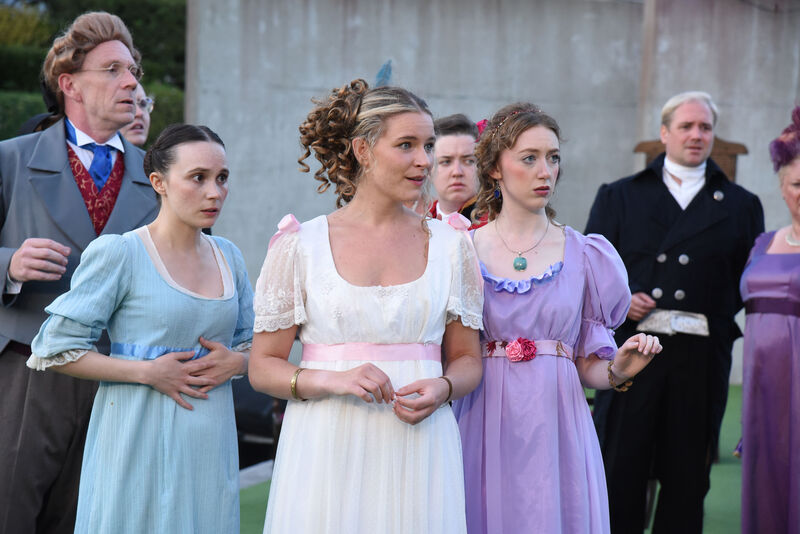
“ A young man of very good fortune, quite independent, and remarkably agreeable… I am the only one… that have escaped with a whole heart.” An older sister to her newly-arrived younger sister, whose adoption by rich relatives has come to an abrupt end. Familiar? Kind of. In 2018 dramatist Laura Wade – famed for POSH and Home, I’m Darling – took up what many film-makers might have tried: Jane Austen’s unfinished novel The Watsons plays at Brighton Little Theatre at Brighton Open Air Theatre directed by Tess Gill, with assistant director Holly Everett, till August 22.
But finishing it in the way Austen outlined? Wade might have ideas, but the characters when they realise, have others altogether. Pride and Prejudice takes tea with Pirandello in this uproarious, spirited ensemble piece. Yet one with a heart.
That quote sounds familiar. Having used the most famous version in Pride and Prejudice, with over-eager younger sisters, might suggest Austen felt she was re-treading. But the loss of her beloved father with a sudden move and impoverishment seems the immediate cause for abandoning the novel. The Watsons, which Austen wrote 1804-05 between first versions of the first three novels and the final three, is full of echoes and pre-echoes. Far more than Sanditon, her final unfinished work – which Austen couldn’t bear to invest in, nearing death – you ache for this promise of a masterpiece.
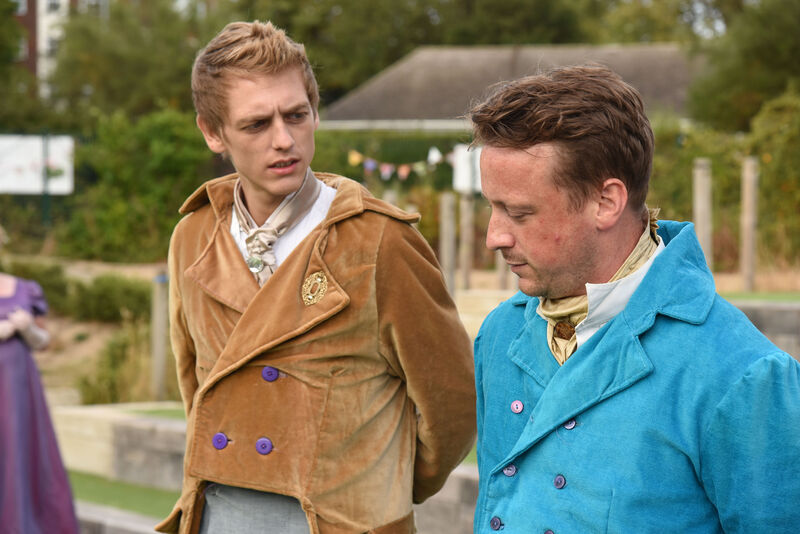
Harry Browse as Lord Osborne and Thomas Dee as Tom Musgrave. Photo Credit: Miles Davies
But do the characters? Wade plays it straight, unlike some “completions” of The Watsons. So the opening third of this work is pure Austen. Emma Watson, 19, youngest of the Watsons, has been cast off by her aunt because her new Irish husband doesn’t want her around. Anna Sloan makes a striking debut, one of many whose voice cuts through the dusky air, despite the breeze. Sloan projects a mix of sympathy, a bit of entitlement and ready empathy (for Robyn Ives’ delightful Charles Howard, a young boy at a ball, a telling Austen moment).
Emma’s been brought back to share life with her genteel impoverished siblings, some of the poorest in all Austen. Her eldest sister Elizabeth (Emily James) is relatable, down-to-earth and pragmatic at 28, contrasting Emma’s “I’d rather be a school teacher” with Elizabeth telling Emma that she’s never been to school, or she’d not say that.
James in her retiring blue gown sets off Emma’s white with more than colour (shout out for exquisite costumes curated by Christine Fox and Myles Locke). Elizabeth shadows Emma with warm good sense and a pragmatic streak, especially when it comes to Emma’s refusing a baronet. Nevertheless Elizabeth warns her – as the opening remarks indicate – of Thomas Dee’s winkingly rougeish Tom Musgrave: a mix of Willoughby and Wickham.
Their widowed father Mr Watson (Dug Godfrey) a poor clergyman nears death and lies upstage through nearly the entire action, silent. Not forever though.
As for Emma’s refusing Lord Osborne, middle sister Margaret (a consummately flouncy Fleur Macdonald) can’t believe it, full of angling for the only choice a woman has: to marry well. Margaret’s here made a cousin, daughter of the less agreeable Mr Robert Watson – Leigh Ward with his tremendous cut-through makes him a more affable creation. His wife Chantelle Winder, a slinky woman with designs of her own unleashes a late passion. Winder and Ward, Dee and others come into their own as agents later on.
Dee’s Musgrave – oozing devilish charm and an upper-crust Irish lilt like Austen’s own first love Lefroy – is one of those in attendance to Lord Osborne. Harry Browse makes an exquisite empty-headed aristocrat: awkward, unable to understand why a woman can’t acquire a horse: since women look far better on horseback than anything else. Emma’s cutting remark about finance is her first to openly contradict an overweening upbringing.
Still Browse and Kerri Corcoran’s Lady Osborne aren’t what they seem later on. Both excel when they’re liberated, Browse rejoicing in a pirouette of sudden elegance. Lady Osborne is surprisingly full of fury in the original Austen outline when Emma refuses her son (Lady O has designs on the same man Emma has attracted). Corcoran’s character though primes a rainbow surprise. Wait for her encounter with Nanny: Mimi Goddard, armed with exquisite timing, also wields a magnificent speech comparing Rousseau in translation to the original. That’s when everyone starts on Hobbes.
Osborne’s sister Olivia Jeffrey is rapturously entitled, and guys herself each time. Osborne’s other appendage, his chaplain Mr Howard (Craig Hearn) is Emma’s love interest. That’s how Austen sees it anyway. Hearn shows Howard a worthy Edmund Ferrars type, a touch parsonical but sincere and capable of feeling. Is he what Emma wants though? She’s predisposed to take handsome Osborne. But then…
This is where Ella Turk-Thompson apparates as the author Laura, disguised as a servant to stop Emma accepting Osborne. It’s where Austen breaks off: in fact before, but Austen intended a refusal, and suddenly there’s a crack. Turk-Thompson, who so often recently has provided the music, has always been first-rate at BLT and here she gives the performance of her life. Shrugging out of her servant weeds for Act Two, she finds that guiding Emma has gone awry, as the first act closes with a coup: the whole company have realised they’re characters. and they want answers. Pure Pirandello?
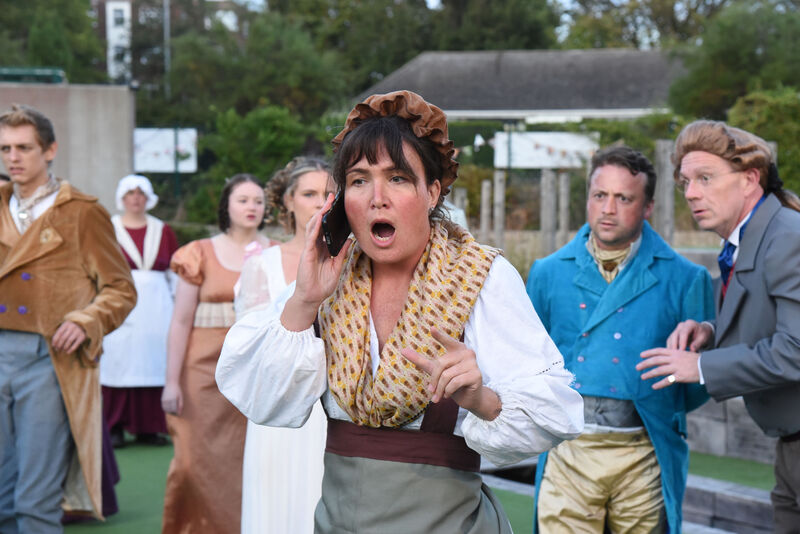
Harry Browse as Lord Osborne, Mimi Goddard as Nurse, Olivia Jeffrey as Miss Osborne, Anna Sloan as Emma Watson, Ella Turk-Thompson as Laura, Thomas Dee as Tom Musgrave, and Leigh Ward as Mr Robert Watson. Photo Credit: Miles Davies
Turk-Thompson is now assailed – the pairings-off Austen might have devised meet characters who don’t necessarily want them. Philosophical discussions begin, wit and intelligence flares as characters break out with a post-enlightenment erudition to challenge the author. Laura herself faces a kind of breaking-down.
The whole Act Two denouement must be seen. There’s riotous breakings-out, and Laura’s shocked when Will Conway’s handsome officer Bertie emerges from under the bed with well, find out. This is after a rapturous Margaret (a delicious scena from Macdonald) expounds the delights of marital sex. Characters aren’t waiting any more.
There’s polite complaints too from Libby Danahar’s Mrs Edwards and Rosalind Caldwell’s Mr Edwards. Where can they have lives? That goes too for Matthew Nisbett’s Captain Beresford, Suzanne Heritage’s Mrs Elizabeth Jennings and Kylie Pearson’s Mrs Harriet Sinclair.
The moment the new phone rings, and Ward’s Mr Robert Watson answers it to a famous figure in history, it’s clear Wade has realised the year The Watsons is set in.
After this Wade’s drama loses some focus. No reflection on the glorious wrap made of these scenes by the ensemble – very fine choreography by Patti Griffiths and Katie Ford; and by now at dusk some superb lighting from Beverley Grover, dousing the world in red shifts with Grover’s sound design too. As ever Steven Adams’ set is versatile, points up interiors with a giant clock and bed, with moveable feasts of chairs and a sofa that finally gets sat on in Act Two.
A loss of dramatic tension in Wade’s writing however only occurs after the superb dance sequence. This is followed by a strange breakout – enormous fun in itself and terrifically delivered. Then there’s a postlude with Laura, Emma and Charles; which might have preceded this riot. Had the play ended at the phone-call after this warming scene (which is strong and a perfect dovetailing of fictive and real life), it might have seemed as if real history intruded, asking further questions.
Nevertheless The Watsons does end gently, reflectively and sets the seal on an otherwise outstanding production. Over two hours 45, a few words blown away on a blustery evening makes little difference with this company: always riding the whirlwinds of drama, and luckily here directing the storm-clouds. A must-see.
Stage Manager Stephen Evans, Sound Design Kev Heritage, Lighting and Sound Design Beverley Grover, Set Elements Building Steven Adams, Leigh Ward, Stephen Evans, Rosalind Caldwell, Mimi Goddard and Dug Godfrey. Set Elements Painting Tom Williams and Cast, Prop Design Chris de la Nougerede.
Dance Captain Mimi Goddard, Intimacy Co-ordinator Elodie Foray, Committee Liaison Dawn Draper, Production Assistant Sam Taylor, Photography Miles Davies, Programme and Poster Design Holly Everett.
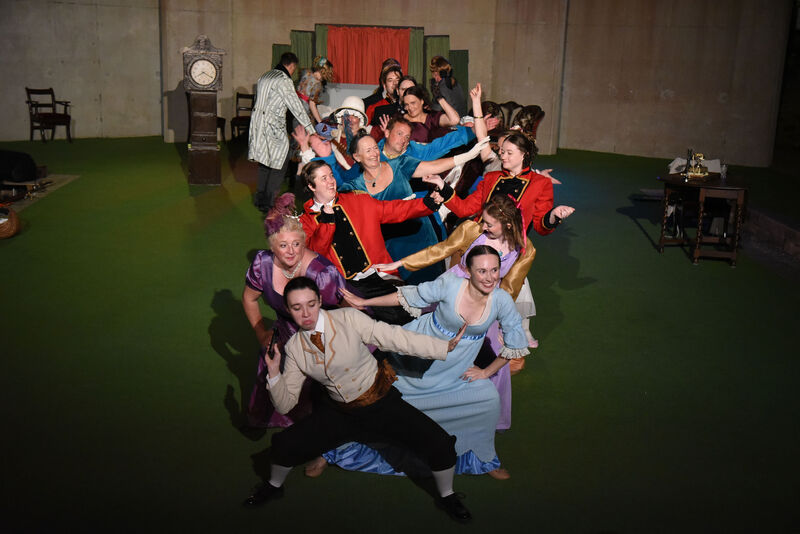
The Company of The Watsons. Photo Credit: Miles Davies