

Review by Simon Jenner, August 14 2026
★ ★ ★ ★ ★
Though we had the musical Lizzie at the Southwark’s new Elephant Theatre in 2023, the case of Lizzie Borden who “took an axe/gave her mother forty whacks” has come to Southwark’s traditional Borough home. The one we hope they’ll never leave. The revival of Sasha Wilson’s 2018 Bury the Hatchet comes to Southwark Playhouse’s Little (Borough) Studio till September 5. It’s directed by Vicky Moran for Out of the Forest Theatre. Despite an estimated 60 minutes it runs to a furious 80.
Bury the Hatchet is exceptional theatre and may have got even better. It originated at New Hope Theatre with two different actors (noted below), a string of awards then and on its 2019 revival. Then as now Wilson featured as Lizzie. Wilson’s been known recently for the more ambitious if slightly shorter The Brief Life & Mysterious Death of Boris III, King of Bulgaria. Which toured to the Arcola to acclaim in 2023. The cast here as well as director, light and costume designers were all part of that production.
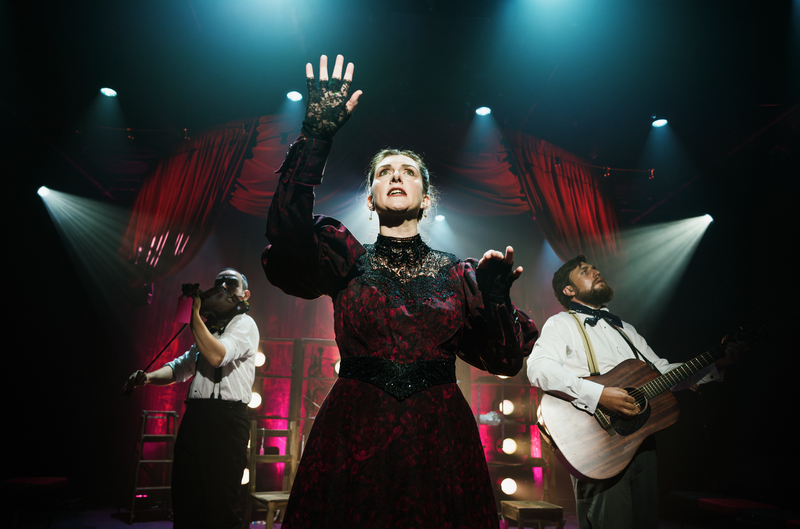
Lawrence Boothman, Sasha Wilson and David Leopold in Bury the Hatchet. Photo Credit: Alex Brenner
Anyone seeing that truth-based history – with its vaudeville but heroic king, saving 50,000 Bulgarian Jews and poisoned by Hitler – might guess what they’re in for here. Quite apart from the violin, guitar and mandolin of the three actors. Whilst Boris III is often funny, it’s deeply serious. So is Bury the Hatchet at times, but it’s more broadly funny, more local. The title sets the tone. You can have more gags with less bodies. Ultimately there’s less at stake here than Wilson’s ambitious (and occasionally sublime) successor.
That isn’t to belittle the tone of Wilson’s creation or the murders themselves; nor the fervid voyeurism of the trial, and the circumstances where the state had decided not to hang women: in part so people couldn’t look up their skirts. Much though has to be stripped away for the sensationalism of legend to get to the sensation of a young woman arraigned for the brutal murder of her overbearing – and mostly mean – father Andrew and stepmother Abby: who had seen to it that much of the family fortune was siphoned off to her relatives (to be fair, one or two needed it). Add the stopover of a maternal uncle John abnormally close to his niece, as is a maid Bridget O’Sullivan, called “Maggie’ as all maids were (literally reducing O’Sullivan to a generic and not a human being), and the ingredients are there. And an absent elder sister Emma, some miles away. Who sticks to Lizzie throughout. As does Bridget.
Wilson’s style is a superbly-interrupted bricolage of bald fact, docu-quotes interpolated by gags, narrative fillets, speculative flights and sheer theatrics. And plenty of fourth-wall moments. When one actor speaks Southern drawl Wilson quips “it’s the only accent he can do” and the accent immediately modulates to east coast. Not even murders are sacred. Judging by uproarious audience response, this version of the Lizzie Borden case must surely garner more laughs than any dramatic treatment of her over the past 134 years.
Lawrence Boothman and David Leopold take on multiple characters, male and female, with writer Sasha Wilson as Lizzie, centring the action. Whether home, courtroom or parts of town, the trio shift from performative catches broken-off at times to an array of accents and genders, occasionally guyed. They’re consummate, so adroit they can turn on an axe-head and deliver it glinting.
August 4 1892 has spawned an industry, with the very house and sofa where Andrew was butchered now a themed B&B. The public fascination with these murders made it both one of the most documented yet most evidentially polluted. Local incompetence meant bodies were shifted, moved onto the kitchen table whilst the occupants slept; whilst later the prosecution detached the skulls (the bodies had been left un-refrigerated and decomposed), and presented them in court. This was too much; one of the reasons the fainting Lizzie was famously acquitted.
Wilson’s adept at introducing evidence in an order it can be assimilated and patterned. The purchase of prussic acid (cyanide) by Lizzie the previous day to clean winter sealskin (really?), and sickness of most pf the household on old mutton was ruled as too far back for the murder (we’re talking a matter of hours here). The local doctor for instance administering morphine to Lizzie so her testimony, being self-contradictory enough, might be explained by the fact that she was pretty non compos mentis. Or basically high. Difficult enough if you were a clear-headed murderer, getting facts right. By contrast uncle John unnerves the police by giving over-precise explanations of where he was, down to the number of the cabman’s badge. Their suppositions are aroused.
Wilson introduces moments of speculation. An incestuous relationship meaning John – who’d been involved in heated negotiations over disposing the family fortune – dispatches the couple for his beloved Lizzie. Or that Lizzie, later reputed to be gay, was discovered enjoying a tryst with Bridget by her stepmother. There might be no way back from that. Certainly that latter explanation has gained a lot of traction over the past 40 years. Yet there’s contradictions everywhere. O’Sullivan later married, though what does that prove? Everything’s presented from pre-meditation to spur-of-the-hatchet; and of course, persons unknown.
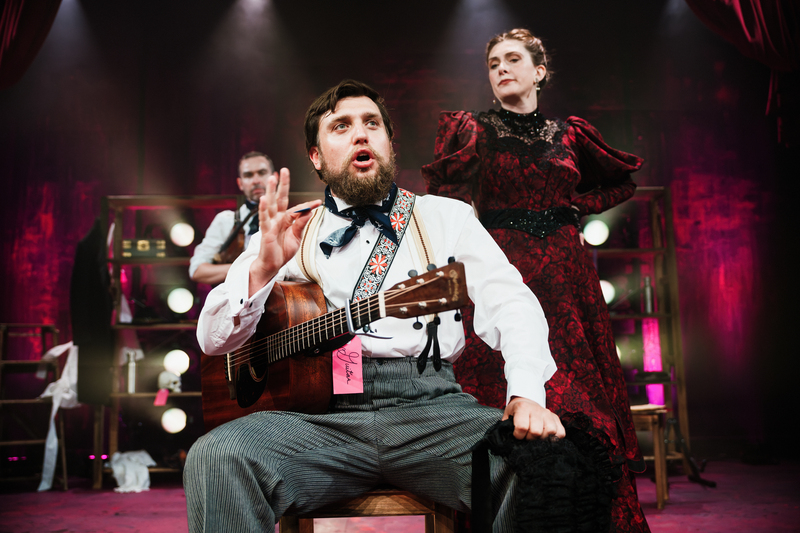
Lawrence Boothman, David Leopold and Sasha Wilson in Bury the Hatchet. Photo Credit: Alex Brenner
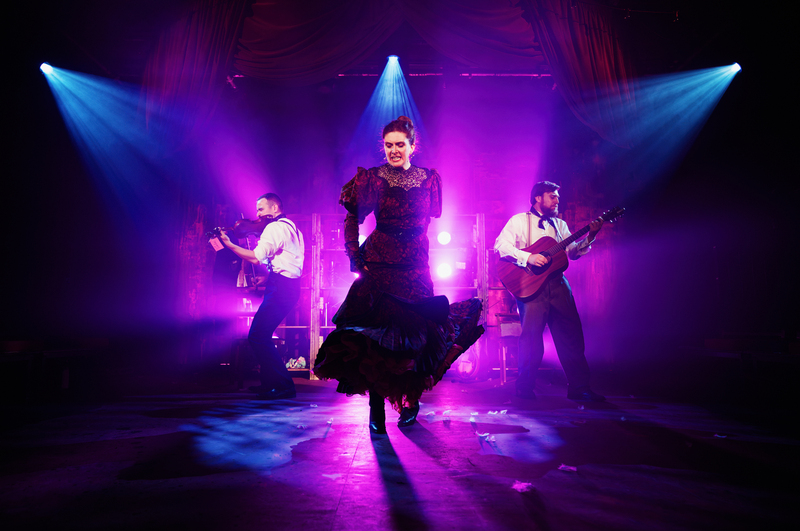
Damien Stanton’s spare set with its suggestively bloody-blent stage floor, with a few stools and an upstage set of shelves containing exhibits with an axe – sorry, hatchet – standing by. In fact, two. The Little’s intimate space is lit by Will Adler with a bank of white, rose-violet and pink, irradiate set moments of romance/horror, and stark brilliance with nowhere, seemingly, to hide. At other moments there’s snappy horror-snaps to black. Helen Stewart’s costumes are the standout, with Wilson’s dress a writhing complexity of red and black, like the floor. And period costumes for the men, plus bonnets and hats swapped in and out.
Musically the trio are a delight. There’s wit and fleeting references, sometimes brought to an abrupt half-cadence. For instance the trio wink with a delicious Lachrymosa from Mozart’s Requiem (Boothman on violin leading) to point up a funeral. Then there’s Bluegrass, and ‘Don’t Leave Nothing But The Baby’ bringing up the epilogue.
“Maybe being found not guilty is not the same as being innocent.” Not proven perhaps. Lizzie defiantly stayed on at Falls River though she and her sister moved to a larger house, and Lizzie took up with an actress Nance O’Neill. Her loyal sister was scandalised and things came to a head in 1905. History repeating itself? Not quite. The postlude, where Lizzie lived finally as a recluse is sad. One recalls her brief freedom in 1890, on a whistlestop grand tour. And perhaps her relationship with O’Neill.
This is an outstanding take on a case with contradictions to make the audience explore and judge. Indeed they’re invited to. If there’s only one historic verdict that stands, the audience’s sympathy might be played with to induce another. Nothing here though is inaccurate: ordering of material isn’t manipulative so much as artful. Fiendish fun though, despite the gruesome evidence. Though we were spared the ubiquitous photos of the bodies. This is killer theatre whetted, ground and gleaming. It will turn heads. Again. Unmissable.
Associate Director Madelaine Moore, Design Assistant Henry Anderson, Lighting Assistant James Sadler, Costume Assistant Ella Gridley, Stage Manager Zoe Mackinnon, Rehearsal Stage Manager Sasha Bonner, Videographers Taiichiro Ono, Georgy Grankin, Photographer Alex Brenner. Producer Claire Gilbert
Original design for Hope Theatre Production David Spence. Original Performers Sam Jenkins-Shaw and Joseph Prowen.
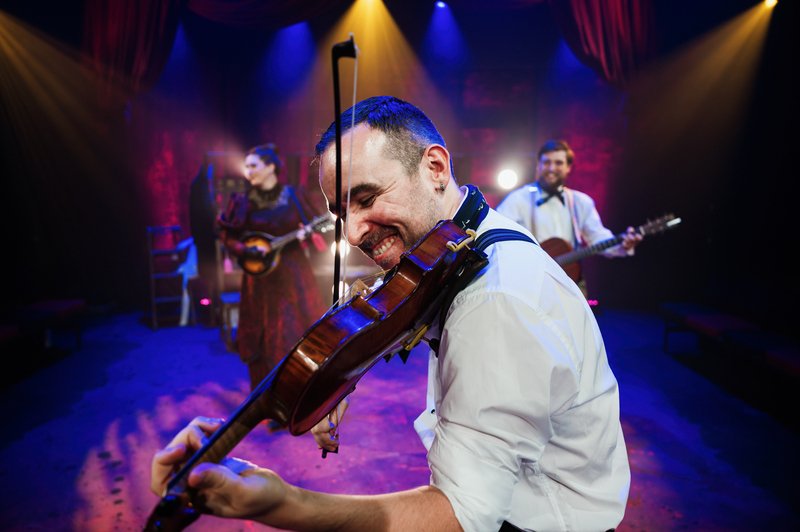
Sasha Wilson, Lawrence Boothman and David Leopold in Bury the Hatchet. Photo Credit: Alex Brenner