

Review by Simon Jenner, August 8 2026
★ ★ ★ ★ ★
Is Love’s Labour’s Won at last? Back in 2015 Christopher Luscombe’s RSC pairing of Love’s Labour’s Lost and Much Ado About Nothing posited an exquisite 1914 and 1918 vision of the two plays. They were however discrete. Characters naturally didn’t overlap. Tom Littler does something altogether more interventionist – and brilliant – with the next war. Transferring from Guildford Shakespeare Company this co-production of Love’s Labour’s Lost and Much Ado About Nothing directed and adapted by Littler at St Thomas College, or Orange Tree on the Hill, plays till August 22.
Seeing Love’s Labour’s Lost cries for at least a postlude if not sequel, and Much Ado features at least two couples who’ve previously met, Littler goes further than anyone. He “stitches” and otherwise edits the two plays, themselves three years apart (1595 and 1598). Mainly he dovetails Much Ado – so the two plays boast the same characters. Thus their names are often therefore doubled: Benedick Berowne, and Claudio Dumain. Though each name is emphasised in their respective plays. Benedick Berowne is a good match, matched itself by the merging of Rosaline into Beatrice. Other characters – when earlier ones are less developed – allow the latter play its sway.
Set in the summers of 1939 and 1945 this before-and-after is placed squarely near an English village, but called Messina. Which given the record heatwave throughout most of this run seems prescient too. There’s still the Price of Navarre and Princess of France. As academic Hester Lee-Jeffries remarks in conversation with Littler, they’re “dreaming into these plays.”
Fierce vexations aside, Littler has worked with daylight clarity: cut, added from other Shakespeare sources or occasionally invented some clever verse or lines, and once or twice mischievously tweaked a line from other classics.
That said, very little is excised, and that mostly from eliding characters, through working with a cast of ten. Four characters from Love’s Labour’s Lost (Costard, Don Armado, Moth, Jacquenetta) and Borachio from Much Ado appear in those plays only: the rest are neatly conflated. 17 characters with 12 common to both.
There’s repeated reference to six years after in Much Ado. Littler takes up the cloud imagery of the first play to haunting effect when he recruits Sonnet 33: “The region cloud hath mask’d him from me now” addressing war trauma in Much Ado’s 1945. Indeed sonnet-writing is another feature the plays have in common. Littler also invests a latterly unpleasant plain-dealing villain with some famous lines on military futility: both Henry V is referenced earlier by the Princess and Hamlet by “John” Longaville. Only a deep knowledge of Shakespeare allows such reverent violence, and it works.
Since that one character at least has to change from affable to nasty there’s enough charity to redeem, or at last explain him. War trauma haunts Benedick Berowne too, when he cowers at the starting of a car. It twins him, however briefly, with John. Four Guildford Shakespeare players enjoy a depth of experience which combine with four Orange Tree returnees and one actor who’s appeared with both companies; and a newcomer. Vocally every one of the company are a delight. The lowest burring, the keenest inflections carry outdoors. They set a consistent standard few can equal. And one key moment of Much Ado proves it, putting it among the very greatest I’ve seen.
Both works too come freighted with knowing winks to sequels and play-acting, as if jostling to be played with. There’s no rough-hewing the magic here though; the plays are jointed. Text and performances lift both into a miraculous pivot of redemption.
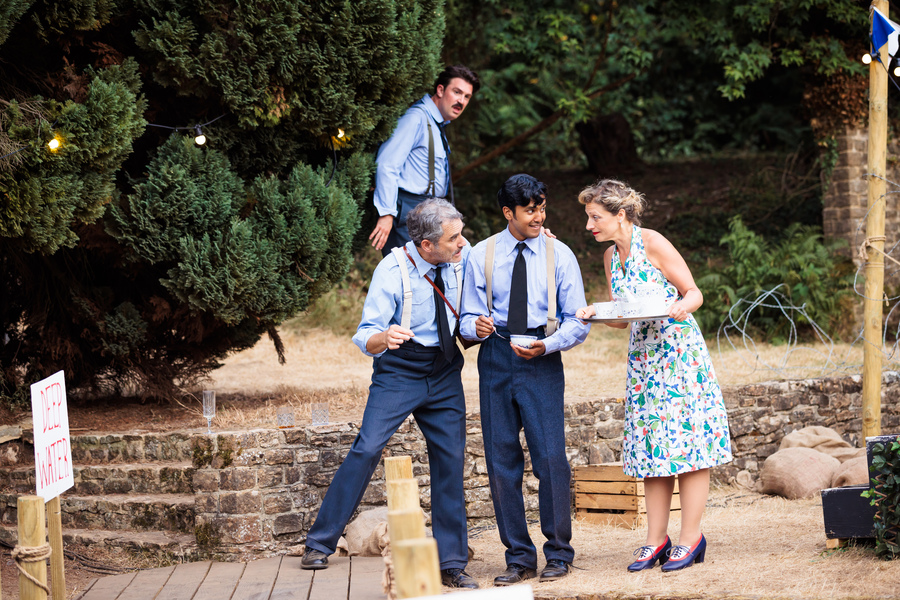
James Sheldon, Owen Oakeshott, Chirag Benedict Lobo, Sarah Gobran in Much Ado About Nothing Photo Credit: Harry Elletson
Love’s Labour’s Lost
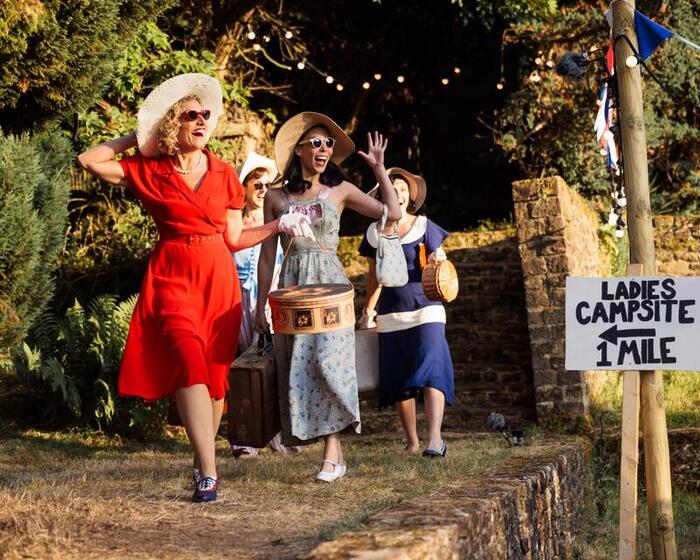
This “prequel” allows its successor to gather more weight from the extra small tensions it builds, but this never clouds the comedy itself, despite the imagery. It spells innocence, till towards the end, over experience. Littler’s 1939 world plays it straight, adding details that only tell afterwards. The set (described below) is the same, but the hazy eternity belongs here alone, in a thoroughly balmy outdoors with the roof too high as the Princess points out. Thoroughly anglicised, despite the “Messina” setting, the now slightly eccentric premiss pays dividends later.
Banished is the boyish prig of a Prince gracing some productions as Owen Oakeshott’s resonant Prince of Navarre is a mature man gesturing behind him to St Thomas’s very mature academy. Littler’s addressed both plays as those of lost moments and second chances, riven by war. The self-imposed isolation of the opening, easily punctured is re-imposed by the women on more genuine grounds (grieving): but that year of course extends to six, when those impulsive bonds are stretched to vanishing-point and might not be recalled.
Joelle Brabban’s Hero (now daughter to Princess of France) replaces Katherine as she responds playfully to Dumain. As Moth though her singing “Sigh no more” is a delight, and as she twits Robin Simpson’s finnicky Don Armado with zinging one-liners, batted gamely by Simpson. Who seems to burble scrolls and folios as he turns sonnet. There’s warmth and strength to Brabban’s voice that lends her a more passionate profile later. Simpson reappears as an authoritative Revd. Boyet (to repurpose himself as an even more reverend Friar Boyet in Much Ado). The seeds of his parsonical calling are clear, as he advises the women Visitors.
James Sheldon’s Berowne (the Benedick prefix appears later) is quick-witted and faintly Python-esque in his (occasional) self-mocking exaggerations. Self-conscious, he grows from self-delighting to “earnest” in Much Ado as his challenged friend attests. Matt Pinches’ John Longaville has less to do here than later in that role. But as the deliciously twinned Constable “Dull” Dogberry, conflating the two officers of the law – surely another argument for the mirror-imaging of these play – Pinches is superb. As “Dull” he’s a prototype for the full-braying Ass he becomes.
Chirag Benedict Lobo’s Claudio Dumain naturally develops his bashfulness and petulance later, but as Nathaniel, appearing alongside Oakeshott’s other role of Holofornes (all pedantic verbal twirls in mid-air), he’s a wickedly-observed pick-me pupil, with sudden perceptions of his own.
Sarah Gobran, co-founder of GSC brings a lightly-borne gravitas as Princess of France in her dealings with Oakeshott’s Navarre. There’s a wary protectiveness of Brabban’s Hero, and a tender moment or two. Gobran’s notable in roles that exude an easy regality and she delivers here. It also swerves the dynamic, both she and Navarre being older than their friends.
Sally Cheng’s Jacquenetta is zesty, running both Jeremy Lloyd Costard and Simpson’s Don Armado off their feet. As Margaret Cheng absorb the Maria role, the woman Pinches’ Longaville pines for. She, Lloyd and Pinches will triangulate later too.
Lloyd’s Costard as a fast-talking publican employed for all sorts of dogs-bodying proves hasty rather than dull-witted, and wittily pragmatic.
As Beatrice, absorbing Rosaline, Phoebe Pryce is no pale forerunner of the full Beatrice – who’s distinct here – but a more carefree, still observant yet joyous creation, on terms of equality the war might unbalance in her favour.
The farce of sexually restrictive laws, to become grimmer in Measure for Measure, seem a very British farce. The wooing similarly daft, and the unravelling of the vows with the four as Berowne pretends virtue skulking in the boat serves as prelude of course to the later overhearing. It’s as if Littler has identified several strands of DNA and brought them to face each other.
Nevertheless Lloyd’s interruption from answering a phone as the messenger of death is aptly halting; and the seriousness played with truth, stripping pretence. The sadly exuberant playing-out of Worthies and skirmishes between Costard and Armado now all seem like a prelude to war. Though with 1930s dances Asha Jennings-Grant stamps the amplitude and energy of both productions belying storm-clouds.
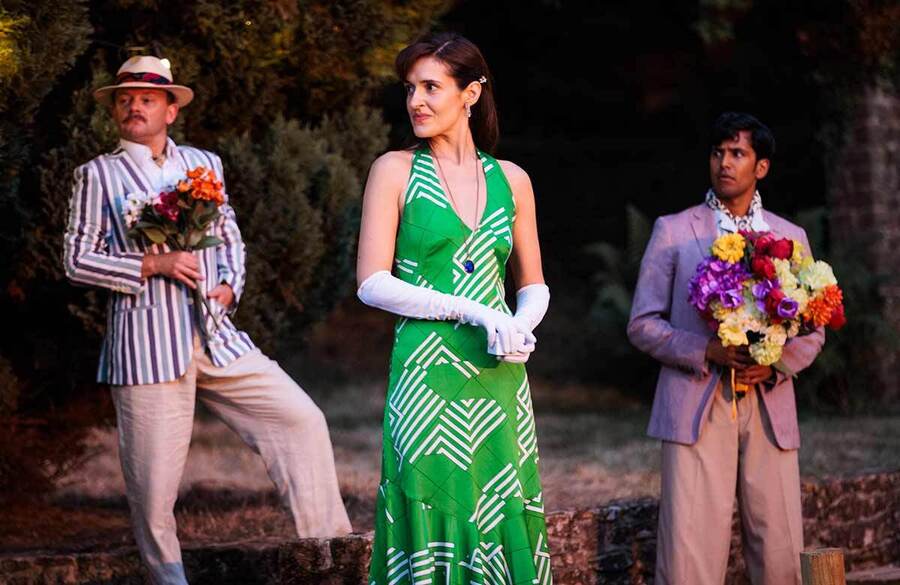
Matt Pinches as Dogberry, Phoebe Pryce as Beatrice/Rosaline, and Chirag Benedict Lobo as Claudio Dumain in Much Ado About Nothing. Photo Credit: Harry Elletson
Much Ado About Nothing
As characters file on in unform the temperature’s chilled. Two of the women’s quartet clamber out of nurses’ unforms but not Beatrice… Set designer Neil Irish co-designs costumes with costume supervisor Anett Black: everything from 1930s dresses through nurses and RAF blue, to a sudden break into civilian exuberance for the women, A witty nod to the National’s 2022 Jack Absolute Flies Again lies in Beatrice sporting full RAF wings too. Like the 1940 Lydia Languish she was transporting planes: though it’s signalled, not enlarged on.
The four men have clearly served together as pilots. Sheldon’s Benedick Berowne is – initially – studiedly avoidant, wrapped in a newspaper (it looks pink like the FT). He’s not as traumatised as John Longaville, obscurely in disgrace, and coeval with his air-gunner Borachio (Lloyd again). That one additional speech of Pinches gives a depth to John’s singular lack of joy. His relationship with Cheng’s forthright, now slightly bawdy Margaret seemingly isn’t renewed. The war’s taught her a thing or two. She’s swiftly opted for the more available if rough charms of Lloyd’s Borachio – and Lloyd delights in developing a rasp and skirl.
Brabban’s Hero is given room to breathe here, a few speeches transposed to her and a passion and capacity for forgiveness that you feel Claudio Dumain doesn’t quite earn. Nevertheless Benedict Lobo’s less vicious than some Claudios, and appears genuinely penitent. Still he’s a bit “dismissed to happiness” as Johnson says of Bertram, by the warmth of Brabban’s performance and embrace. You feel she deserves more than the medieval lady tested.
Simpson’s Revd. Boyet briefly takes centre-stage as deviser of a counterplot against Hero’s denunciation. Gobran’s see-sawing between furious shame at her seeming-dishonoured daughter and passion when she discovers the truth, perhaps squeeze out Benedick’s brief gesture to her and a now avuncular Oakeshott to rekindle flames.
The manner of Benedick’s and Beatrice’s snaring by their friends is handled in time-honoured fashion: as they skulk and crash against furniture, thrash through trees, recalling the four friends’ antics in the previous play. Only now it’s turned slapstick.
Pryce’s and Sheldon’s exchanges are quickfire and cut-through, sculpting the air with quips you could slice shapes from. The joy of this production is how clear it is, even accelerated full-tilt as an Alvis up the gravel drive. This time though the pair’s previous encounter gives weight to Beatrice’s usurer wordplay on hearts: “he lent it me awhile, and I gave him use for it, a double heart for his single one.” There’s a palpable rind of bitterness. Their first encounter is more guarded, edgy, even frost-rimmed. Pryce though when acknowledging her love proclaims it in deadly serious way, not at all comic. It’s as if something shell-like cracks. Pryce is passionate: you feel a great moment later will prove unique.
Any great production of Much Ado though swivels on “Kill Claudio”. Usually, even in superb productions there’s a titter or laughter. Not here. Pryce’s shuddering distress and fury is matched by the added weight of Sheldon, amplified through his hesitations around Hero’s denunciation. You see this Benedick watch carefully, still move after the others. But he falters exiting, turns slowly but decisively. He’s leaving one set of loyalties behind. Both characters beat towards this moment: as passionate as anything in Romeo and Juliet. And deeper for being tested, adult, supremely aware. There’s silence, then true feeling and dark solemnity in their mutual undertaking. The release as Pryce’s ferocious interruptions flail against Sheldon’s final “Enough” is visceral. This marks out the production as great.
Pinches enjoys his extended moment as Dogberry, and the watch are now Oakeshott and Benedict Lobo neatly revived in Holofernes and Nathaniel mode. It works perfectly. The confused telling is more economically dispatched here by Lloyd’s repentant cut-through confession and exculpation of Margaret.
As the “brief period of rejoicing”, voiced at the beginning, moves into full swing (and this is 1940s Swing) you feel somehow everything’s been earned. Jill shall have Jack, though there might be delays for the older couple, and a bit more penance.
Irish’s set is a before-and-after of the same place: in 1939 the jetty giving on to a small river with a moored boat abuts Costard’s Café and Bar. Postwar it’s all been mothballed for the duration and “Keep Out” signs and tarpaulins are slowly removed at the start of the second play.
No place for a piano, Matthew Floyd-Jones’ memorable songs – ‘Sigh No More’ and ‘The Owl and the Cuckoo’ in Love’s Labour’s Lost prove memorable enough to cause a stir in between shows. The recorded sound round these, and ambient Merlin Spitfire engines as well as 1930s charabancs are given a stereoscopic sweep by Matt Eaton. Philip d’Orleans elegantly savage fight-direction. Asha Jennings-Grant’s movement and choreography makes this a breakout for the Orange Tree. The production relishes the bigger space, exulting too in vaulting offstage and into the distance.
Hannah Walker, amongst other things the lighting designer, has crafted a subtle array of lights, enough for dusk and never obtrusive. The neat glare towards the end seems an apt sunset.
An outstanding and landmark double production.
Associate Director Millie Gaston
Production Manager, CSM and Lighting Designer Hannah Walker, Deputy Stage Manager Megan Smith, Assistant Stage Manager Ebony “EH” Fosuhene, Production & Technical Director Phil Bell, Production Technician Priya Virdee. Set Builder Sam Cox, Photo Credit: Harry Elletson.
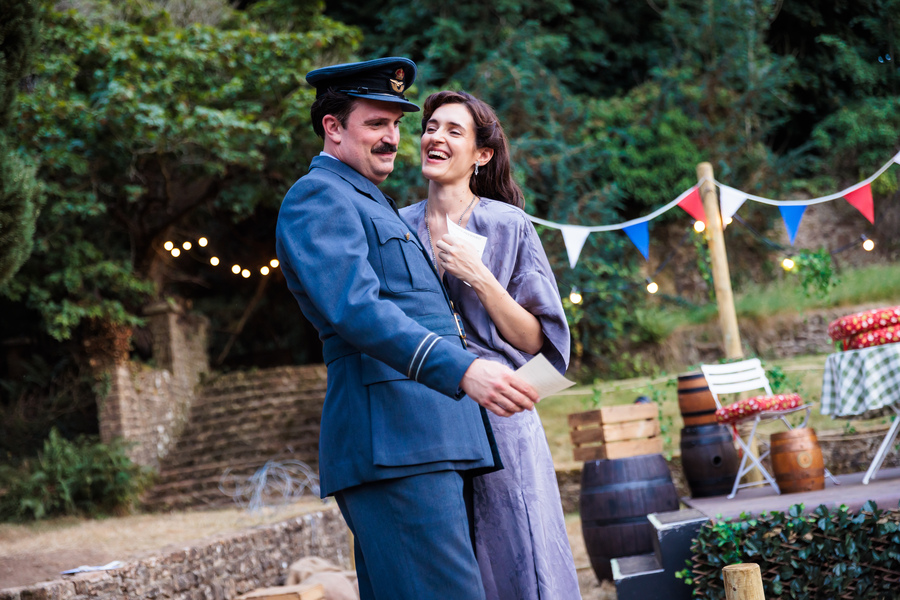
James Sheldon and Phoebe Pryce in Much Ado About Nothing. Photo Credit: Harry Elletson