

Review by Simon Jenner, August 21 2026
★ ★ ★ ★ ★
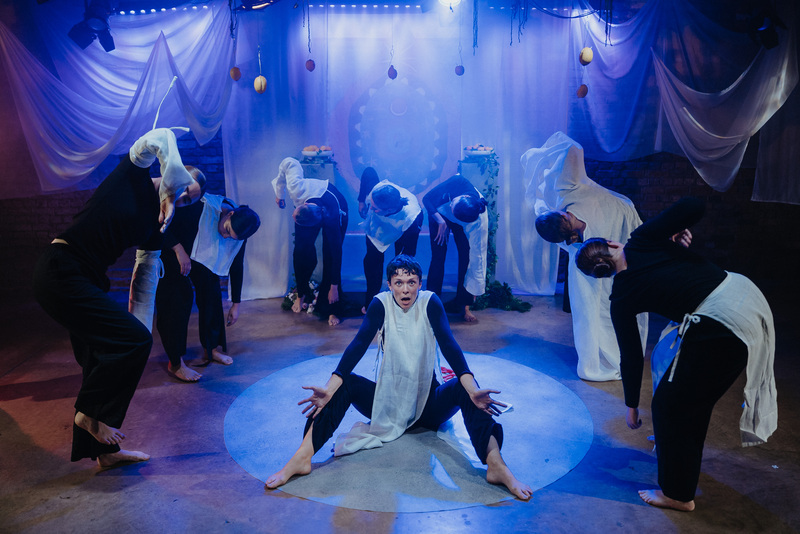
Eight veiled souls enter severally in procession chanting Latin. It’s 12th century plainsong and in fact the earliest Western music we have, not counting Kasia, an early 9th century Byzantine nun. But Hildegard Von Bingen (1098-1179) was so extraordinary – as abbess, composer, visionary, poet, herbalist and political advisor – that half of Europe heeded her. Bitter Visions by Order of Hildegard, with music by Hildegard and Florence Carruthers-Andrews with the ensemble directed by Caro Lesemann-Elliott, comes to Arcola’s Grimeborn Festival till August 22.
It’s a production brought by the collective Ololyga. In ancient Greek it stands for a high-pitched female cry or triumphal shriek; such as in ritual, sacrifice or childbirth; cries forbidden within a man’s earshot.
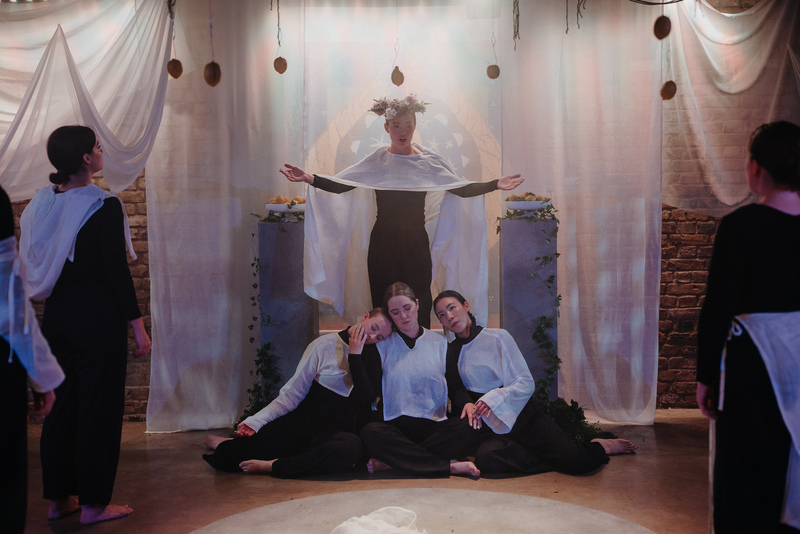
Lydia Ward as Queen Humility. Emily Beech as Victory, Issy Roberts as Mercy, and Sara Knight’s Discretion, and Company. Photo Credit: Alice Underwood
Carruthers-Andrews is also the Soul tempted by the Devil (Eleanor Westbrook). With green makeup on one side of Westbrook’s face and what looks like military camouflage, Westbrook seems attired like the Green Woman. And in an ensemble that’s what she is and becomes. The theme – outlined in the West’s first mystery play Ordo Virtutum (another Hildegard first) – is that of a soul’s ensnaring and redemption.
In five acts though female queerness, sexuality and an ultimate Bacchanale as the Devil is cleansed, takes on a very earthy dimension. The celebration of virginity that Hildegard meant has become something other. A sexuality that needs no man to fall into; and a gritty transcendence eschewing female proscription.
If Caruthers-Andrews with her striking deep soprano range is pierced by Westbrook’s eventual soprano as she both disrupts (with a mic) then some devilry vocally – they’re just two of nine outstanding soloists; and a startling parade of veils and shrouded backdrop including a kind of altar that’s never unveiled.
Bea Vina’s set both shifts and dissolves as various items – lemons above all – apparate in sudden church symbolism. The bitter strews the ground. Lit crucially by Eli Hunt to allow the diaphanous materials to be lit almost from within by a bluish whiteness, the visual is fragile but compelling. Katie Kelly’s movement though is what grounds the perpetual chant and electronic counterpoint: a truth of holy theatre. A term genuinely not overused here.
The five acts foreground different groupings. Each of these singers enjoys a solo moment, nearly all singing with a powerful mid-soprano range soaring up at given moments; or with a potent mezzo. Not so much counterpointing as underscoring tonally. The Three Virtues: Salome Siu, Miranda Ostler and Amy Kearsley all enjoy moments of pure soprano production delivering the Latin plainsong.
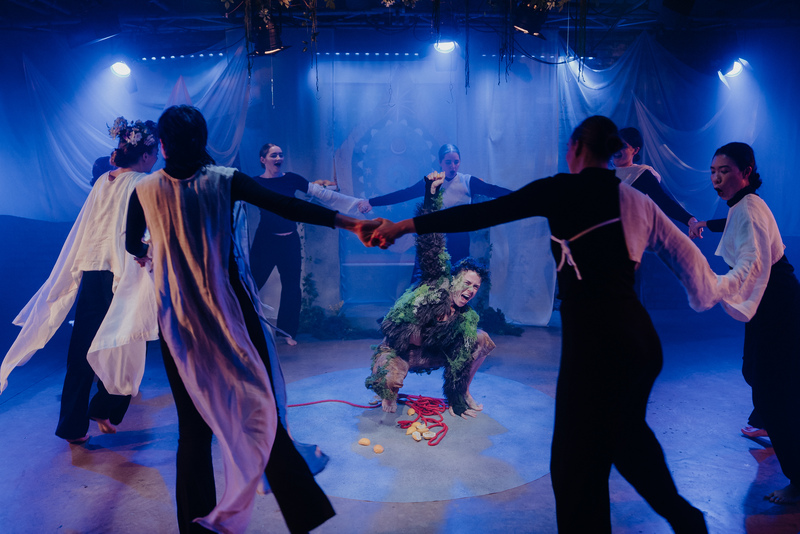
Eleanor Westbrook (centre) and Company. Photo Credit: Alice Underwood
It’s soon clear that apart from Carruthers-Andrews’ beguiling electronic composition sashaying (amongst other things) a touch of rock with John Tavener, that Hildegard’s own 12th century music has enjoyed (via Carruthers-Andrews) a little creative harmony from 13th century organum: either that or Leonin and Perotin have taken even more from Hildegard than my ears told me. It’s entirely in keeping though and is simply an occasional harmonic enrichment; stopping short of polyphony proper, as from a later age.
The theatrics of performer Carruthers-Andrews’ enchainment by Westbrook is heightened in red bonds (ultimately Soul being led off like a dog), as if crucified; but also at first in a sensual doubling that makes them seem Hildegard 1 and Hildegard 2. This sizing of the soul is striking and a white/green marriage of soul/body under veils that – like the other singers – breaks out.
For the third act a group entitled Complaints of Souls Imprisoned in Bodies is led by the pure soprano tones of Lydia Ward as Queen Humility. Later she’s augmented by Emily Beech’s trumpet-tongued Victory, Issy Roberts’ softer Mercy, and Sara Knight’s reflective Discretion.
The fourth part where Soul and Devil return – the former repentant and the latter losing control – is charged with symbolism. This is where the lemons appear. The final fifth act seems a slight tweak as the Devil too is drawn in slowly, now themselves led doglike. But there’s a reprieve and ceremonial surprise as the ritual lento and processional of the whole performance is supercharged to the Bacchanale mentioned – a wild whoop as the Devil too is brought into a whirligig of the Community of Virtue.
As both religious and queer allegory this has something to teach us too. Not quite what Hildegard envisioned, but a lightning-rod of queerness and above all feminine vision of annealing body, soul, desire and virtue into a harmony, and not an exclusion. The Mystery-play atmosphere radiates authentically. Though shot through with contemporary sensibility, the sacred is palpable and preserved.
Were she writing now, it’s suggested, this might be how Hildegard would have recognised herself and women. And no longer to pretend it was God speaking through a weak vessel in lieu of there being no men capable. In its miniature and vast scale, outstanding.
Additional Music Production Matt Huxley, Stage Management Ash Howard, Audio Operation Finn Lacey.
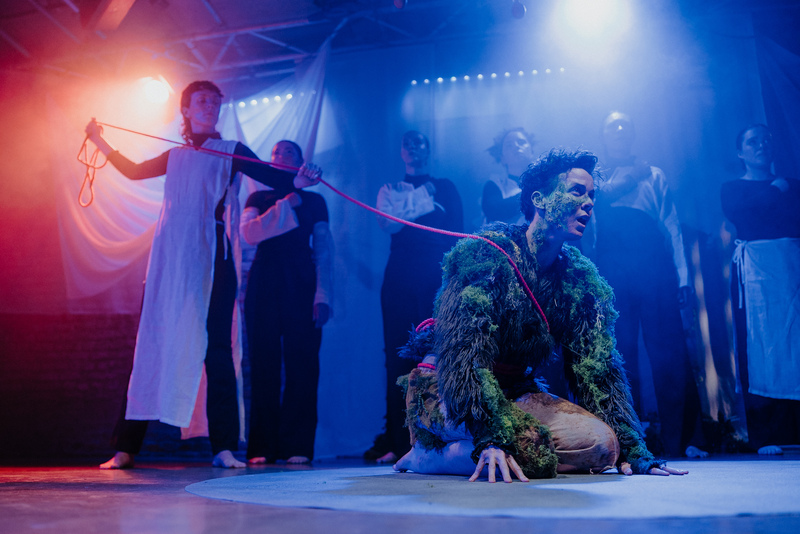
Florence Carruthers-Andrews (left), Eleanor Westbrook (centre right) and Company. Photo Credit: Alice Underwood