

Review by Simon Jenner in East Sussex
★★★★☆
29 August 2026
By 1912 nobody knew what to expect from Richard Strauss. The operatic late-starter with two turkeys had proceeded to create in Salome and Elektra two starkly modernist masterpieces. He had then, with the latter’s librettist, Hugo von Hofmannsthal, gone on to shock in reverse with the Viennese whipped cream of Der Rosenkavalier in 1911.
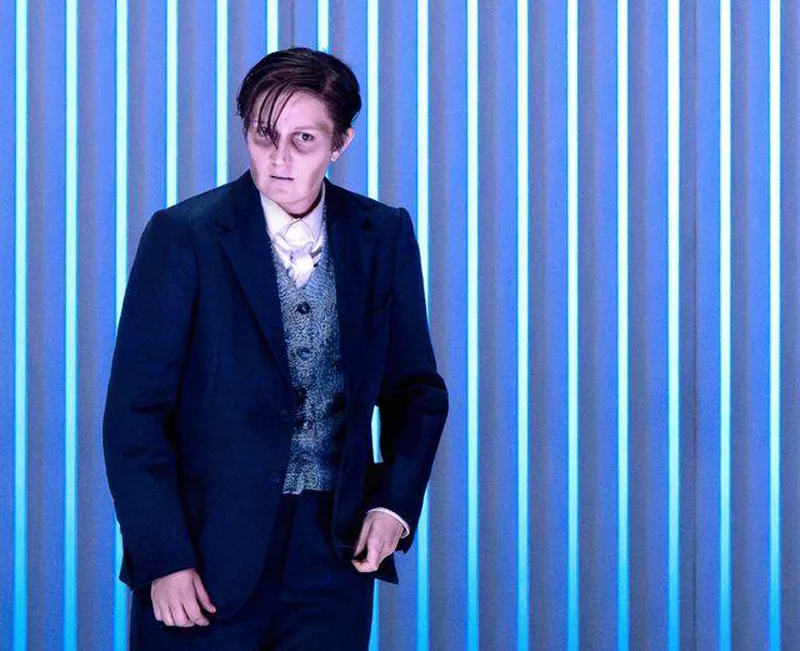
Samantha Hankey as Composer. Photo credit: Tristram Kenton.

This new Glyndebourne version of Ariadne auf Naxos is directed by Laurent Pelly and conducted by Robin Ticciati. Premiering in Stuttgart in 1912, it’s an opera that was never intended as it now stands, one infinitely preferable to the first version. Originally conceived as an accompaniment to Molière’s Le Bourgeois gentilhomme, Ariadne auf Naxos premiered in Stuttgart in 1912. The iteration we know today, with its newly written Prologue, dates from 1916. It features a central figure, the Composer, pulled one way by their tragic creation Ariadne (or the Prima Donna) and the other by the interloping soubrette role of Zerbinetta.
Strauss wrote several coloratura roles but this is surely his finest. Zerbinetta is from a commedia dell’arte troupe. In different ways she does her best to seduce both the Composer and Prima Donna – when onstage as Ariadne. This production with the gloriously vivacious Alina Wunderlin has almost decided that the real title is Zerbinetta auf Naxos. That is unfair to the others, all in magnificent voice and superb actors too. Wunderlin though sets the audience roaring.
With almost two different casts, indeed musical styles, the orchestra – consisting of members of the London Philharmonic – is thankfully chamber-sized, glinting with piano, flutes, oboes and horns. Led by Peter Schoeman, it’s scaled like Handel or Mozart. In this way, even more than normal, you can follow every flicker of Strauss’s thinking as he crafts motifs and shifts mood in half a bar. And Pelly follows him with having flunkeys (Oliver Williams and Liam Forrest) open proceedings bringing in regal chairs. As Strauss touches on the briefest of Viennese waltzes (a single bar), one of the flunkeys dances a measure with their cumbrous load. The score’s transparency is so faithfully echoed in direction, you can see Strauss wink through the clarinets.
For the 1916 revision, Strauss and Hofmannsthal replaced the Molière play with an entirely new Prologue, lasting around 45 minutes. It is witty, mischievously pitting comedy learned from Der Rosenkavalier against (say) the tragic death urges in Elektra, with the Composer, now transformed into a major singing role, embodied by Samantha Hankey.
Like Elektra, the Composer’s opera – the eponymous Ariadne auf Naxos of the entire work – references the world of Greek tragedy that Strauss had already visited and would keep revisiting his entire career. Later on the Composer’s creation, Ariadne, sings of death as consummation, a send-up of Tristan und Isolde. If nothing else Strauss exorcises here the last traces of Wagner from his aesthetic.
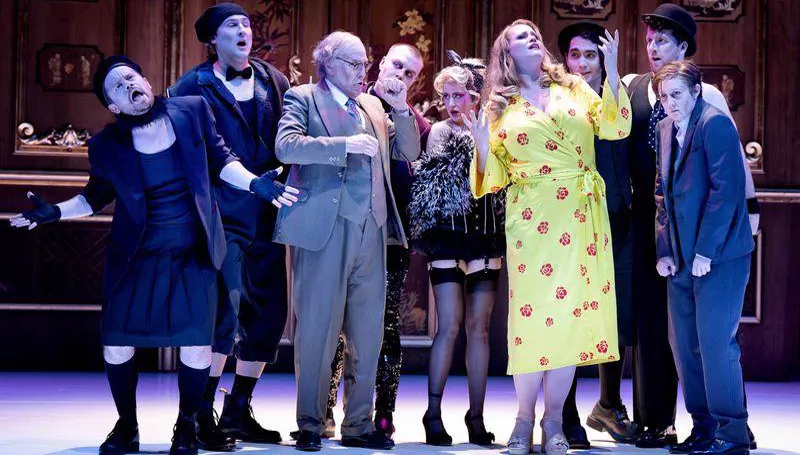
Pelly first visited this opera 20 years ago and is on record as saying that he feels his staging then was too cluttered. With designer Massimo Troncanetti, he strips the stage back to a huge grandly-panelled frontage with doors and the theatrical coup of the evening, given to a speaking voice, William Relton’s Major-Domo who pops out of a hidden top hatch for his exit-line: “Get on with it!” A philistine role, it’s underlined by the fact that actor Relton never sings. In the “opera” half, a blue-grey shale (recalling the slag-heap of Saul last year), covers most of the stage as Ariadne and others clamber over it. Marco Giusti’s lighting distinguishes a townhouse room’s glare from the second act’s moody twilight – in that same house’s domestic stage.
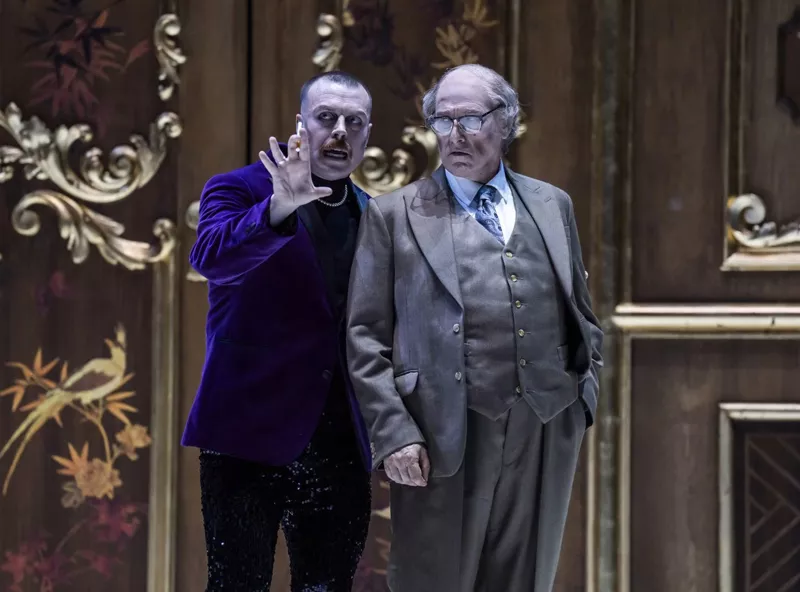
Ru Charlesworth and Michael Kraus. Photo credit: Tristram Kenton.
The Janus-faced plot is simple. It’s set around 1740, at the house of “the richest man in Vienna” – plausibly the same as Der Rosenkavalier. Relton’s brutally philistine Major-Domo informs the Music-Master (Michael Kraus, pragmatic, yet careworn) that his protégé’s opera will take place before or after a visiting dance troupe performs an Italian comedy. Kraus’s Music Master accommodates with Ru Charlesworth’s perky Dancing Master. Not long after the Music Master finally breaks the bad news to the Composer, the Major Domo pops out above them and declares the two entertainments will be performed simultaneously. The furious Composer, who has no choice (they have all been paid), is then entranced by the appearance of Zerbinetta.
Zerbinetta – entertaining her four lovers one by one – later does her best whilst “trespassing” on the ensuing opera to cajole Ariadne out of her death wishes by recommending a new lover who, of course, appears. More immediately she interacts with the Composer who immediately hits on a new tune he forgets and then remembers in his interactions with her.
For some the new Prologue is the thing, and one can see why. The singers of Act Two are revealed here brim-full with insecurity and vanity. The tenor (later Bacchus) David Butt Philip only has a brief moment complaining to the Wig Maker (a flurrying Hector Bloggs) before Rachel Willis-Sørensen as Prima Donna (later Ariadne) erupts in a saffron-coloured dress, swapped for a sadder simpler costume, paradoxically when acting Ariadne. Act One is full of details like this, followed to the second in orchestral zig-zags.
If Strauss could contrive to have three female voices singing at once he would opt for it, as in Der Rosenkavalier. Here he almost manages it twice. The glorious trio of Anna Denisova (Naiad), Ekaterina Chayka-Rubinstein (Dryad) and Erin Rognerud (Echo) come into their own swooning over the approach of “the young god” Bacchus when he finally arrives. Earthy Rhine maidens as it were. The trio of Ariadne’s Willis-Sørensen, Zerbinetta (Wunderlin) and, of course, Composer (Hankey) never sing as a trio (duets have Wunderlin common to both).
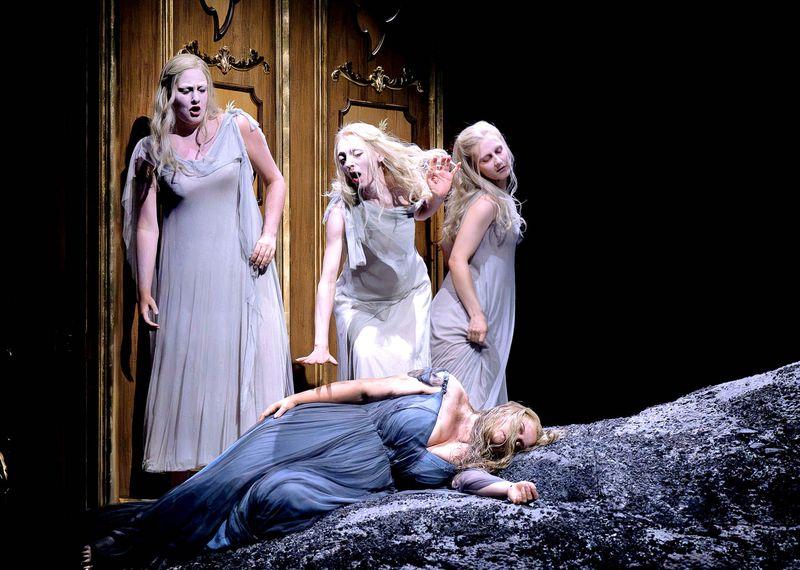
Anna Denisova (Naiad), Ekaterina Chayka-Rubinstein (Dryad) and Erin Rognerud (Echo) with Ariadne’s Rachel Willis-Sørensen,. Photo Credit: Tristram Kenton.
In the “opera” though, Pelly has the Composer lurk onto Naxos, shadowing Ariadne and the interloping Zerbinetta. A kind of trio. With this stage direction, Pelly ensures the Composer too intrudes on their own opera just as much as the troupe. It’s a novel, complex touch, suggesting the Composer is transformed by the comic disruption. If Ariadne is deaf to Zerbinetta (but gets her man), you feel Zerbinetta gets the Composer – among others. In Pelly’s vision, Zerbinetta is the catalyst here who both ignites two disparate worlds and fuses them together.
Certainly the most moving moments in Act One involve Wunderlin’s interactions with Hankey’s Composer. Zerbinetta’s life-affirming creed here literally seems to infuse the composer’s death-directed opera. At one level, surely she magically changes it? Ariadne waits for Death and is convinced that when Bacchus comes, he’s it. At one level you see Zerbinetta redirecting this to the new lover, being a god, able to transform Ariadne from Thanatos to Eros and an eternity of it at that.
It doesn’t come quickly. Liam Bonthrone (Brighella), Liam James Karai (Truffaldino), Caspar Singh (Scaramuccio) and Mikhail Timoshenko (Harlequin) delight as both a white-faced and hatted dance troupe and supporting act for Zerbinetta who flirts in an overtly sexual way with each, now in a pink costume with candy-floss-pink boa. She remains brightly clad as do her black and white troupe. By contrast, Ariadne is clad in a strikingly similar blue-grey to the shale-shelving set, clearly the blue of her own despair.
Since with no lines Hankey can only lurk round the stage, it’s Wunderlin’s continual cajoling as soprano with a powerful mid-range, and flirty acting who holds centre-stage. Willis-Sørensen is superb as Ariadne. There is not a weak link in this cast and all nail the Straussian idiom. Willis-Sørensen in herself takes the guyed Wagnerian soprano to credible heights. Her Ariadne’s anguish seems real in a trance-like way. What Willis-Sørensen manages is a nobility in the face of life getting in the way.
Wunderlin ensures it does, though Willis-Sørensen’s Ariadne remains impervious. Wunderlin’s stratospheric soliloquy is the showstopper though. The original 1912 was higher still but transposed down by Strauss as almost unperformable. Wunderlin could easily have managed those fearsome F sharps, and the way she sings it you almost feel she has.
But she is performing the modified D major version. One day perhaps. It’s stunning. Zerbinetta’s justification is that she falls in love not “on a whim” but as a “compulsion”. (Richard Neel’s translation neatly adapted in well-defined surtitles). Together with Wunderlin’s outrageously funny acting – she hesitates for whole bars together – it’s the opera’s highlight. I’ve never heard it sung like this. Wunderlin plays shamelessly with the audience hanging on every note she delays singing; she holds us breathless. And shaking with laughter.
Butt Philip has an unenviable role at one level: Bacchus famously comes in very late. And then sings a cruelly exposed tenor line. (Strauss never loved tenors). Butt Philip though makes it both effortless and rapturous. He and Willis-Sørensen encounter each other in a dreamlike unreality. Ariadne thinks Bacchus is Death and welcomes him. Bacchus thinks Ariadne’s some goddess of the place he’s not met. Between them the two manage an ecstatic duet that almost convinces you it’s the highpoint. And it is one of the twin peaks. Wunderlin enjoys the last word (basically “I told you so!”) and watches the newly-mated lovers depart while downstage she muses on some women getting it right second time. She will cheerfully keep on trying.
In short a glorious revival, one of Glyndebourne’s finest Strauss ventures. If it has to be confessed Wunderlin is the star and rivets her role forever on those who have seen her. Hankey, Willis-Sørensen and Butt Philip are wonderful too. Superb.
Previously published in Plays International and Europe, whose kind permission to reproduce it here is gratefully acknowledged. Editing by Jeremy Malies.