

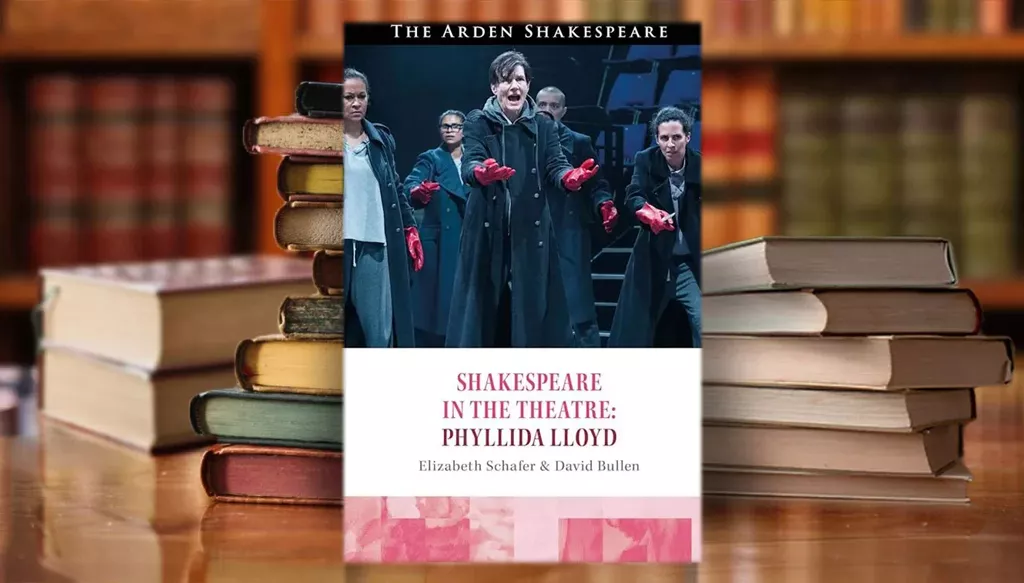
The Arden Shakespeare: Bloomsbury ISBN 978-1-350-10634-5. 197pp.
Review by Dr Simon Jenner, November 1 2026
I
At the moment that the RSC, alongside social justice theatre producers KPPL, announces a new co-production of Phyllida Lloyd’s Julius Caesar in November 2026 – with many cast returning – a study of Lloyd’s Shakespeare productions arrives too. Shakespeare in the Theatre: Phyllida Lloyd by Elizabeth Schafer and David Bullen is published by Bloomsbury in their Arden Shakespeare imprint, forming part of the Shakespeare in the Theatre series.
Julius Caesar, being the first of Lloyd’s acclaimed Donmar trilogy of Shakespeare plays, forms part of the climax of the book. This narrative prepares for it scrupulously by examining Lloyd’s earlier work on its own terms. Nevertheless the last 72 pages of the 156 pages here (plus 41 of notes and index) discuss the trilogy, its effect and aftermath, as well as including interviews with actors involved. The writers make it clear that a prime document and spur was Plays International’s interview with Lloyd conducted by Jeremy Malies: “that offers valuable insight into Lloyd’s approach to Shakespeare”. Certainly this book is now in itself a rich document, freighted with source material, particularly in the interviews.
A gap in Lloyd’s Shakespeare career (what might she have achieved there in more recent years?) is her working at the RSC in 1991-92 but not returning until 2026. Yet this new co-production – already flagged at the end of the book – highlights exactly why Lloyd has steered clear of the RSC. As indicated, KPPL is a production company with a social justice focus. It seems Lloyd has got her way.
Though Shakespeare-focused and ending the narrative essentially in 2017, the writers give a generous overview of Lloyd’s career. They dwell on Shakespeare but fill in much of Lloyd’s other work, showing how core experiences shaped her: the painful challenge of a National Theatre Pericles from 1994 and Lloyd’s subsequent popular 1999 theatre and 2008 film hit Mamma Mia! They frame the opening and full onrush of her mid career, bookending the end of a partial success (few productions of Lloyd are anything but successful) with the heady mix of patronizing critics and euphoric audiences that has kept Mamma Mia! playing ever since.
The climax and close focus is the fascinatingly detailed, multi-levelled Donmar trilogy, involving the women’s theatre company Clean Break and originally staged from 2012 to 2016: Julius Caesar, Henry IV (mainly Part 1) and The Tempest. The two earlier productions were revived (with some cast changes) in 2016 as a trilogy with audiences encouraged to see the all-day production of the three. The trilogy (not as a set – there were separate New York engagements) transferred to St Ann’s Warehouse in New York beginning in 2017. The impact of this environment is just one of the many changes both director and cast registered when developing the show. It also coincided with the U.S. production of The Taming of the Shrew, very different to a 2003 production that Lloyd took over, but also featuring Janet McTeer.
However brilliantly Lloyd started out, one emerges from watching the videos of the trilogy (happily caught in the US, over two weekends) by concluding that the work as a whole is more dizzying than anything even Lloyd had attempted. It stands as the culmination, so far, of her work as a radical director. Its vertiginous meta-theatrical and theatrical layering (actors, their prison character and acting a Shakespeare role as that character) render it more complex conceptually than the grand and partially successful Pericles.
The emphasis, heralded in chapter headings at the start and conclusion, is on Lloyd as a bringer of disturbance as well as diversity to the theatre with results that ripple far beyond the Globe, for example, where arguably Lloyd’s innovations have been mostly deeply absorbed. The study quotes actors and creatives extensively, highlighting Lloyd’s collaborative approach as “team leader” as Janet McTeer calls her.
Though a few actors baulk at not being director-driven, most revel in opportunities to bring their particular skills and ideas to a production, discussing and shaping the play, trying out and sometimes discarding ideas worked on for days (as famously the refugees scene in the Donmar The Tempest). Lloyd is never afraid to jettison something she feels might work, but actors and herself prove does not work in practice. This inclusivity has had huge consequences for working with the company Clean Break in the trilogy for example. Whilst scrupulous to avoid suggestions that Lloyd alone is responsible for this, the writers’ conclusions point to Lloyd as prime and persistent disturber of the peace of “The Crown Jewels”. (This is Lloyd’s phrase for the Shakespeare canon she insists on shaking loose.)
One thing has remained constant and directorial however. Lloyd has always walked in at the start with the cut of the Shakespeare play she wishes to direct. Even that though, changed with the trilogy, as she tried various parts of plays on the cast, discussing with specific actors which speeches spoke to them. This worked particularly in The Tempest. Lloyd’s increasing emphasis on actors speaking with their own accent has moved to testing what connects with particular performers, especially those with no experience of Shakespeare as with some prisoners working with Clean Break.
The writers label those non-Shakespearean productions of Lloyd they discuss with “Disturbance”; in the way others would make interludes or intermissions. Almost as if Lloyd were escaping her true Shakespearean vocation for something that made her Shakespeare heavier with the weight of her return from exotic lands.
II
After sketching Lloyd’s background – she was born in 1957, attended an RSC-visiting boarding school, and studied English & Drama at Birmingham – the writers prove that their subject’s career from 1984 was innovative from the start. Her first four years brought A Midsummer Night’s Dream (1986) with its unusual pairings (Egeus/Bottom), an imaginative cross-casting Much Ado (1987), The Comedy of Errors (1989) with nightmarish surreal elements, and The Winter’s Tale (1990) re-focused on women’s power so moving away from Leontes.
From 1993 after her awkward RSC stint, it was Lloyd’s move into opera – notably Britten’s underrated and savaged Gloriana from 1953 – that saw her amplifying her powers with operatic productions. This fed straight into the way she addressed spectacle.
Indeed it preceded the spectacular and ill-fated Pericles of 1994 at the National’s Olivier. Working with designer Mark Thompson – a frequent collaborator since – Lloyd devised an astonishing spectacle fit for the meandering Pericles.
Different languages were spoken at some stops on Pericles’s odyssey, and scholar Roger Warren praised Lloyd’s “bold reorganization of the text”. Lloyd, however, made the mistake of designing prior to working through the production with the cast. Not only did they seem marooned but the stage machinery and the Olivier’s dreaded drum revolve stalled. Though technically things were patched well enough, and the production improved, it had few outright champions. Some, like Michael Billington, found much to admire and everyone agreed Pericles needs something like this on a large stage to work at all. It marked a nine-year pause in Lloyd’s Shakespeare work though. Lloyd herself described it as “particularly painful”.
It was with Mamma Mia! five years after Pericles, that Lloyd – never given the kind of recognition of say Trevor Nunn or Nicholas Hytner as the authors point out – stamped her international arrival. Naturally it led to snobby backlashes about surrendering commercial theatre. Lloyd’s overriding theme though, a theatre that gives women more visibility and agency, is triumphant.
This more radical step towards making women true protagonists might have lent Lloyd even more confidence. Henceforth she addresses not only more operatic productions like Verdi’s Macbeth, reinvesting it with much Shakespeare, but in 2002 a radically re-oriented The Duchess of Malfi where she cuts down Bosola’s part. Hence she refuses to let him become the anti-hero of Act Five after the duchess’s murder in Act Four but focuses on the duchess herself: the magnificent Janet McTeer whom Lloyd would soon work with again. A remarkably lucid and “psychologically acute” Mary Stuart at the Donmar in 2005, nearer the first of two productions of The Taming of the Shrew with McTeer as Katherina in 2003 at the Globe, and as Petruchio in the 2016 U.S. production.
Taking over from another director the Globe’s The Taming of the Shrew in 2003 was not ideal but somehow Lloyd reinvested it with far more input from the cast. It’s here perhaps that accounts – from cast witness – of the mature Lloyd’s methods of working date. They are detailed in the book, as they would later be for the Donmar trilogy. Her collaborative approach, team-leading, inviting input and trying and testing ideas, playing to cast strengths and special talents, never obscure the fact that Lloyd still leads. When given a free hand (so not entirely in this production) Lloyd will arrive with that pre-edited Shakespeare script. The play’s parameters and emphases then are set. But within this envelope, Lloyd proves herself open to try and fail.
After her debut as film director – of Mamma Mia! again in 2008 followed up by Abi Morgan’s The Iron Lady in 2011 – Lloyd in collaboration with the Donmar’s newly-appointed artistic director Josie Rourke decided to try something extraordinary. Rourke made a swift decision to invite Lloyd to direct a project that Lloyd decided should be an all-female cast of Julius Caesar. Incidentally, in 2012 “all-female” seemed still acceptable. It was within these very productions of the trilogy that several cast members themselves transitioned over four years to non-binary identities. It’s not too much to suggest that the trilogy marked – or at least highlighted – one of the most profound changes theatre has undergone in recent memory.
III
Lloyd’s groundbreaking trilogy in 2012 came about as Rourke was appointed artistic director of the Donmar. Finally in a smaller West End venue, two women could come up with what was arguably by then an overdue revolution. It didn’t feel like that at the time to many. Lloyd’s decision to cast Harriet Walter as Brutus in an all-female (as the term was then) production of Julius Caesar was in retrospect a natural progression. But, slightly less visible (of course) than some male peers, no-one had been watching.
Julius Caesar
Harriet Walter, writing her own book Brutus and Other Heroines, noted that she still felt first that she needed to seek permission to play Brutus: the way in that Brutus gave her to explore power in a context that normally excludes women. Secondly, the pragmatism in setting it in a women’s prison that both rationally excluded men and allowed the prison violence to naturally fit the play’s violence.
One key insight Walter shares is her perceptions from playing Lady Macbeth. “That Brutus was like Macbeth … Worked on by Cassius as Macbeth is by his wife.” These are the levels and disturbances that re-gendering Brutus and Cassius lend, telling us infinitely more than many more gender-conformist readings. Jenny Jules’s “fiery” fanatic Cassius was acknowledged by even resistant critics. It also highlights challenges already present: the moments when they weep together – which can occur – threaten to destabilize Brutus’s relations with his wife.
This allows Lloyd, Walter and cast to address the role of marginalized women in Julius Caesar and later in Henry IV. Here Portia self-harms with a dagger across her thigh and her speech is impassioned, making far more of an impression as Cato’s daughter, far more Brutus’s equal. When Brutus here claims he will tell all, the consequences of not doing so might lead to suicide. The truncated end, where the cast are not allowed to finish their performance because of intervention by the warders is a genuine shock after such a lean and hungry realization. Jackie Clune realized a particularly entitled, heedless Caesar.
Reactions were so vitriolic from some quarters that Rourke’s immediate response was to commission another all-female Shakespeare: Henry IV. This too utilized the prison scenario and established the triple level of actors playing names, prison inmates playing Shakespeare. Walter for instance is the lifer Hannah whom she modelled on revolutionary American “terrorist” Judy Clark. Someone who drove the getaway vehicle and killed no one – though her comrades did – and whose refusal to cooperate resulted in decades at a facility in New York State. Walter thought Clark a suitable model for Hannah, with sentiments not far removed from Brutus. Further, there are unusual shafts of humour that Lloyd, Walter and the cast relished that are echoes from real-life prison conditions.
Henry IV
In Henry IV – mainly Part 1 with the rejection scene from the end of Part 2 added – Walter plays the title character and others take centre stage. Clare Dunne as Donna – a Dublin woman who has learned that she is eligible for release in three weeks – plays Hal. Donna is trying to rehabilitate from drugs. Falstaff/Ashley McGuire is fearful of losing her to early release. Choosing between two “father figures” is addressed as a high-stakes relationship between Hannah and Donna.
Henry IV from 2014 enjoys a more profound dynamic between the prison characters, just as perhaps the tension between the Shakespeare play and its prison context, paradoxically, seems to slacken. This was my own impression and does not seem unique. One reason might simply lie in the choice of play. The choice of Henry IV still seems on the face of it an excellent one. And the possibility of a female Falstaff surely proved irresistible. It’s a lively reading, though perhaps the iron-like quality and lean writing in the Roman plays translates more easily to prison conditions than comedy or romance? There is no logical explanation of that, bar the tenor of tragedy, loss, and despair inherent in prisons inflecting the plays realized.
Still, there were so many delicious moments: the cardboard Harriet Walter faces depicting her as Henry IV might not embody those famous red gloves in Julius Caesar but this is assured comedy and touches like this still make this Henry IV more inventive and richer than many. Clune’s Glendower too was thought to be a fine comic creation. By contrast, Sharon Rooney realized the normally comic role of Lady Percy as tragic, not far short of Portia.
The women prisoner stories being more pronounced mean that Walter’s Henry is not only learning to let go before she dies but that the profound prison dynamics of those staying and those to be released, nearly all serving disproportionate sentences, one might add (in comparison with men), also allows that dynamic to foreground itself. The question is, how much could an audience pick up? We are readier now.
The Donmar trilogy as such was intercepted by a second Taming of the Shrew with McTeer again leading, this time as Petruchio. Cush Jumbo taking the role of Kate – eventually – as a Republican Stepford Wife – was unnerving. Realized half a year after Trump took up the U.S. presidency (the production opened at the Delacorte Theater, Central Park, New York in June 2016) the layers of irony and difficulty made the project – with its questioning of female roles – crackle with urgency and resistance as outlined above. McTeer and Jumbo start as equals. But boys here have permission to be bad. Women, never. If the constraints of the 2003 Shrew were generative of something remarkable, the 2016 Shrew was seen as Lloyd’s Mamma Mia!, not quite realizing the sum of its parts. But then Lloyd was in 2016 directing four all-female/non-gender Shakespeare productions and in New York much had to be rethought.
The Tempest
The Tempest in 2016 suffered from physical displacement – the temporary King’s Cross Theatre seemed to leak energy. There was an abortive attempt to integrate refugees’ stories which took up energy before being reluctantly abandoned. Macbeth had been considered but interest stopped with the Witches. Nevertheless Hannah and Walter were back as Prospero, the Hannah character a fixture in herself, and a cast whose journeys were now clear to the actors. Dunne/Donna had been “released” so couldn’t come back.
This production was “obsessively concerned with transitions into and out of prison” with isolation (Hannah’s Clark-like experience) highlighted. This certainly built on the Donna/Dunne theme. Most of all – and the King’s Cross set highlighted this – the island was a place of transition too or at least holding. The set possessed less of the steel clangour of the Donmar and the feel of something improvised, even (dare one say it) suggesting a church hall. Now the asylum seekers theme is public knowledge – something the audience were not aware of – an element that made less sense to this writer before but now clicks. The feel of this Tempest was just that: of a cavernous dropping-off point with plastic bags and the impression, if not of reality, of fuzzy edges to the stage.
That said, elements of the Clark experience make new sense altogether. Prospero’s book becomes Hannah’s lifer journal, and her small desk and “cell” a cave-refuge of making. The storm is imagined, Leah Harvey’s Miranda leaps up, wrests the book away from Walter and the Shakespeare begins. Prison conditions are everywhere: Harvey’s younger more recently-imprisoned character Aisha is more innocent. As, surprisingly, is Jade Anouka’s Ariel. She is now a more resolved character (as Sade) than her Mark Antony and Hotspur because – of course – she is promised imminent release. No wonder Sade bridles at more work and her “liberty’ is resonant. It is suggested that Anouka’s Sade character, being Black and queer, has been cruelly exploited by an embittered Hannah. Like Harvey’s Miranda though (who will marry Ferdinand when out) she is awaiting release.
By contrast Marina Laird, playing Alonso and taking over roles in Julius Caesar and Henry IV, shouted “I can’t breathe!” This cry references police and warder brutality that predates George Floyd. Elsewhere though there is originality in casting Falstaff actor Sophie Stanton as Caliban: a literal white-trash prisoner clearing trash away and exploited by everyone else in a kind of prison-caste hierarchy.
Stanton – like Anouka – plays her character as a confused innocent. The notion of her being readdicted to alcohol (in contrast to her trying to re-addict Dunne’s Hal via drugs) lends her “a tragic recapitulation”. Whether or not she’s still the Andrea character (formerly known as Falstaff, the distinction is blurred, as the writers say) the interruption by real ex-prisoner Jen Joseph as prison officer reinforces her isolation after Dunne is released. As Joseph noted, casting an ex-prisoner as prison officer was an inspired choice for someone with limited experience then but who knew officers intimately.
Laird’s Alonso and Carolina Valdés’s Antonio add another dynamic as once high-status people brought low for corruption. Their humiliation by officers (Joseph relishes this) is one thing but Walter’s Hannah who fought such people as a “terrorist” declares that they are “a large part of the reason we’re in here”. It’s an ingenious rationale for Hannah’s desire for vengeance on a class, if not individuals. Hannah’s promise in the masque scene for McDonald’s (that sent up an inmate roar) ends with her popping balloons as if not able to contemplate consumerism in any form. It’s another point subtle enough to be lost on me, though the film has Walter’s Hannah mouth a disdain that clarifies it. It’s one of the tiny revisions that render the New York St Ann’s Warehouse experience more explicable than to those who, like me, saw the London version only.
By this time, Anouka’s Ariel/Sade has displayed a personal mischief: in for instance chloroforming Zainab Hasan’s Gonzalo mid-flow in Gonzalo’s (here) particularly futile vision of Utopia. This agency reached its zenith as Anouka asked the audience to switch on the supplied torches for Prospero’s renunciation of magical powers speech, making them complicit as spirits. That gesture unsurprisingly landed with the audience when I attended. Nevertheless, a major part of Hannah’s final compassion resides in her not being able to inflict on Alonso the loss of a child in Ferdinand, such as she will lose in Miranda’s Aisha. Forgiving Alonso and Antonio is, as the writers claim, “gut-wrenchingly hard to offer. She offered it nevertheless.” Anouka’s “I would, were I human” has played its part too. By the end, gifted a book by Harvey’s departing Aisha/Miranda, Hannah is virtually alone. Only Stanton’s Andrea/Caliban, still cleaning, remains and she will eventually leave.
Having seen these plays in their original productions one after the other, it’s hard not to conclude that Julius Caesar remains outstanding – and groundbreaking in its rationale and beyond the (then-termed) all-female casting. It’s also hard not to feel (as I did then) that the subsequent two productions don’t quite make their profound subtextual worlds sing out. I missed some of it, particularly in The Tempest. The prisoners’ journeys, the subtle semaphoring of say Falstaff trying to goad a lapse in Hal’s drug rehabilitation, were sometimes visible in Henry IV. Though The Tempest seemed to lack the crackling energy of Julius Caesar in particular, and some subtext leaked away. These impressions can be corrected happily in the films: by the time these were shot in 2016 there were mostly gains. Reading this account makes me want to see them in their entirety and reassess what I missed, by not seeing the trilogy afresh.
IV
In the conclusion, the writers discuss the trilogy’s metatheatrical devices and characters’ journeys in detail, something certainly more accessible to those who saw the trilogy in a day with the prison characters updated and sharpened. Their assertion that each play’s end traces a development away from violence – the anguished unfinished Julius Caesar, the hope of resolution with Henry IV, and the release for most at the end of The Tempest – crafts an affirmative arc. And yet Hannah/Brutus’s cry at the end of Julius Caesar remains unappeased: “The world’s gone to hell, we can’t do anything in here.”
There is an invaluable trove of interviews with cast members and Lloyd herself. They discuss everything from Queering Shakespeare – and the development of non-binary identity that in part arose for several during their traversal of the trilogy – to the impact on schoolchildren that Lloyd herself witnessed. There is also further assertion of (as a subsection entitles it) “Lloyd’s lasting disturbance” on directors and theatre generally.
It’s clear that Lloyd’s work – especially the trilogy – has had a huge effect on the Globe particularly, with its gender-blind and trans-affirming work through Michelle Terry’s tenure, now ending after a decade. Such new Globe plays as Morgan Lloyd Malcolm’s Emilia and Charlie Josephine’s I, Joan (Josephine being a 2012 Julius Caesar cast member) seem godchildren of Lloyd’s initiatives. Though Lloyd can hardly be credited with changing much of this culture single-handedly, she might be the single most potent influence. Even down to auditions where women and non-binary people can offer parts written for men. And while the writers remark that other directors – Josie Rourke and Emma Rice are cited – have sheered off Shakespeare after critical hostility, Lloyd apparently has not.
This book performs a singular service. It affirms Lloyd’s centrality in contemporary theatre and details her huge success, scattered over several genres and still not sufficiently appreciated. It patiently unfolds – with cast commentary, the innovative techniques used – as with metatheatrical identities. Most of all it discusses how Lloyd has succeeded in foregrounding women and latterly non-binary actors as mainstream. Her legacy is not only secure, it towers among contemporary directors and alters what comes after it.
Previously published in Plays International and Europe, whose kind permission to reproduce it here is gratefully acknowledged. Editing by Jeremy Malies.