Review by Simon Jenner, August 6 2026
★ ★ ★ ★ (★)
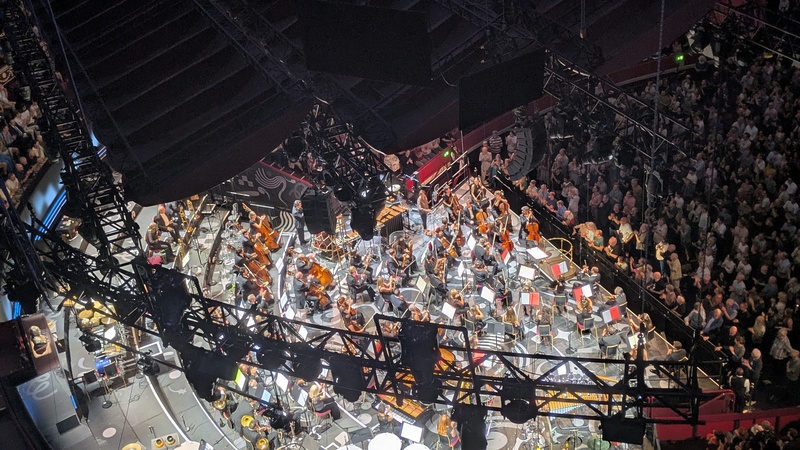
In a shorter-than-usual BBC Proms – and like many now, starting at 7pm – there were just two works: the first lasting 20 minutes. Edith Canat de Chizy’s percussion concerto Skyline received its UK premiere (also a Proms co-commission with the ONF, Orchestre National de France), and the main fare: Shostakovich’s Symphony No. 10 in e minor Op 93. It’s making its 37th appearance at the Proms outstripping every other Shostakovich work here, even the Fifth. The BBC Symphony Orchestra was conducted at the Royal Albert Hall by Cristain Macelaru.
Canat de Chizy is known over here mainly by a couple of CDs, but like most contemporary French composers isn’t really performed. is the first woman composer to be elected to the Academie de Beaux-Arts. Born in 1950, taught at the Conservatoire after broader study sat the Sorbonne, Canat de Chizy became a friend and was closely inspired, rather than influenced, by the French-Spanish-British Maurice O’Hana (1913-92). The influences lie in titles and genres. De Chizy sounds very different.
Skyline is nothing less than the birth flourishing and death of the universe. It’s the kind of theme Canat de Chizy is obsessed by: the mineral power of the natural world, formations and dissolvings. Percussionists Lucy Landymore, Emma Arden and Delia Stevens for a triad of percussionists with Richard Cartlidge on timpani. It boasts an array of instruments – a gong or timpani being rubbed with a rubber mallet to curve the sound. There’s a phenomenal array of instrumental choices too: bells, gongs, cymbals, chimes, harps and string as The work skims from one soloist to the next, with certain moments repeated in an ostinato. They’re often punctuated by woodblock or the wood of the string-section bows. At others, a melodic cell rises against them, and this makes Canat de Chizy distinctive amongst modernists. At a halfway-point there’s use of a bull-roarer – a plastic tube whirled round the head of a percussionist to create a vocality to the swirling air. A harmony of all the spheres.
It’s a highly attractive piece, if a slightly uncertain one. Up in the Gods (aka Gallery) it rose to its fullest extent but didn’t seem to possess the momentum of its premiss, in the way say a Xenakis piece of percussion manages. As a piece about the universe, it slightly underwhelmed in a way that Rued Langgaard’s astonishing 1918 Music of the Spheres didn’t. It didn’t meet with favour in my corner of the Gallery. Nevertheless, knowing and liking Canat de Chizy’s music, this is one to which I’ll return for as long as the BBC allows (30 days after the Proms ends), to seek persuasion.
Shostakovich’s Tenth was a delayed ninth, after that work cocked its ironic snook at the notion of a choral Ninth (soon scrapped) to celebrate the Soviet victory in 1945. As a piece the Ninth more snarls than laughs, and lacks the lightness Prokofiev can bring. Still it’s highly inventive and royally pissed off the authorities. The Tenth, despite ex-pupil and now commissar of music Tikhon Khrennikov’s condemnation was recognised as Shostakovich’s true ninth, or musical summus to date. When it appeared in 1953 shortly after Stalin’s death it was understood as a pent-up release: eight years of enforced silence of most major work, simply to stay alive during Stalin’s senescent revival of the terror.
This performance burns through the score. It’s lengthy – it takes an hour, far longer than I’ve heard (timings normally range between 50 and 58 minutes, but usually around 50). But it’s supremely atmospheric, detailed, and ever drags. The opening Moderato is memorably laid out, and coils tension like a giant spring somewhere in the wind section. Macelaru takes his time but he never lets tension drop. The plangency of this movement and the third movement Allegretto are riveting with oboes and other instruments moodily nudging in, as if something ominous is being stared at or stared down.
So much so the normally hellish Allegro, widely believed to be a portrait of Stalin, lasting about four minutes, and effectively a scherzo, seems more a powerful extension of the opening Moderato. More allegro than scherzo certainly, which usually takes four minutes. But then that’s the marking.
What this also underscores though is the personal motifs, an infatuation we now know that Shostakovich had for a music student (his wife had an open long-term affair with a physicist; theirs was an open marriage). The student – Elmira Nazirova – kept all the evidence and doesn’t seem to have resented it. These motifs transcribed as also for Shostakovich’s own DSCH – mark the third movement and we enjoy getting to realise the great power of the first and third movements in this work. Perhaps slightly at the expense of the popular second, but then it becomes truly part f the work.
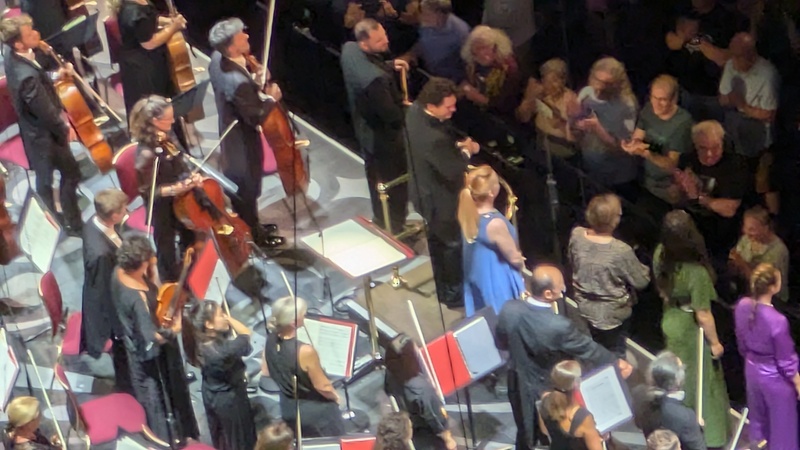
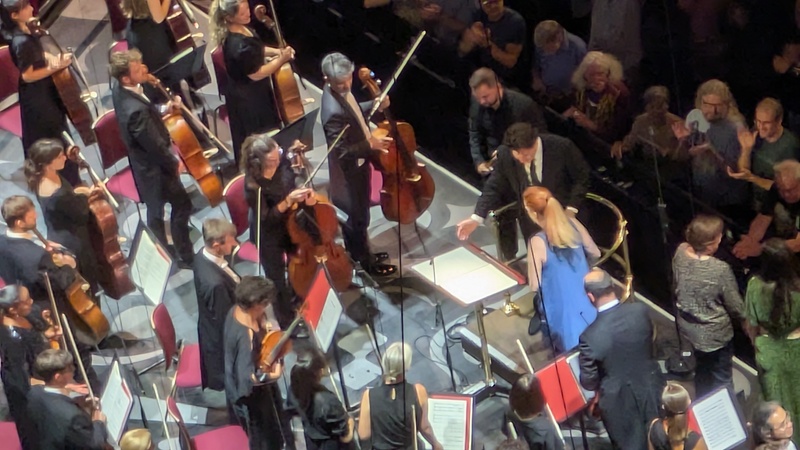
The BBC SO winds here are particularly memorable. As they are chipping in quite slowly as the fourth movement’s lacerating high jinks take an epic struggle to kick in. It’s a harder-won battle than it can be, and all the better for it. Following the Eleventh on the 3rd August, this year’s Proms rather continue last year’s 50th anniversary of Shostakovich’s death, than wind it down. One older Prommer declared that was the finest Tenth he’d ever heard. I wouldn’t disagree.
Photo Credits: Simon Jenner