

Review by Simon Jenner, July 27 2026
★ ★ ★ ★
A recorded voice from 62 years ago. Then an actor on stage speaks as himself, as if giving a lecture. Then without any inflection, he dips into the voice’s character – another actor – who was imitating a historical figure. Here, one actor-director, Alastsair Whatley of Original Theatre, pays homage to another, Micheál Mac Liammóir, invoking Oscar Wilde in his 1960 The Importance of Being Oscar. After Original Theatre and Reading Rep revived their touring production (fittingly, near Reading Gaol), in 2024 and again in 2025 (at Jermyn Street), Whatley brings it via a tour to Park Theatre directed by Michael Fentiman till August 22.
Imitation can be more original than flattery. Though if that’s a double imitation it can also recess into a wilderness of mirrors.
Actor-playwright Mac Liammóir (1899-1978) bestrides the one-man Wilde play like the originating colossus he was. His The Importance of Being Oscar even exists as a 1964 film. Whatley has been touring this production on and off since 2010. Yet its staging has changed significantly since 2025; and seemingly performative elements have too.
Alastair Whatley in The Importance of Being Oscar. Photo Credits: Marc Brenner
So dominant was Mac Liammóir and his play for more than 15 years, that – only after his death – he (and Wilde) achieved the rare feat of inspiring a tradition: Mervyn Holland’s The Trials of Oscar Wilde and in 2021 at Jermyn Street itself, Gerard Logan’s Wilde Without the Boy. This latter is similar to Mac Liammóir in structure and shares material: but uses more original matter in the second post-jail half, dispensing with most of pre-1895.
Indeed Whatley’s and Fentiman’s version discards a fair amount of Mac Liammóir’s work too. Originally 140 minutes plus interval, Mac Liammóir himself adopted and dropped as it went on. This revival cuts the account of Dorian Gray in particular, and snips judiciously; whilst adding newly-discovered letters. At 95 minutes plus interval it navigates the mostly Wilde material almost without you noticing cuts. And seems lighter on its feet. You can tell, since some of that recording closes the show too.
Mac Liammóir asserts Wilde “invented the 1890s, that remarkable decade through the first half of which he strutted, and through the latter half he staggered.” With a little help.
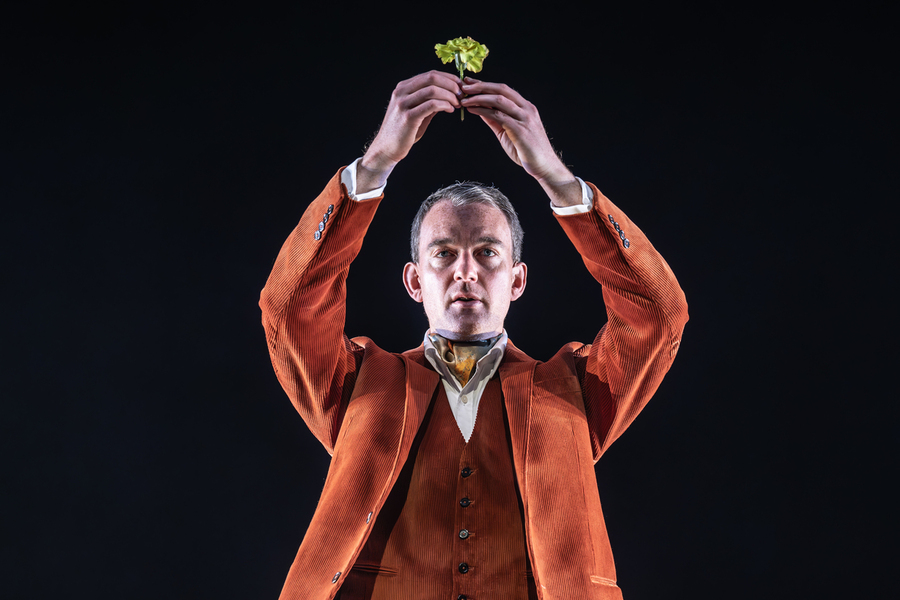
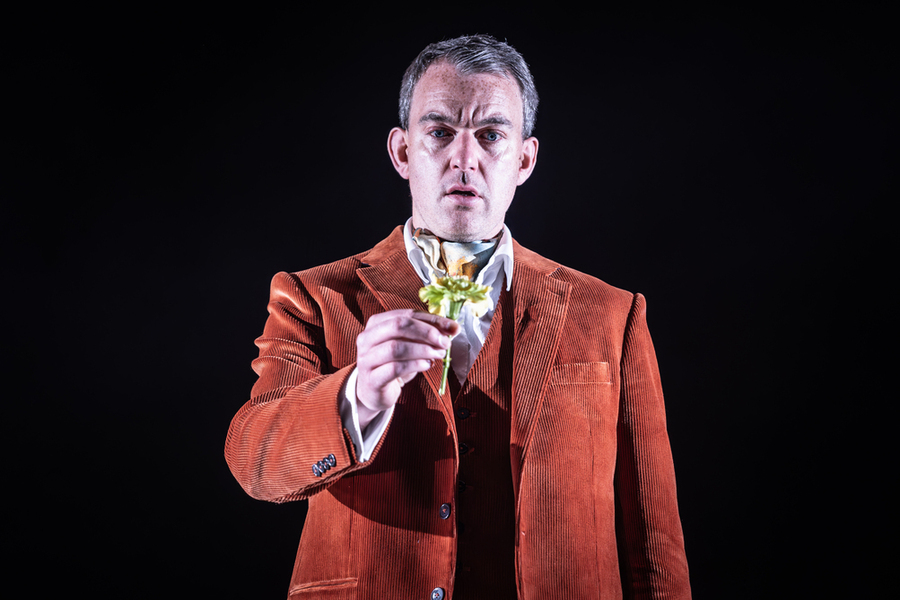
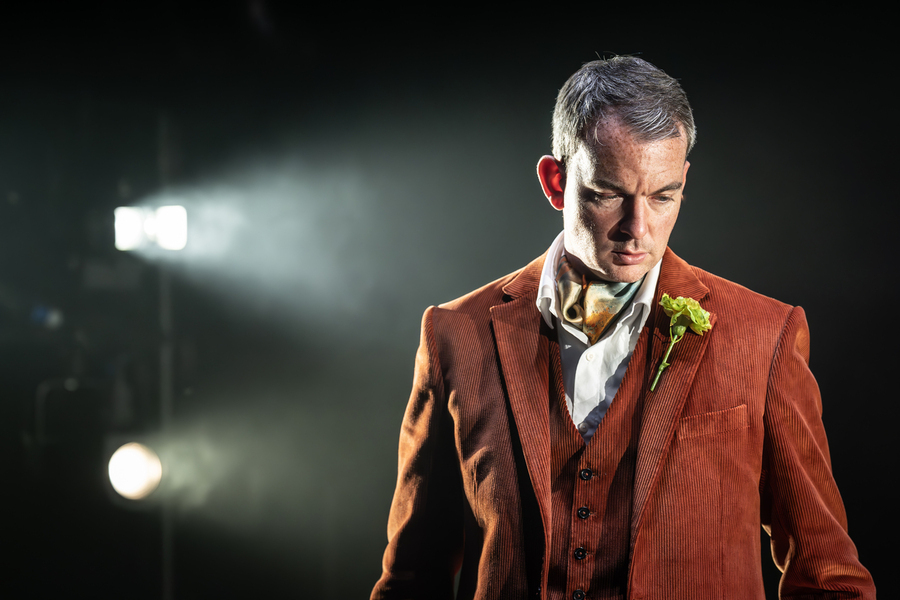
After a newly-written prologue from 2025, Whatley still starts with the early life, where the only conventional thing Wide did was leave Ireland as soon as possible. The 1880s self-declared aesthete, never mind genius (inspired by the personally more timid Walter Pater), Wilde was at first all cut lilies and carnations. Indeed Whatley’s major prop in the first half is a green carnation. Wilde’s aesthetic poetry was tended for Lily Langtry, of a very different stamp to that last blazing Ballad. We’re soon in America with miners, the best-dressed men he’d met there. “I had to tell them that Benvenuto Cellini had been dead for quite some time. At which they immediately asked: ‘Who shot him?’”
Whatley’s performance doesn’t adopt the Irish lilt Mac Liammóir re-integrated into Wilde’s persona, long excised by the British: who having broken Wilde colonised him with an accent. But to imitate Mac Liammóir, as Simon Callow, his dresser and finally successor proclaims, was something he said (in his Introduction) he “must absolutely not attempt.” Nor does Whatley.
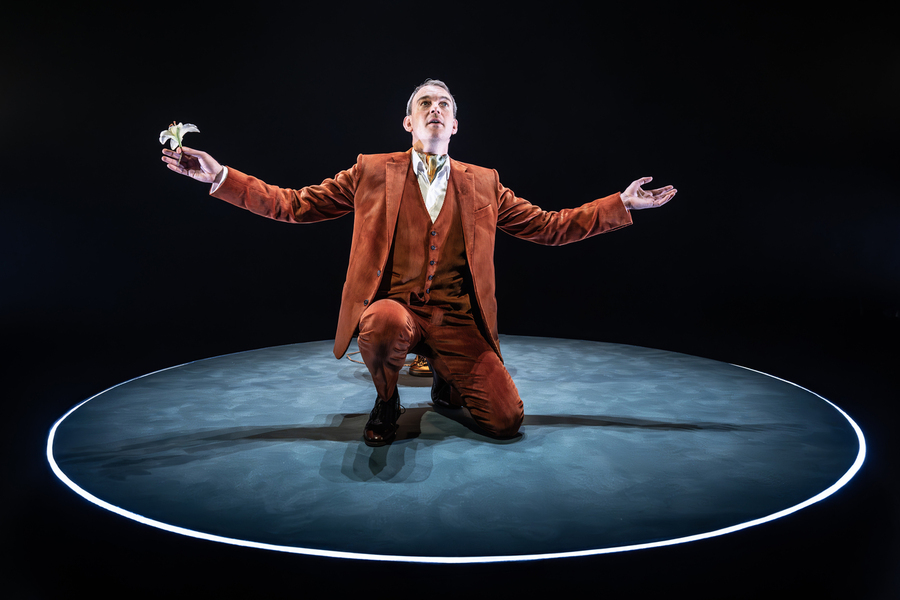
Madeleine Girling’s set of two Os still concentrates predominantly on a patch. A circular teal-coloured dais and with Chris Davey’s lighting (including the traditional lamp, latterly replaced by a prison stool) an illuminated oval like a mirror invokes a portal of quiet magic barely used. Here though it’s at ninety degrees rather than overhead. Because one later scene is so finely wrought, you wonder at what other effects might have been achieved. This production doesn’t thrive in holy stark spaces.
However other moments have vanished. Whatley no longer rises or stoops in a semi-recumbent position, Nor does he lie down. The staging in Park 200 is bleaker, less theatrical, bar one moment. This strips some of the flaneur from Whatley and in the first half makes him more an after-dinner speaker of himself. A rare exception is the prosecutor flaying Wilde and his co-defendant Alfred Taylor, with three voices switchbacking. After the interval, things improve.
Whatley, clad in Girling’s unexpected rust-brown velvet suit, steps through those Os or retreats behind. Though there’s nowhere but dark and occasional wan moonlight playing on his face when Whatley recites, much later, ‘The Ballad of Reading Gaol’. This at least captures some rapt magic. Whatley seems more comfortable, inflecting his voice more – as indeed he does through the less clattering second act. Barnaby Race’s use of Chopin’s wintry Ballade No 1 in G minor – and of Ballades 2 and 3 before the opening – evokes moments of Dorian Gray.
The title might more recently suggest early identity politics, but more importantly it reveals Wilde’s truth. Moving from “Life is far too important a thing ever to talk seriously about,” to his assault on “shallowness”, we’re conducted rapidly through unfamiliar poems, better-known tales and stage triumphs (pausing on the ”handbag” moment in The Importance with Lady Bracknell).
Alastair Whatley in The Importance of Being Oscar. Photo Credits: Marc Brenner
This Wilde is inevitably a stark before-and-after. That turning-point is reached on The Importance’s opening night February 14th 1895. Assailed by two almost identical men, the father-son Scylla and Charybdis of Queensberry and Bosie, Wilde defies all advice to defend “the love that dare not speak its name.”
In De Profundis, the long letter Wilde wrote Bosie from prison in early 1897, Wilde is now the scourge of “shallowness”. But was this volte-face really the product of prison? Whatley draws Wilde’s breath in pain as he essays this: an eloquence gravid with tragedy, with a different tone to the Ballad, where he withdraws into a wraith of himself. The lighting comes into its own and Whatley floats, the ethereal performer; not urbane lecturer, or in character: prosecutor, wit or foil. This moment transcends my previous experience of the production.
That scourge, primarily of himself, is how Whatley opens Act Two. Wilde, above all, is his own Sphinx, more than his beloved Ada Leverson (later celebrated for The Little Ottleys trilogy and invoked here). Author of The Soul of Man Under Socialism, the last thing Wilde truly thought was that “all art is utterly useless”. He sought to hide being Ernest, in every queer or literal sense. Best do it in plain sight.
Whatley reveals some more vocally agile notes than the originator. He doesn’t portentously accent the judge as Mac Liammóir did. But he lightly inflects a gallimaufry of characters, rendering Wilde more mercurial, quizzical and fun. This lightning-sketch of joy and stillness – informing Wilde’s incarceration – flickers with images: of Wilde, on November 13th 1895 being transported to Reading, then spat upon; just as the gentry and prostitutes had danced on hearing of his sentencing. There’s fine moments too of a French life talking with the young Andre Gide; the moment with Bosie almost passed over (it was the core of David Hare’s 1999 The Judas Kiss). And after one last, surprise tale, that terminal moment with magenta wallpaper.
This is a fine revival, though with less concentrated staging, and (earlier at least) less Wildean pressure, less afffecting than at Jermyn Street. The first act rattles too quickly; there needs to be some distinction between Whatley and Whatley-as-Mac-Liammóir-as-Wilde. Whatley’s adept though at invoking nuance and half-lit smiles, a world of covert celebration. Indeed he pre-empted the National’s joyously gay production of The Importance of Being Earnest with one (dare one say more earnest, engaged) during the Vaudeville Theatre’s festival of the four comedies. Whatley takes the joy of the sorrow, and in the Ballad, makes it his own. Still a milestone every Wildean should experience.
Producer Jennifer Amey for Original Theatre, Originating Producer Reading Rep Theatre, Production Manager Brian Watson, Company Manager on Book Maria Gibbons, General Manager Lisa Friedrich.
Production Sound Engineer Gareth Stevens, LX Programmer Ruth Corris, Production Electrician George Rogers,
Marketing Pam Kehoe for jma, PR Alison Duguid PR, Artwork Photography Michael Wharley, Graphic Designer Steph Pyne, Photographer Marc Brenner, Social Media Manager Paul Jennings for Hero Social, Website Design Aaron Weight.
Alastair Whatley in The Importance of Being Oscar. Photo Credits: Marc Brenner