

Review by Simon Jenner, July 22 2026
★ ★ ★ ★
“We start in space just above the Kármán line; the official line just above where outer space begins, sixty-two miles above sea level.” It’s 2011. “Nain” or grandmother Gwen is telling two children stories. Emily White’s Atlantis starts and ends by slyly invoking Captain Cat in Under Milk Wood. The eternity of Thomas’s Llareggub though is shattering slowly over 28 years. Among other things Atlantis is about how a village, one among many, is about to die through rising sea levels caused by climate change. Having opened at Theatr Clwyd, Mold, in June, in a joint production with Chichester Festival Theatre, Atlantis now transfers to the Minerva Theatre directed by Guy Jones until August 15.
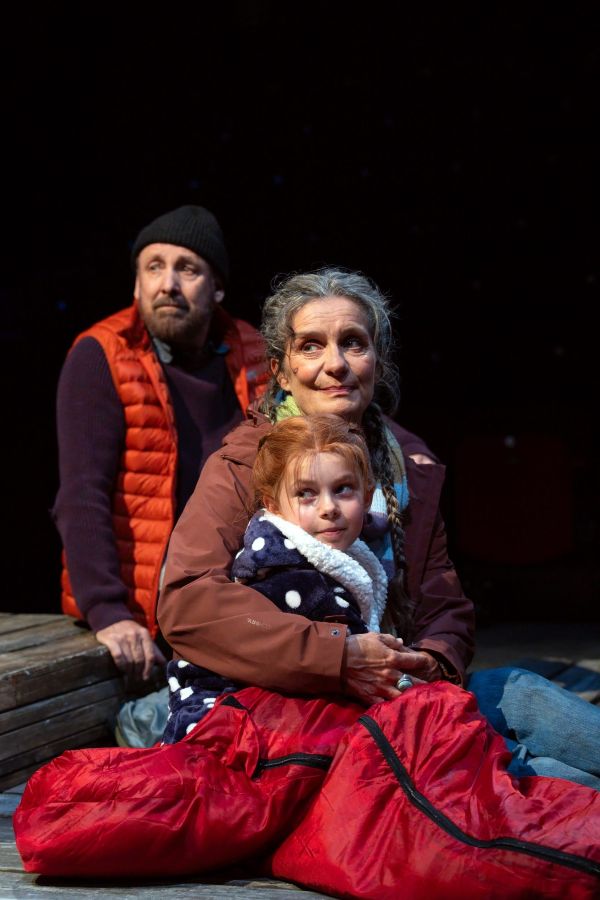
Richard Elfyn, Iris Dempsey, Vivien Parry in Atlantis at the Minerva Theatre, Chichester Festival Theatre. Photo Credits: Marc Brenner and Danny Fitzpatrick
Atlantis and the larger issues the piece contains are told through one family and four generations from 2011 to 2039. Gwen (Vivien Parry), an old Greenham Common campaigner, enjoys a loving, playful relationship with husband Bryn (Richard Elfyn). He’s a fisherman and well-informed on climate catastrophe as it will affect all coastlines. He berates the media (portrayed by cast members who play the next generation) for taking both sides on the issue and ignoring the (historical) fact that the council decides not to mount sea defences or compensate people for the loss of their homes. Indeed alerting everyone immediately makes houses unsaleable and many are trapped.
These facts are based on White’s own research and interviews, but come over in Elfyn’s tirade as fresh and surprising. This is where White scores over Steve Waters’ eloquent pair of plays entitled The Contingency Plan (2013, updated 2022) which also address rising sea levels and wield a dizzying degree of data. In Atlantis by contrast, facts are telegraphed by two characters but characters dominate.
Parry, who also sings hauntingly, gives weight to Gwen’s national campaigning instincts that cut across Bryn’s more pragmatic, locally-targeted furies. They are not at odds, but their ideals aren’t quite aligned. Several times they re-enact their courtship in a touching mnemonic capsule whose significance shifts.
Gwen’s activism matters little to their daughter Claire (Catrin Aaron) who had to drop out of university to have the first of her two children (Rhiannon and Phillip, played winningly on press night by Iris Dempsey and Rex Bamber). Their father was killed in a car crash and Claire has been a care-worker on minimum wage ever since. Aaron throbs with frustration at her mother’s intransigence; then, much later at her father’s. You can see how White moulds character from the withdrawal of life chances. Claire’s word is quietly desperate and narrowed under pressure of work and child-rearing. Later for a reason she suppresses, Claire turns to drink. But when she utters it, she’s transformed.
As they grow, Claire’s children diverge. Rhiannon (from the pre-interval 2019 scene played by Eirlys Lovell-Jones) is the bright fearless Cardiff University-educated journalist who, much later, stands to be arrested for combatting climate denial. Lovell-Jones blazes across the play, firstly in a family Extinction Rebellion moment. Then increasingly enraged by 2029, she removes the mic she is using as she stands on a table addressing student journalists and harangues the imagined crowd without authorities jabbering in her ear. It’s a fine moment though trumped by an unexpected howl later.
As Phillip, Alfie Llewellyn navigates the unenviable, slightly duller brother role. At the age of 14, Phillip meets the girl who will define him. Astrid (Sara Otung) is slightly conservative, wealthy and, unlike his atheist family, religious. Otung makes Astrid’s pragmatic family values relatable, and glows with them. Phillip’s innate disaffection from radical politics after his teens is accelerated. Yet the touching peer relationship between Otung’s Astrid and Llewellyn’s Phillip is also life enhancing.
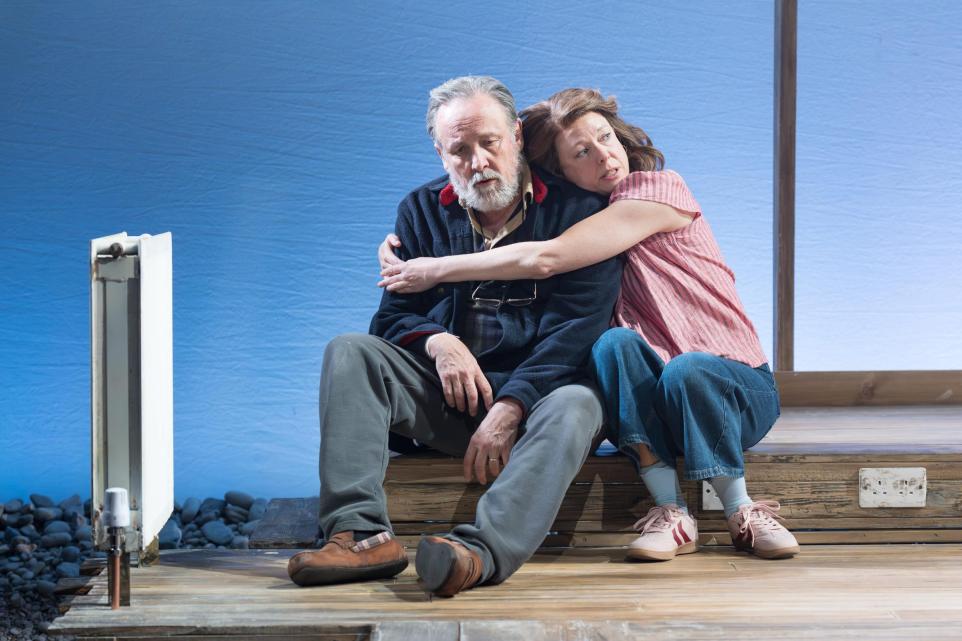
Richard Elfyn and Catrin Aaron in Atlantis at the Minerva Theatre, Chichester Festival Theatre. Photo Credits: Marc Brenner and Danny Fitzpatrick
Though the family ripple with an underlying hostility towards Astrid, the pair are not a mere foil to Rhiannon’s fierce journalism which compromises the family. By 2030, life and death jostle. In one striking scene, Astrid and Rhiannon make different decisions over a shared issue. It’s not the only dramatic irony. Others take time to detonate, like Gwen’s speech about the Suffragettes being force fed.
White is on firm ground up to 2019, with recent historical events including the exuberant Extinction Rebellion scene that closes the first half. The playwright navigates a speculative future though believably, without many hostages to that future. By focusing on a family, and mostly one room, White cannily frames a future through Rhiannon’s rogue keynote speech: of authoritarian crackdowns with the rise of the Far Right. Recruiting recent events, she presciently references group proscriptions and journalist arrests for telling the truth. Some of this seems written a couple of years ago, as some fears have lightened, while others intensify. It hardly matters since the drift is clear.
White also leaves the political world – with one exceptional reveal – for the familial. By 2038 the long-predicted storms rage, counterpointed by rich family disagreements and a cat’s cradle of resentments that build and often explode – giving Aaron’s Claire and Otung’s Astrid more scope, reacting to Lovell-Jones’ Rhiannon in different ways. Even here dynamics shift fundamentally between Rhiannon and Claire. Claire – and Astrid’s – objections to climate signalling are cogent. They make, powerful, different cases for simply living, even celebrating life in a world where climate is a background rumble. As Ibsen would say, everybody is right.
Parry’s Gwen is never far off and she and Lovell-Jones sing an achingly regretful duet – Jennifer Pearson’s music direction and Luisa Gerstein’s arrangements are remarkable too for arising so naturally and quietly out of the texture. Though there is a brief choric moment, the effect is elegiac and organic and the cast sing with haunting authority. Jess Williams too seems to plant cast movement as moments of pause and hurry: time slowed or accelerating.
Elfyn’s great moment comes as Lear-like he rages on top of the set against the storm and the dying of one person’s light. Bryn steadily loses focus from 2030, and these last three scenes are both poignant and disturbing. White is never predictable though, and the final scenes, where Benjamin Miglioli’s warmly confident David appears, are both consolatory and cyclical.
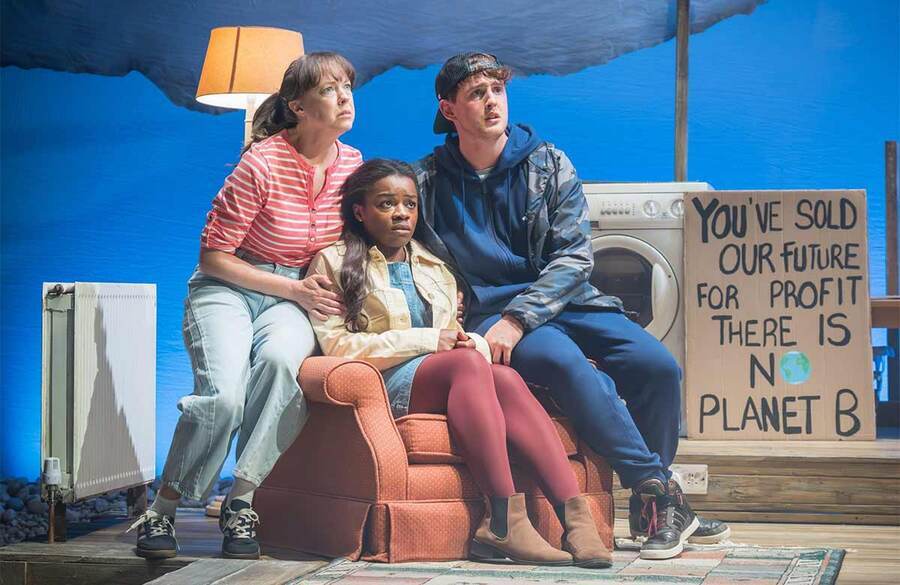
Frankie Bradshaw’s set looks as if could be packed away: indeed by the end that begins to happen. Dust sheets lift off and ingeniously hang like clouds over a kitchen-diner area. This owns a few fixtures like a washing machine (like a gun, it’s used); moveable tables and chairs sit on a raised dais of slatted wood. Joshua Pharo’s lighting and video are notable for their restraint (dates appear, discreetly) and striking pitch-black moments jagged through with storm or torches.
Dystopic futures are notoriously tricky to realise without seeming immediately dated and overblown. White’s theme of a cataclysm already quantified and unfolding, is just the beginning of how she navigates climate catastrophes without producing garishly obsolescent denouements. More importantly, White brings wholly believable, often historically grounded characters to life. She subjects them to subtle then open conflict. She also manages those unpredictable moments where everything changes. Sometimes in a look, or a telling. You leave certain of White’s truth and the sturdy capacity of this play to weather whatever imaginary or real futures throw at it. Superbly acted across its 140 minutes, Atlantis is the most outstanding play I’ve seen addressing this theme.
Previously published in Plays International and Europe, whose kind permission to reproduce it here is gratefully acknowledged. Editing by Jeremy Malies.
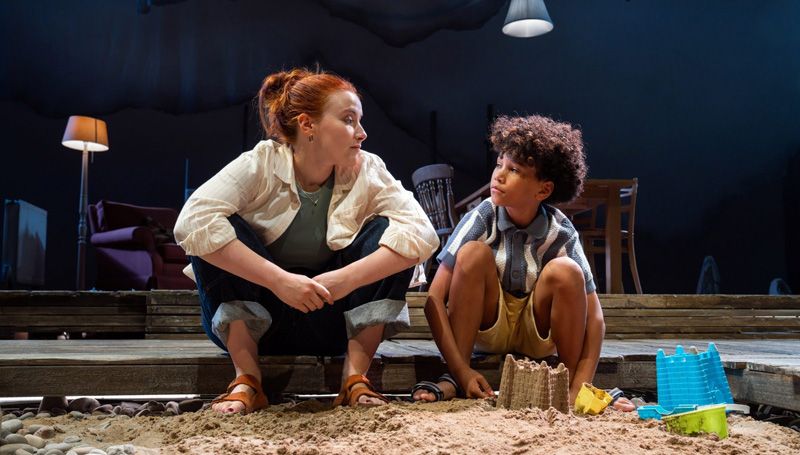
Eirlys Lovell-Jones and Benjamin Miglioli in Atlantis at the Minerva Theatre, Chichester Festival Theatre. Photo Credits: Marc Brenner and Danny Fitzpatrick