

Review by Simon Jenner, July 21 2026
★ ★ ★ ★
Last year it was Mozart’s Don Giovanni, and now the next two great Mozart operas arrive at Grimeborn. Cosi Fan Tutte – the last that Lorenzo Da Ponte collaborated with Mozart on before escaping for New York – is directed by Jenny Miller for Barefoot Opera. Their new production runs at the Arcola Theatre, Studio 1 till July 25. The Magic Flute will take to the boards in a month.
It’s their final but not easiest opera to love. For once Da Ponte wasn’t working with a Beaumarchais play or a myth. It’s all original, with hints from Ovid and Boccaccio. Despite that great quintet the ripple of misogyny – the title means “They all (women) do it” which might be fine if applied to all genders – meant that for the 19th century it was anathema. So Miller heroically rescues the brilliant brats from themselves. Sort of.
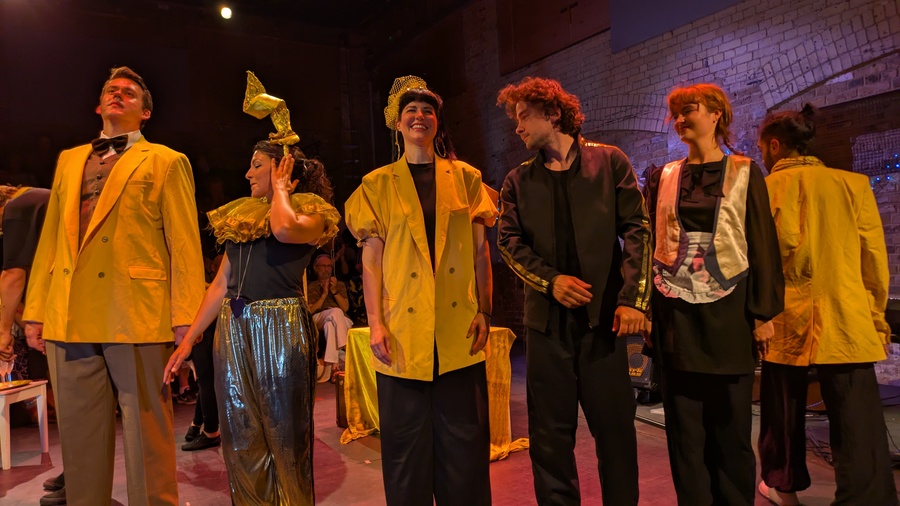
Joel Robson (Don Alfonso), Mahtab Ghmsari (Dorabella), Katerina Oikonomou (Fiordiligi), Bartosz Thirde (Ferrando), Ruby Caddick Laurence (Despina), Oscar Castellino (Guglielmo) in Cosi Fan Tutte. Photo Credit: Simon Jenner
Lesley Anne Sammons’ orchestral arrangement dispenses with the overture. Ably directing from the now fiendishly intricate keyboard score, Sammons loads her keyboard with Mozart’s compressed brilliance, yet clarifies with aplomb and comic vigour. The acoustics though render Amy Baldwin’s fine double-bass-playing scarcely audible. This is stripped-down opera at its most exhilarating. Lit neatly by Jack Hathaway – with little room to innovate – there’s still shadows skulking.
Several of the cast alternate, though the lack of a programme plus the excision of names from the surtitles mean many won’t know who’s who; or on what night which three singers take three of the parts. This might be part of an anonymising aesthetic, yet does singers starting their careers no service at all.
So three of the six roles – Guglielmo, Dorabella and Despina – are played by one of two singers on a given evening: meaning on-stage singers are boosted to nine, allowing ensemble work and heftier choruses; as well as experience for some of these singers entering the profession.
We start with a writhing heap, out of which protagonists are chosen for an experiment by a white-coated clip-boarded Don Alfonso (Joel Robson), perhaps the youngest on record: who takes the role with an excellent baritonal hauteur, mixed with a detachment and forensic question-mark around his singing. Gone is the traditional wise old cynic. Robson invests Don Alfonso with a measure of chrome steel spatula. You imagine him disposing of his samples. That is, till the end.
The charcoal-grey-clad ensemble trio scurry and frolic on the floor like dogs, then the un-chosen three writhe behind the other characters imitating dog-like clones, a bit like the droid round-up scene in Ann Droid.
A bit like Lucy Prebble’s The Effect, a play based on the scientific simulation of love. We’re in an updated world where Don Alfonso’s scientist seems hell bent on proving “all women do it” and female infidelity as natural as breathing: and pushing humans through like lab rats – to change the animal. What could possibly go right? Two sisters are engaged to two men. The wager is they men disguise themselves, come back and court a different sister.
Given the disguise the men undergo as Albanians after the ravishing ‘Soave sia il Vento’ trio costumes are happily swapped throughout. The women chosen add blue skirts like tutus and red sashes till later they don male-like attire denoting a kind of sexual liberation (they act like men, a neat sartorial emphasis, subtler than anything else given the constraints of the libretto). The men from contemporary fatigues and shades return fantastically arrayed with little caps.
The two more serious lovers – though not initially of each other – are played throughout by the same singers. Ferrando (an ardent, sensitive Bartosz Thirde) only later on courts Fiordiligi (Katerina Oikonomou, glowing and rapt, as well as seriously conflicted). On this occasion Guglielmo is sung by Oscar Castellino, giving a magnetically comic performance, the most memorable male role of the evening – though like any raffish male, he has an advantage. He’d make a fine Don Giovanni and in another register, Leporello. Isaac Conibear plays Guglielmo on other occasions, and here swells the ensemble.
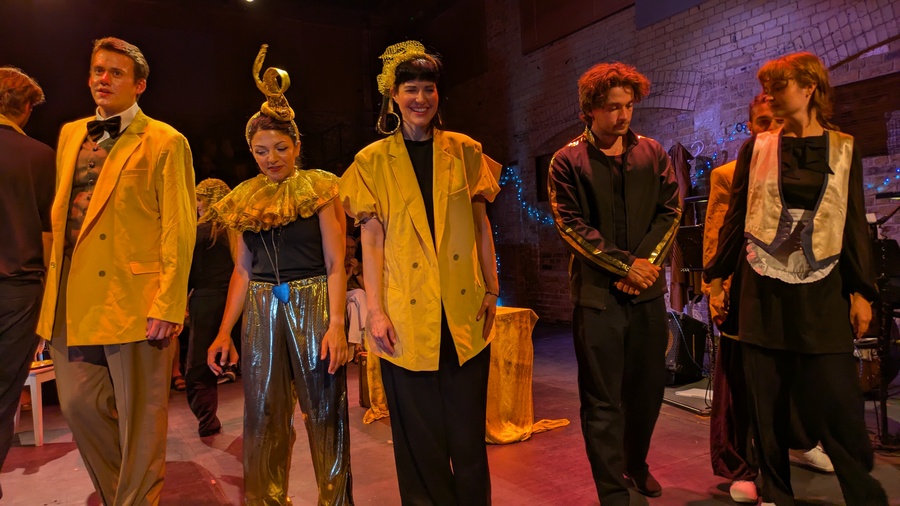
Joel Robson (Don Alfonso), Mahtab Ghmsari (Dorabella), Katerina Oikonomou (Fiordiligi), Bartosz Thirde (Ferrando), Ruby Caddick Laurence (Despina) in Cosi Fan Tutte. Photo Credit: Simon Jenner
Dorabella (Mahtab Ghmsari on this occaisonal at other times, Ilona Nastase, here part of the ensemble too) is quicker to fall for the other lover, Fiordiligi. Who shocks Guglielmo with his quick triumph. Guglielmo though has a tougher job with Fiordiligi: Oikonomou and Castellino inch towards each other with a kind of vocal pain. Oikonomou surrenders slowly. The contrast sin singing are lyric (Ghmsari darkly mischievous too, with Thirde notably warmed and surprised); and with Castellino and Oikonomou , tensely dramatic.
The glee in the men, about to lose their bet and prove the women they love unfaithful seems particularly to prove it’s the men who delight in all doing it. Castellino’s triumphant, Thirde notably more conflicted.
Ruby Caddick Laurence’s Despina as the soubrette maid is as raffish as Castellino’s Guglielmo and as cynical as Robson’s Don Alfonso, and makes a compelling case for maid liberation and sing with point and verve, not without her own romantic longing: perhaps most of all for hot chocolate. To the shocked sisters she asks with Da :Ponte: “why can’t a maid have two admirers?” Her complaints that she’s never allowed to taste the hot chocolate she makes, only smell it are given amplitude, weight and props. Da Ponte is being both stereotypical and revolutionary; allowing the maid legitimate sexual desires as much as the privileged sisters. She sings with a flexible light soprano that provides a fuller mezzo on occasion. Her alternate Zara Donaldson also sounds promising in the ensemble, like the other alternates.
Surtitles, despite excising names, are exemplary and translations clear and idiomatic, never overloaded. A little delayed synching isn’t intrusive.
With Miller’s premiss, one can imagine a far more radical ending than the one we get over two hours, which may not be a bad thing. The lovers actually swapping, or the women rejecting their suitors. This doesn’t happen, and one’s left with unfinished business perhaps. Nevertheless, a brave step though towards realising the uneasiest of Mozart’s great operas. Barefoot have allowed us to see it up close and ask questions of patriarchy, sexuality and the legitimacy of multiple desires. The singing is wonderfully fresh, the musical direction sparky and solid. Here’s a great chance to see up-close and classical some stars of tomorrow. Despite other slight reservations, highly recommended.
Vocal Consultant Penelope Randall Davis, Movement Director Alexandra Baybutt, Costume Designer Wendy Oliver, Stage Manager Eric Moll, Assistant to the Music Director Boaz Johnson, Assistant Movement Director Maya Dagan.
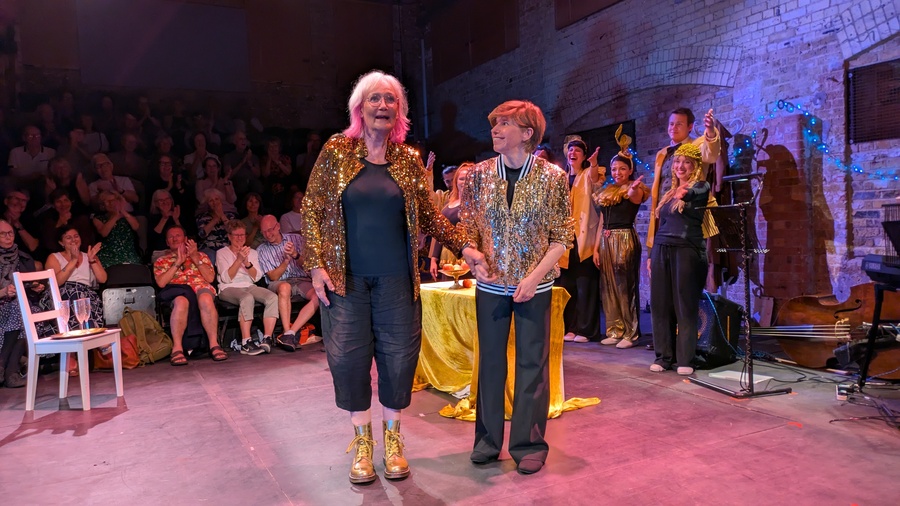
Lesley Anne Sammons, Amy Baldwin and Company in Cosi Fan Tutte. Photo Credit: Simon Jenner