

Review by Simon Jenner, July 11 2026
★ ★ ★ (★)
A fugitive childhood with one parent vanishing. A wild adolescence with mushrooms and a friend who burnt with an incandescence that couldn’t last. Colin Hambrook’s an extraordinary artist and poet. His poetry volume Knitting Time (Waterloo) acts as a prelude to something here that addresses traumas he’s offering not so much for himself, but for the many with whom he has worked. With Nikki Kenward he premiered Unknitting at the niche studio of Anita’s Room, Brighton Dome, on July 1. It will return enhanced and expanded.
Hambrook’s prominent at Disability Arts Online (an Arts Council-funded National Portfolio organisation), of which he’s editor and director emeritus. He has also been involved over the years with Survivors’ Poetry, of which he was a founding member back in 1991.
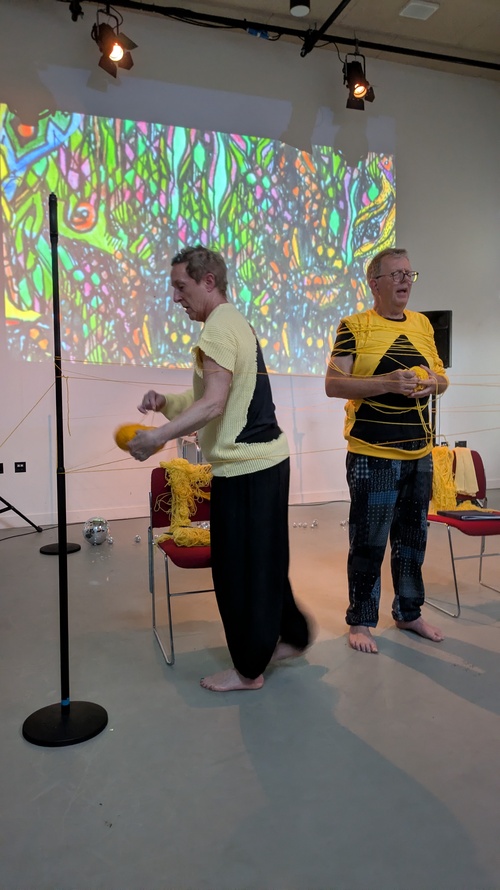
Photo Credit: Simon Jenner
Unknitting the Days, a creative collaboration and artist residency project is a first theatre piece. Hambrook developed the work alongside physical theatre director and performer Nikki Kenward at Anita’s Room inside the Brighton Dome. It’s a space geared towards research and development. So a privileged few witness the first iteration of what will become special, tender, fierce and ultimately transcendent storytelling.
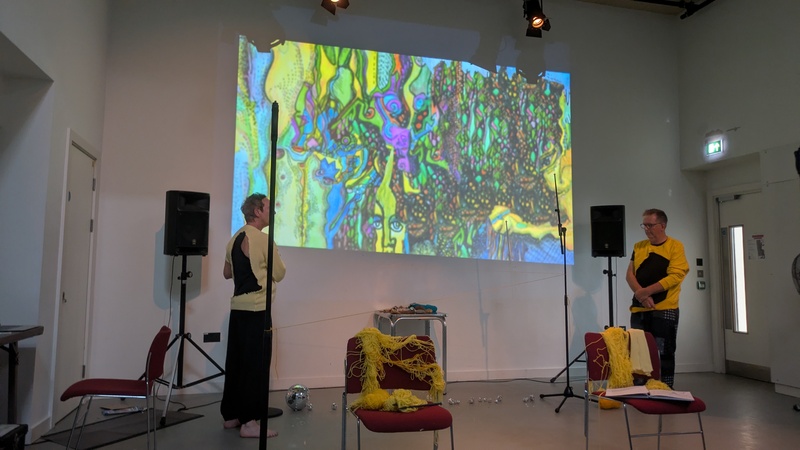
Hambrook is a poetry reader rather than theatre performer, but his collaborator Nikki Kenward has created some entrancing, haunting and extremely colourful theatre business. This is split with vivid backdrops, of Hambrook’s own artwork; and a variety of tender theatre games, un-skeining wool, and clothing; one of the colour predominating is yellow.
Hambrook’s narrative is split. The firs concerns the disappearances of his mother, told from an anxious child’s point of view. Hambrook weaves round his mother played by Kennard, with a series of question-marks. Why does she suddenly vanish, and what happens to her. Kenward has created a literal maze of wool threads emblematic of the poet’s and artist’s mind, his illustrations and of course resonant of the kind of confusions that made that creative force what it has become. Kenward is dropping a virid marker colour in the slow unfolding of Hambrook’s mind, and we watch as it curls in on itself, and expands.
The language used is both hesitant and resonant, the maze intensely watchable and currently quite slow. Kenward takes time to ensure both actors move at the same pace, and in time this will accelerate. The theatrical moments, of laying out discoveries and small objects becomes an act of tremulous remembering, and against the siege of oblivion. Images – like Hambrook’s own paintings and drawings – etch themselves on the viewers’ memory.
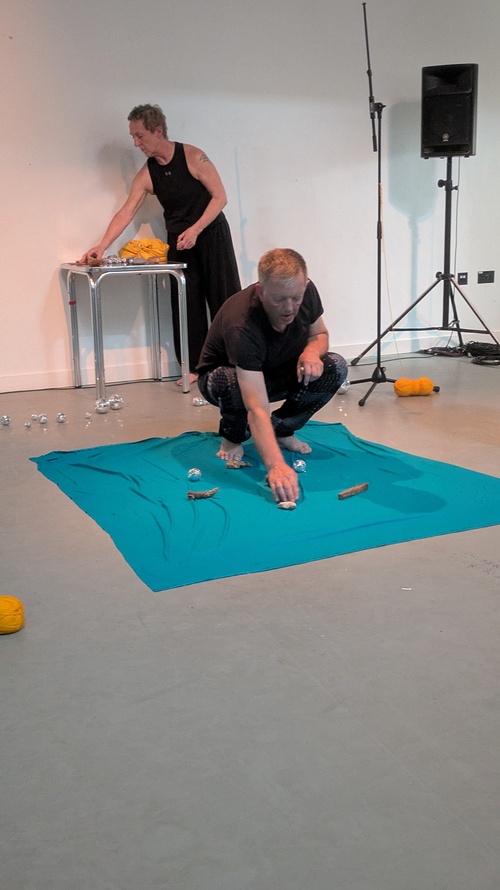
Photo Credit: Simon Jenner
The second narrative floats in after several images light up the blank wall behind. A remarkable friend of the young Colin introduces him to a vast array of books, existentialism, squats, drugs, love and political radicalism. This was the late 1970s and early 1980s. All this is told in brief spurts of fire, though mainly we’re still engrossed in a trance-like state, with as yet less tempo change than might work here: it needs to be a more up-tempo half.
As yet the division between the two narratives is numinous, and perhaps for the moment that’s how it should be as the work takes on new tensions and material however – it only runs to 38 minutes – this might suggest a more impelling separation.
There’s moments of wonder, as both the young Colin’s mother and his friend get him to gaze far out. there’s a touch of the visionary here; and Hambrook’s superbly abstracted patterned work flashes across like a psychedelic Blake in its colour values, though shorn – here at least, not elsewhere – of the human form.
Hambrook has shown enormous courage in detailing the two people who made and unknitted him emotionally and psychically. The reveals of his mother’s incarceration slowly shatter over the space of telling. His friend’s meteoric explosion as a rocket that ha to explode suggested with a few strokes. This narrative in particular will need a more painfully crisped end. This is a work of acute psychic disturbance and overcoming. We should let it unfold as it compels. For the audience it already has. For a wider one, its time, and its expansion, will come.
Highly recommended on its return, like Halley; though more rapidly!
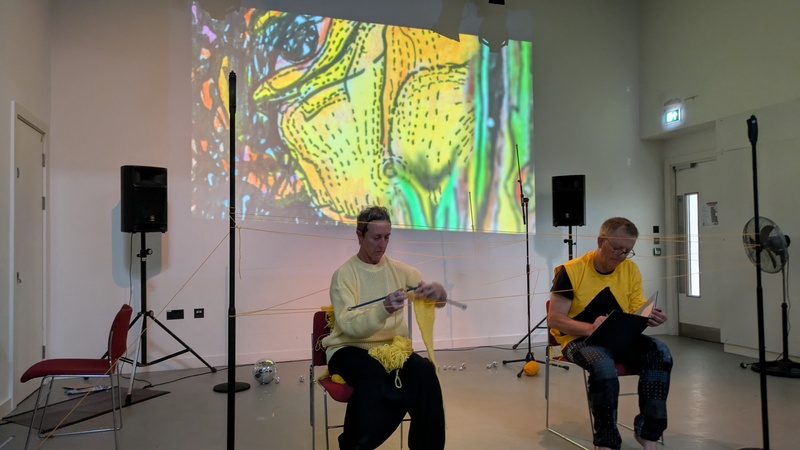
Photo Credit: Simon Jenner