

Review by Simon Jenner, May 18 2026
★ ★ ★ ★(★)
The Royal Court’s celebration of 70 Years, studded with terrific premieres like Guess How Much I Love You? and John Proctor is the Villain, continues with another revival. Last year it was Sarah Kane’s 4.48 Psychosis, with original cast and creatives re-enacting the premiere 25 years earlier. This time a play premiered 68 years ago is paired with a 19-year-old’s work premiered last year. Leo Simpe-Asante’s Godot’s To-Do List directed by Aneesha Srinivasan, preludes Beckett Krapp’s Last Tape Royal Court directed by Gary Oldman, originally staged at York Theatre Royal. If 68 years means the original actor of Krapp’s Last Tape isn’t available, Oldman himself returns to the Court after his last appearance there or anywhere on stage, 37 years ago. The double-bill plays Downstairs till May 30, running overall for 75 minutes. And the whole shows opens with the venerable “We Three (My Echo, My Shadow, and Me)” elegising a forlorn love-affair. More Krapp than Godot.
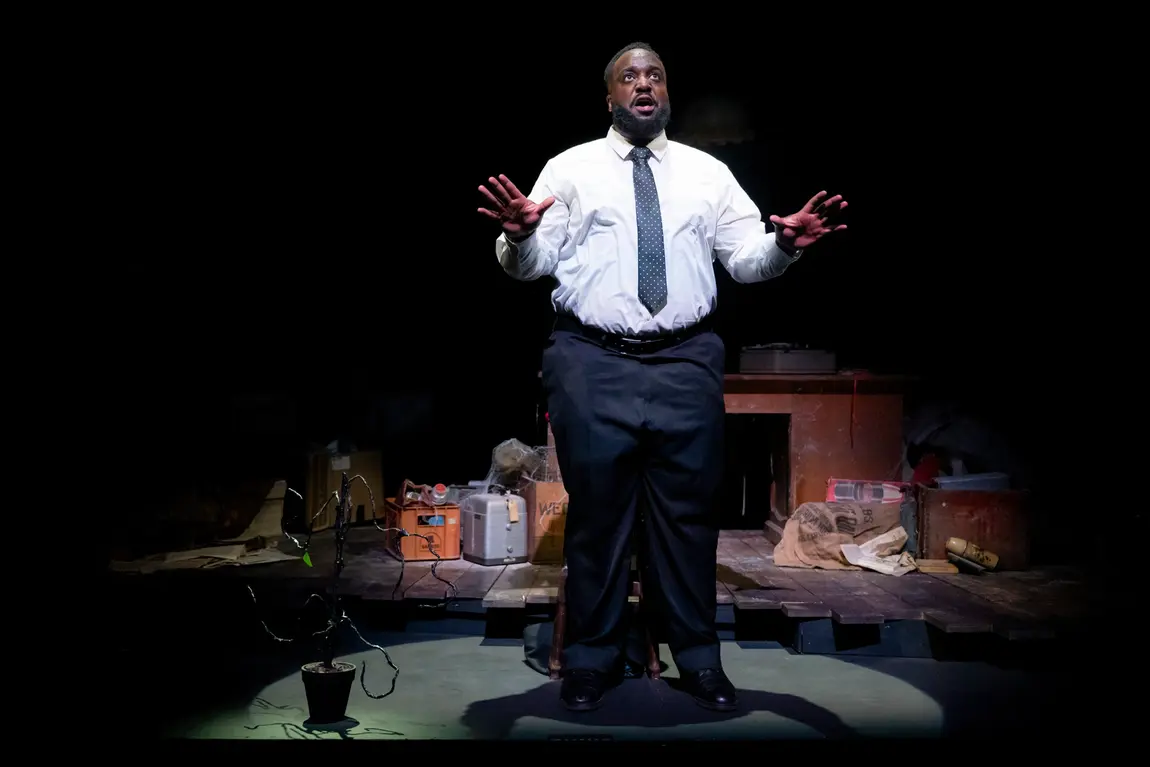
Shakeel Haakim in Godot’s To Do List. Photo Credit: Camilla Greenwell
Godot’s To-Do List
Winner of the theatre’s inaugural Young Playwrights Award ( Simpe-Asante was 18 when he won it last year), Godot’s To-Do List inverts every Godot imagined. Interview-suited, trailing a bowler hat like his friends (though cleaner) Shakeel Haakim’s not anyone’s Godot but Simpe-Asante’s. Godot is a befuddled young man, not an authority figure.
In fact the real Godot is the almost-Alexa performance by offstage Flora Ashton: disembodied, spookily calm, a mix of Hal 90 and lift announcement. Who seems to have the drop on Godot. Who himself can’t (or Kafka-like imagines he can’t) leave till he satisfies her demands. This is to complete a never-ending (or spooling) list of tasks. There’s “take a breath” or “piss yourself” or “do the splits” or “work through your relationship with your father”. Or ”have an existential crisis” and the reverse.
If Estragon exclaims at the start of Godot “Nothing to be done” Godot has everything to do. It’s a neat joke and there’s other parallels in Simpe-Asante’s ratchet of existentialism. Especially when considering carrots and fingers, a particularly visceral joke. To a series of pings (for “tasks successfully completed” to a boing for not, in Marie Zschommler’s sound design, it’s like NLP as torture.
Lit by Lucinda Plummer, just enough of the downstage set pools, with a small desiccated tree placed in a plant pot at Haakim’s feet. What emerges as Haakim both comically and painfully confronts the voice, might be existential. Certainly Godot coerced to existential crisis under duress, kicking all the way under the appearance of farce. Most of all, even if having to end on a bit of a quiet chord, Simpe-Asante’s a naturally theatrical writer – this just about sustains its 25 minutes. And that theatricality and jokey, jerky power might be where he goes next.
Godot’s To-Do List is also a clear comment on authoritarianism and privilege, profiling and not knowing the rules you’re being judged by. Nostalgic duffle-coated Fifties existentialism this ain’t. At a time when juries aren’t being told what hidden charges accused protesters are being tried under, where even defending council can be sued for invoking an enshrined 1670 law, this is now. Simpe-Asante’s next work might also be hard-hitting, and we won’t be smiling the same way.
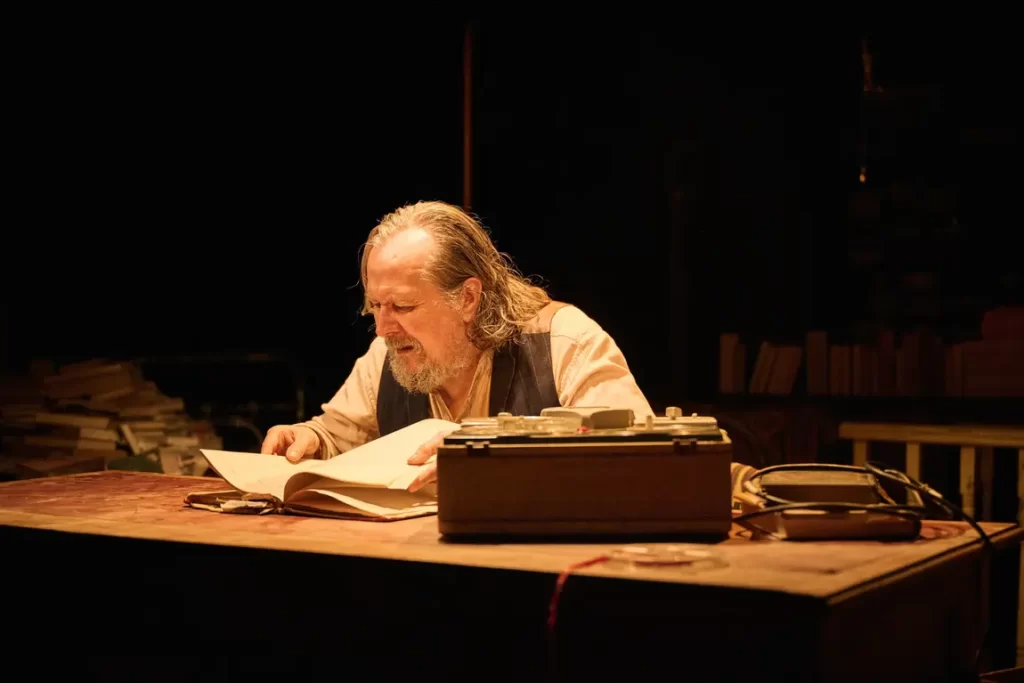
Gary Oldman in Krapp’s Last Tape. Photo Credit: Camilla Greenwell
Krapp’s Last Tape
Repeated experiences of Beckett’s Krapp’s Last Tape tends to shrink it like a white dwarf, smaller and more concentrated each time. It’s distinctly the case as Gary Oldman takes the part created in 1958 in this space for Patrick Magee – with his uniquely flint-edged tenor range and gravelly warmth.
Max Wall in 1988, aged 78 produced a skirling, wildly physical version with Beckett’s approval, yet taking his time. Jumping a few Krapps, for a while the comedian’s sliver of Beckett was emphasised (the 2009 Godot a highpoint). James Hayes too took on a touch of that vaudevillian glint in his Jermyn Steet traversal in January 2020. By the time Gary Oldman transferred from York to the Royal Court, a rather more traditional reading seems to have returned.
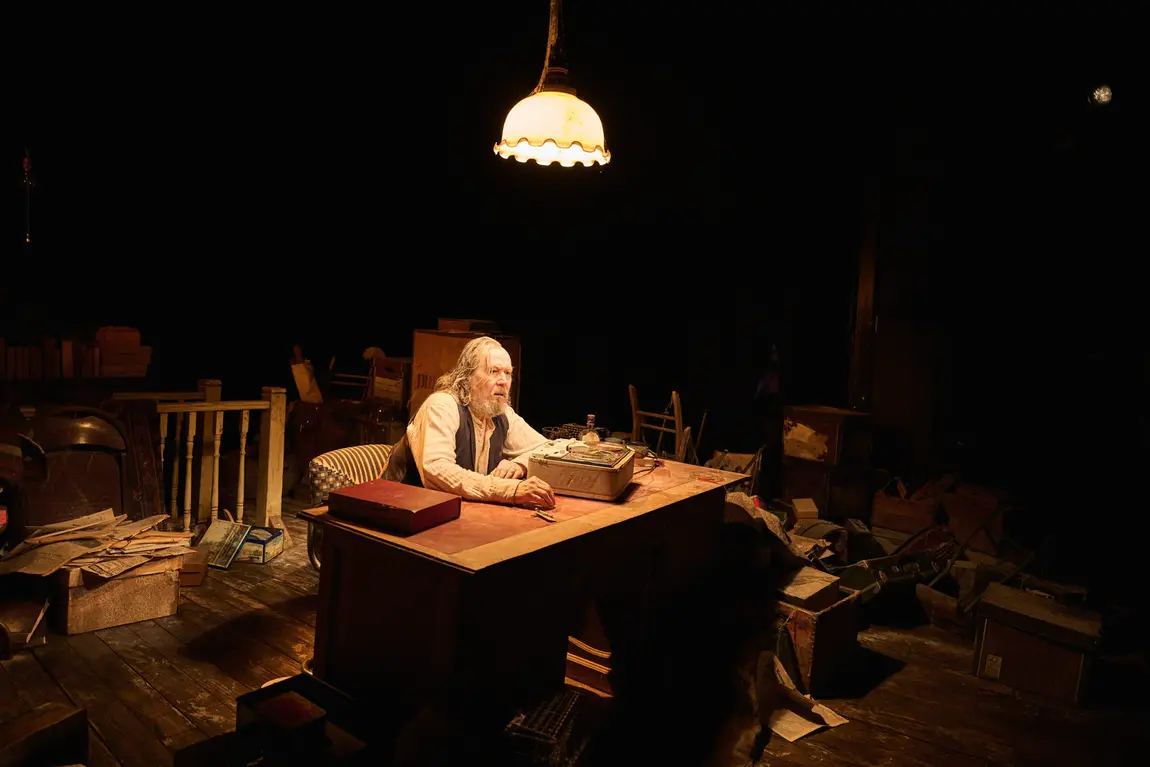
Oldman’s director and designer too, though the costume by Guy Speranza hangs about Oldman like an extension or apotheosis of the attic jumble that’s somehow connected – you might say spooled – round Krapp. Oldman’s active from the start. If active’s the word: it’s understated, incremental. He doesn’t draw out the opening as some do. This is the least theatrical Krapp I’ve seen. Here though, in a cluttered space with the writing desk centred,, all round the detritus of a life, boxes, jumble together, the hoarder’s attic mountain. It’s not simply tapes but the scurf of 69 years. The last point of glimmer is the tape-recorder, hauntingly lit by Michael Rippeth,
This is sci-fi Beckett. Beckett briefly notes it’s “A late evening in the future.” To take that with Beckettian literalness: a man of 69 with at least 42 years of tape perhaps about 2000, stubbornly still using a 1950s reel-to-reel to Millennium fireworks.
Last tape? It’s never explained but last – as in previous – is part of it. Krapp’s splicing perhaps like a ancient DJ remembering a turnstile in a retirement home; and his choice is thirty years old. Sound designer Tom Smith and Oldman have brightened the younger voice, despite its low tessitura. So the current Oldman gives a ruminant yet occasionally flute-voiced raspy performance; a little fizz of energy, a precise vocal register.
So Oldman’s “spoooools” is never indulged but brightly sings out, undercuts the gloom. In the same way the 39-year-old Krapp tweaks his own pomp with a single qualifier. So he’s at the “crest of the wave – or thereabouts.” He then chastises a still younger self we don’t hear. But if the 69-year-old glosses that as “the stupid bastard I took myself for” he now has to look up “viduity” then changes the definition into a bird. Both judging and being judged by his former self, as memory and regret mix with forgetfulness imperfectly stirred.
Oldman cuts back on the encoded pratfalls: unpeeling and eating a banana twice he avoids the usually religiously-observed nearly tripping over the skin. He plays with a third (and with us), desists. Later he discovers a dessicated banana; fruit as it were of another discarding. Uniquely, the jumble replicates Krapp’s mind, and as he tosses bananas or tape-boxes away they’re literally lost in the piles of memory. Spooled or not. There’s eating your masculinity, despite Krapp’s vaunted sexual performance recently, and his 39-year-old taped self, resisting with difficulty eating a third despite his “condition”.
There is still though a wild freedom in being so encased in “four or five” paces as one wildly latitudinous direction has it. The frustration as Krapp sweeps away boxes on his desk is with Oldman an isolated, garish eruption; rather than part of a general glowering. He is literally beginning to drop out mentally like a decaying tape; break up.
Krapp re-inscribes his life with its previous meanings with that relished “spooool” (aerated and clipped here) but he’s been pushing himself to the side of his own life by playing back memories with an ever-increasing supply of years to choose from. And isn’t that a metaphor for what we do anyway? As we age – if we’re not careful – we re-encode the cut memories and false commands that condition us into a rictus of habitual self-parody. Krapp is us, with a techno-tic. His name evokes the fundament in the fundamental, not to mention he’s a failed writer, with copies of his book “seventeen sold, of which eleven at trade price to circulating libraries overseas. Getting known.” There’s that ironic glint of affirmation you can never entirely dismiss.
Oldman accents statistics too – something intrinsically Beckettian. Beckett’s extreme logic is the outcome of any vaguer summing-up. It’s replete with his fixation on his affair: “head between her breasts.. my hand upon her” which he revisits with an onanisitc wistfulness. And – recalling his Trilogy – desire arises for a nurse whilst visiting his dying mother in a nursing home, though her “chrysolite” eyes damn him.
But Krapp’s conclusion is brought out with Oldman reflecting on the tape over past years even then. Krapp’s 39-year-old self affirms: “Perhaps my best years are gone. When there was a chance of happiness. But I wouldn’t want them back. Not with the fire in me now.”
Several have noted Oldman’s performance has deepened since York, a performance I didn’t see. I also missed Stephen Rea, who actually taped himself at 39, a feat no-one is likely to equal. Oldman’s contribution is hyper-attentive, with a voice as grained as the drop-out on old tapes. Despite wonderful arioso moments as his voice lightens, he reins in the devilish glee that Magee would have brought; or that Wall or Hayes managed. It’s a performance of lessness writ large: a man shrinking from his environment, with a hint of Ionesco’s The Chairs hounding him, the memories taking over and kicking Krapp’s mere organic matter out. Each performance I’ve seen seems to make this work briefer, less epic, more graspable. Yet the text runs to just nine pages. Perhaps we’re getting it and Krapp’s Last Tape spools ever swifter in our imagined replay. Oldman joins the voices.
Godot’s To-Do List
DSM Nikita Bala,
Krapp’s Last Tape
DSM Nikki Colclough, DSM Laura Burgess, ASM Anja Bryan-Smith.
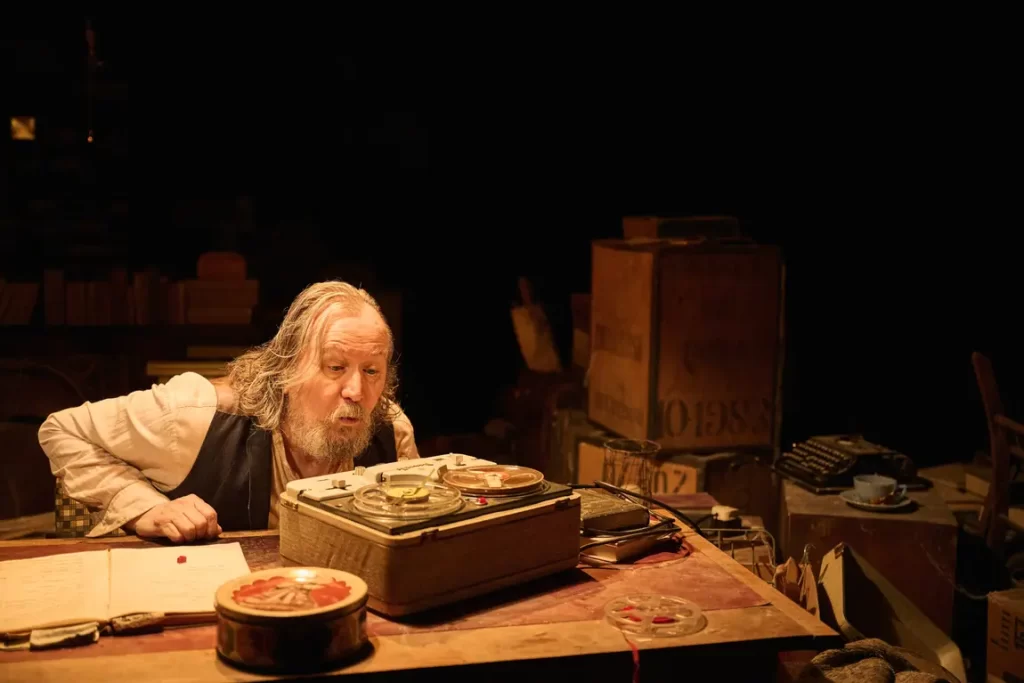
Gary Oldman in Krapp’s Last Tape. Photo Credit: Camilla Greenwell