Review by Simon Jenner, February 13 2026
★ ★ ★ ★
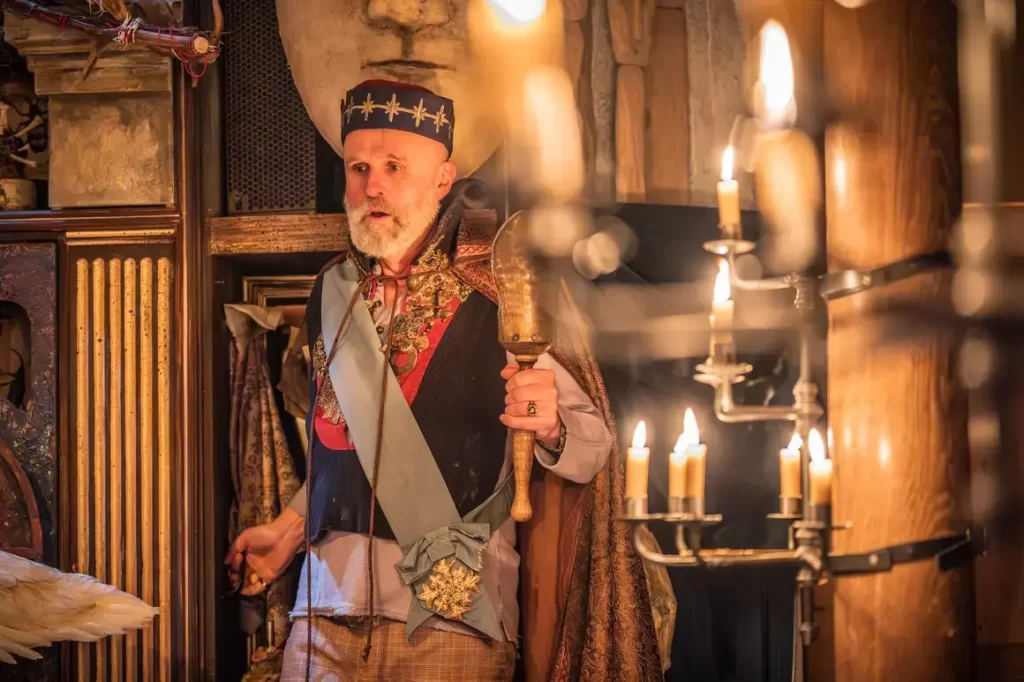
A family of four congregate on the Wanamaker stage. One, Ariel, is knitting. A nuclear family it might be, but this is Tim Crouch, who tends to turn anything nuclear inside out and demonstrate the reactions. He directs The Tempest with himself as Prospero at the Globe’s Wanamaker stage till April 12. From An Oak Tree to a cloven pine isn’t perhaps too much of a jump, by way of Crouch’s other best-known piece, I, Malvolio, performed memorably by Crouch in this space.
The most bewitching element annealing the whole two-and-a-half-hour production is Orlando Gough’s music, mostly sung by Vocalists Emma Bonnici and Victoria Couper. There’s spaces for this, emerging from the audience and ones unlooked-for in the galleries. Shakespeare’s songs are broken and uttered, swung, most of all chanted in an unearthly tessitura any Ariel would recognise. It’s the most imaginative use of music I’ve heard in the Wanamaker quite apart from its rapt quality. This isn’t all. Caliban (Faizal Abdullah) particularly, but also Ariel (Naomi Wirthner) speak in displaced tongues, an experience Abdullah has talked about. It grounds Caliban as someone whose sense of language – rapidly inflected when off the bardic leash – wasn’t wrought by Prospero. Who himself here is also a usurper of an island, much as his princedom in Milan was usurped. The lash goes on. To break up Prospero and others, the quartet take up his speeches in turns. So occasionally the characters like Miranda address themselves. Crouch’s Prospero is by turns beguiling and slightly unhinged in his rage.
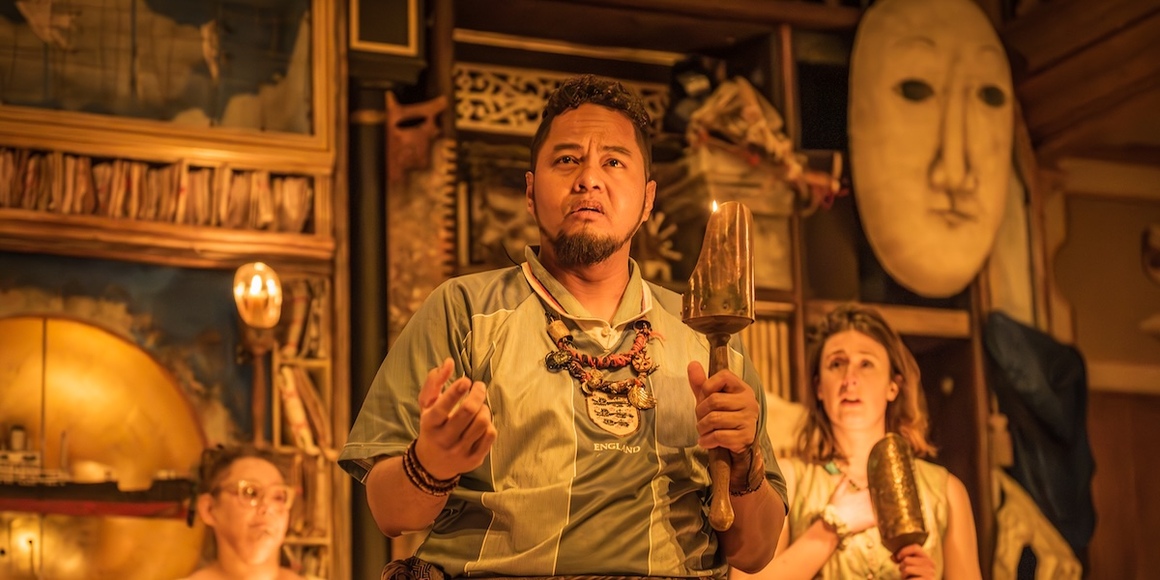
Naomi Wirthner, Faizal Abdullah, Sophie Steer. Photo Credit: Marc Brenner
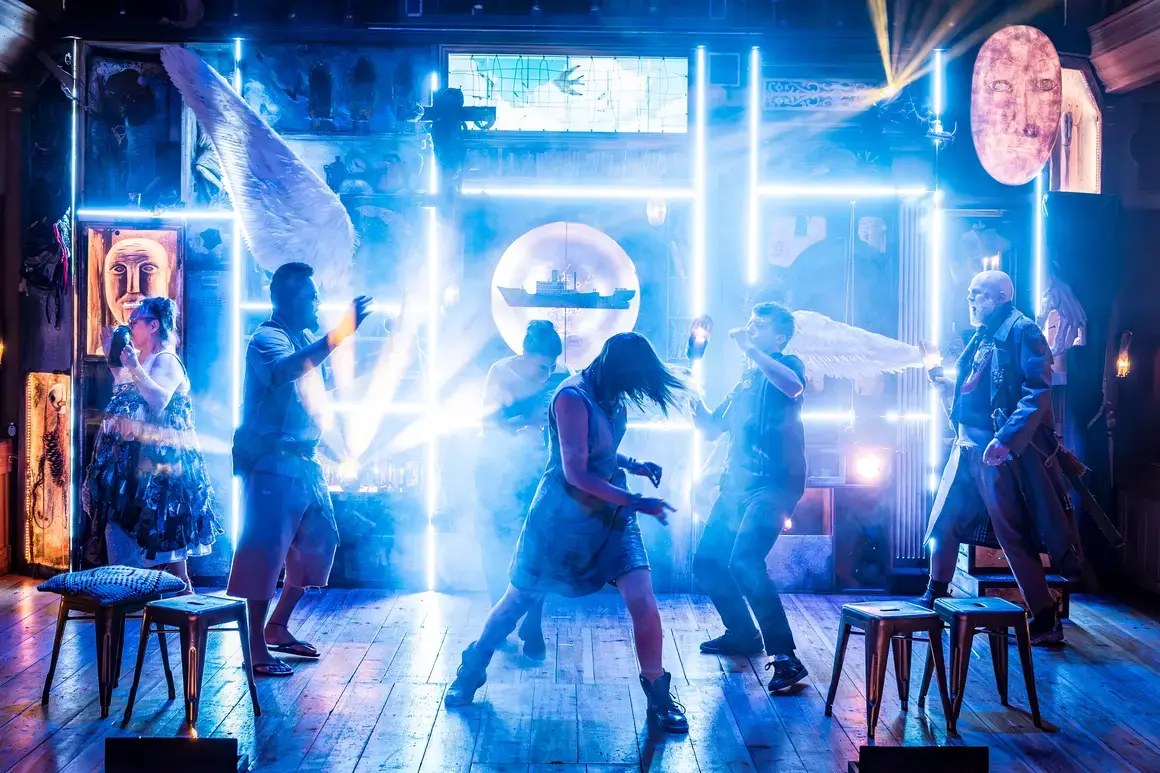
The quartet completed by Miranda (Sophie Steer) begin with preset theatre business and stillness, and end much the same way. In between others gradually populate scene by scene, often from the audience, and melt back again with apologies when that scene’s over. You might even find one whispering next to you it’s the interval and it’s good to clap now. Designed by Rachana Jadhav the set’s far more than the bric-a-brac onstage, with an upstage rich in a revolving image of a modern tanker, hieratic heads from a colonised world and lighting effects particularly in the masque scene recalling the exceptional RSC Tempest of 2017 in miniature. It’s naughty of course, as Anna Watson’s candelight design is both active (lowered at the end of each half) and adopted in individual lamp moments. But certainly nice.
How much of Crouch’s interjections disrupt Shakespeare it might be more than one spoiler to list. They’re funny and no-one is exempt. Crouch deploys the familiar quartet after starting with the second scene with Prospero and Miranda, to comically then more theatrically enact the opening tossed-barque one, pitched queasily between comedy (particularly Steer who warms to her role) and drama. This performative storytelling will be familiar to anyone who knows Crouch, and inlays the plot with a recession and slight alienation from the one story we’re here to witness. That’s in part Crouch’s point: to deconstruct The Tempest’s colonialist themes, done so often that a new way is needed. Crouch has already supplied this in the way Gough’s music setting and other languages throw the text into new shadows. As well as throwing the text about. Crouch naturally can’t leave it there.
There are moments though when he lets Shakespeare speak. In part when Ferdinand (an appealing Joshua Griffin, cosplaying a volunteer usher on occasion) meets with Steer’s ardent and forward Miranda, a role she relishes when given more than a few uninterrupted lines. Yet Crouch – touchingly – allows no touching, except once, of hands. That recalls the period and it works here in a production of gesture and (in part) restraint. Even more, the courtiers are mostly left alone, so the eloquently troubled Alfonso (Jo Stone-Fewings, superbly clear and genuinely anguished) contrasts with scornful Antonia.
This is Amanda Hadingue, by contrast disdaining her role, critiquing it as a Telegraph reader, just the kind of person Crouch believes would launch a coup: she enjoys some of the best laughs of the performance and launches a couple of coups on the audience too. They’re contrasted by suave Davos-suited Sebastian (Colin Michael Carmichael, smoothly persuaded) and a magnificent Gonzalo (Tyrone Higgins), whose gentleness and eloquence is supported by the gravitas of his utopia and the feeling he elicits at the end, making him often the heart of this production.
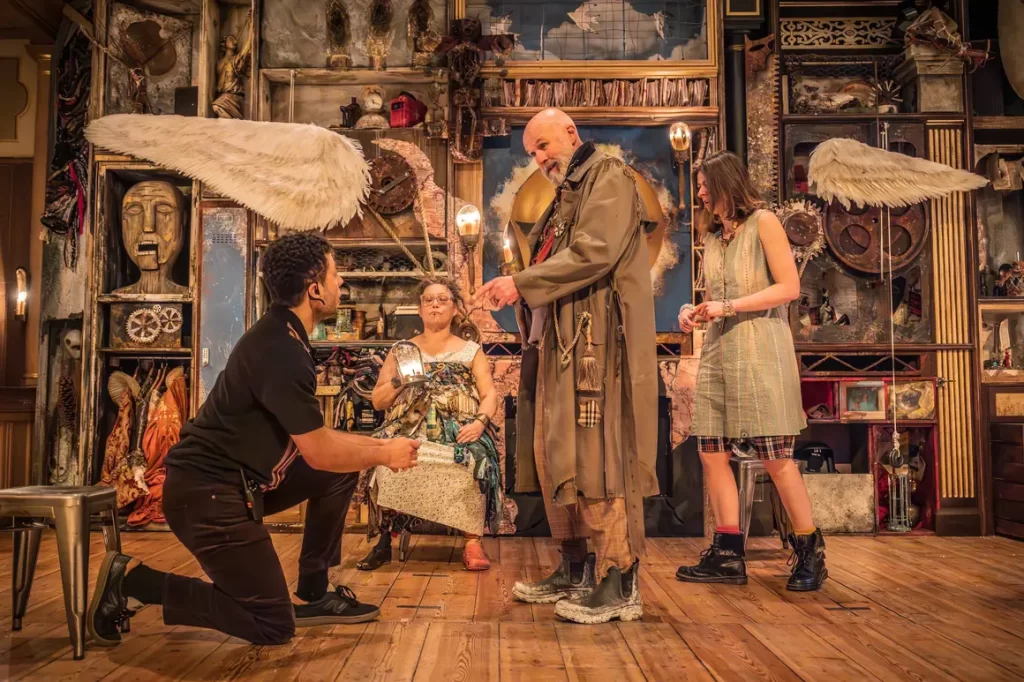
Joshua Griffin, Naomi Wirthner, Sophie Steer. Photo Credit: Marc Brenner
Crouch invites this, as he himself holds off, a chillier Prospero than many. When he banishes the spirits he roars at Ferdinand (as if Ariel’s recalling the plots to Prospero was something Ferdinand might have anticipated); and doesn’t deliver the following consolatory speech. Though wait.
It’s also where Wirthner is able to assert Ariel’s individuality, one of equal heft and considered speech: there’s no fleetness here but a patience and slowly-simmered wrong, showing more regality in her forgiveness, so Crouch’s Prospero in his “then I shall” is gently tutored (if there isn’t that magical pause Roger Allam deployed).
Abdullah’s Caliban enjoys the same with his charges, even if his great speeches are often broken up in front of Prospero (whilst he’s plotting against him, so you begin to think invisibility cloaks). The double-act of Catalan-inflected clown Trinculo (Merce Ribot) and drunken butler Stephano (Patricia Rodriguez) enwrapped in hats and often rushing offstage is self-contained too and works as relief.
Crouch echoes the Globe’s previous 2022 Tempest, transposing Prospero’s famous Act IV speech to the end and omitting Prospero’s final one. It’s as if the directors here think the most famous speech should be reserved till last to cap everything, when Shakespeare might have known a thing or three. The effect is for Prospero to turn from direct appeal to the audience in his plea for release, and leave not a wrack behind, perhaps coiled in a cloud and unforgiven. In 2022 he stumbled off broken. Here by contrast Crouch’s Prospero remains hieratic, aloof, unreleased from his colonial stance and not seeking indulgence, still less forgiveness. Several new strands in Crouch’s production might have moved to something special; which he mars by too much deconstruction. It’s almost as if Crouch has a reputation as disrupter and lord of postmodern misrule to keep up. It’s still hugely enjoyable. Yet Gough’s music stamps this production, and makes the pulleys of reinvention sing despite themselves. For that and the sweep of decolonised languages, a must-see.
Associate Director Justina Kehinde, Voice &Text Annemette Verspeak
Scenic Artist Emily Carne, Costume Supervisor Jackie Orton, Voice Gary Horner
Stage Manager Martha Mamo, DSM Rike Berg, ASM Camila Hoyos Stuttle, Stage Management Placement Olivia Gillespie
Globe Associate – Movement Glynn MacDonald, Head of Voice Tess Dignan, Head of Production Wills, Head of Stage Bryan Paterson, Head of Wigs, Hair and Make-up Gilly Church, Head of Wardrobe Emma Lucy-Hughes, Head of Company Management Marion Marrs, Head of Props Emma Hughes, Senior Technician George Dix, Stage Supervisor Faz Kemp. Casting Director Becky Paris CDG. Producer Ellie James (Globe).
Tim Crouch. Photo Credit: Marc Brenner