Review by Simon Jenner, February 6 2026
★ ★ ★ ★ ★
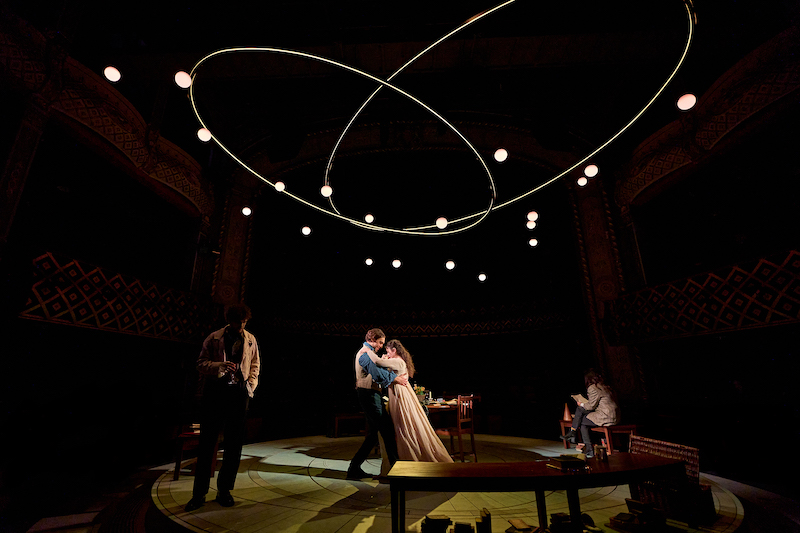
With Tom Stoppard’s recent death the Old Vic’s upcoming Arcadia became a poignant event; the first opportunity to reassess his posthumous reputation. Look no further. Here directed by Carrie Cracknell till March 21, is the real thing: a near-flawless production, Alex Eales’ set daringly in the round, and in Isis Hainsworth a Thomasina Coverly we’ve been waiting for since Emma Fielding created the role.
This is though a luminous ensemble, who sing with the planets revolving as brightly above, lit by Guy Hoare. They shift, gleaming from moonstone to an ominous pink supermoon. Eales’ stage revolves with past and present characters brushing past each other around one spheric table as the planetarium stage-floor twirls; they ride love and chance like a carousel. Just four curved benches mark the outer stage, like the bounds of a known system already pierced by new discoveries. There’s a thrilling, almost vulnerable transparency. And humour. This might be Stoppard’s funniest play: there’s so much humanity for actors to pause with. Conversely the passionate speeches are about science, made by those achingly in love with their addressee. Though playing nearly three hours, just one further (minute) trim suggests itself. This production flies by; especially in the second half.
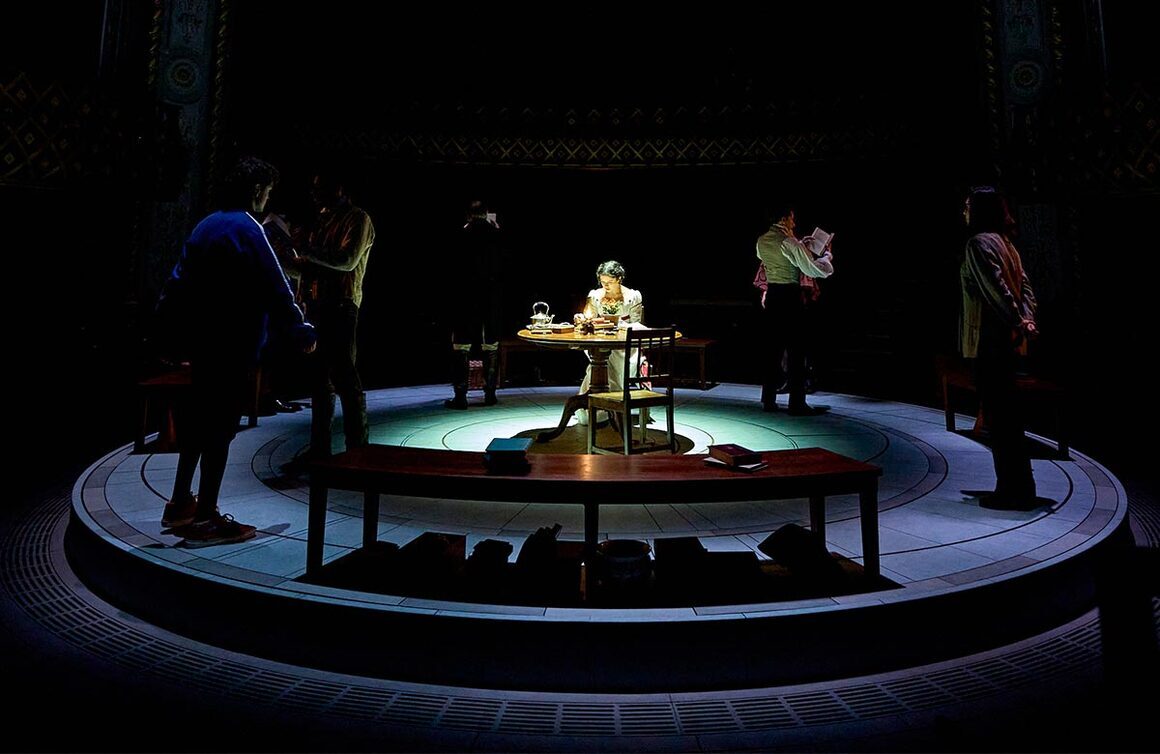
Leila Farzad and the Company. Photo Credit: Manuel Harlan
The Old Vic itself, mounting Rosencrantz and Guildenstern triumphantly in 2017, and The Real Thing in 2024, has been sieving Stoppard’s plays for a decade. The Real Thing this time seemed oddly dated, its debt to Christopher Hampton’s The Philanthropist clear and creaky. Stoppard’s “emotional” play seemed here strained, despite the cast. That term became redundant in 1993, when Arcadia premiered at the National Theatre. Its near-endless symmetries fascinate; and with Cracknell come across fresh and lucid. Fractals and love, mathematics and infatuation spanning centuries, Byron and bad bards, brash wannabe-media dons and feminist authors. They rub up like cats against the tortoise of aristocratic mores. Which go on hibernating.
In one sense the play’s dated into datelessness; so aged well. Set in 1809 and latterly 1812, and recognizably the then present-day 1993, Arcadia spans times of optimism. 1993 with all science thrown up from string-theory to fractals, with (“the end of “) history hurried into hibernation (surely not for Stoppard though), both were optimistic periods. Cracknell keeps 1993 with newspapers (remember them?) when ambitious dons made headlines. “It’s the best possible time to be alive, when almost everything you thought you knew was wrong.” I call that a thing of wonder, now.
Thomasina immediately spars with her arch tutor Septimus Hodge (Seamus Dillane) over the term carnal embrace and this joke – jumping through algebra – is exactly where Arcadia’s headed. Stoppard’s theme – that love is the one random in a determinant universe – is repeated. “Sex. The attraction that Newton left out.” And that Newtonian physics itself is breached by heat cooling. There’s unspoken parallels with Byron’s own daughter Ada Lovelace, who created computer algorithms. Hainsworth’s 13-year-old Thomasina is a similar prodigy, only she prefigures even later science. But again it’s declared to a future object of love.
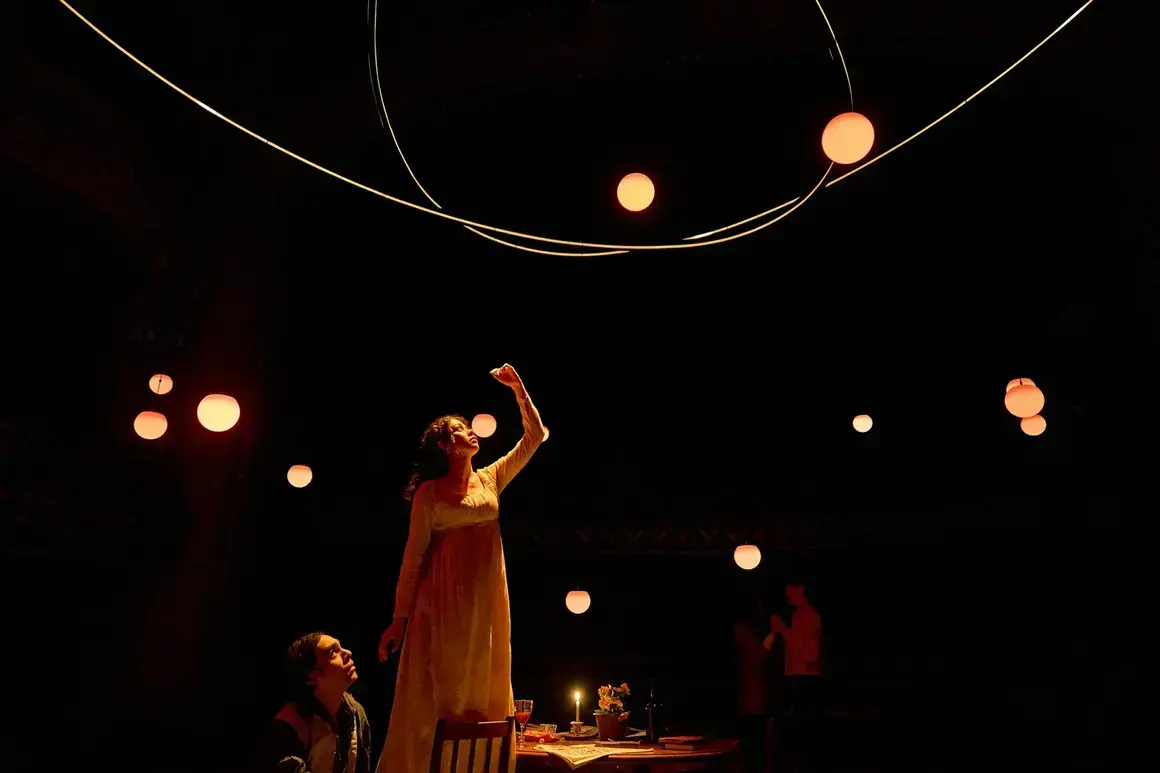
Hainsworth makes a wonder of the part as she reaches up at both the beginning and end poignantly, to harmonize those out-of-reach spheres. To Thomasina she brings the sudden lurch to tragedy or fury she brought to Hermia in A Midsummer Night’s Dream or later, Juliet. Here as teenage Thomasina she’s even more volatile, skittering joy through rage and heartbreak in three heartbeats. Yet three years on her Thomasina’s smoother, still impetuous yet poised; even a little dangerous. She and Dillane enjoy a sparky chemistry and their final scene, as Thomasina is about to turn 17, is breathtaking: the waltz flows with an irony and aching future. Ira Mandela Siobhan’s movement is everywhere exquisite, whether two couples in different times waltz round each other, with Stuart Earl’s classic-referenced music (Donato Wharton’s discreet sound is fortepiano or gunshots); or the larger ballet of two time-zones sashay the stage.
With a balletic spring, Dillane speaks more poignards than a Byronic swordsman, dealing roguishly with the affable poetaster he’s cuckolding, Ezra Chater (Matthew Steer, so twittishly quick to forgive anyone for praising him it’s embarrassing); or stolid Captain Brice RN (Colin Mace, all roast-beef glowering presence), brother of Thomasina’s mother Lady Croom, lover of Hodge and more, classical order. Fiona Button, suave in put-downs or flirting elegantly, draws out Dillane’s gallantry with equal aplomb so the words are having sex.
It’s a different dynamic with Hainsworth, where Dillane shows Septimus’s affection, irritation and despite himself, awe. It’s Button who continually puts down romantic landscape gardener Richard Noakes (an enthused yet buttonholed Gabriel Akuwudike) so elegantly you wonder why he’s there when Croom craves geometry. And it’s Dillane’s Septimus who makes a similar butt of servant Jellaby (Tim Francis, cannily positioned for half-sovereigns) till he needs him. That’s perfect symmetry but the chaos is love.
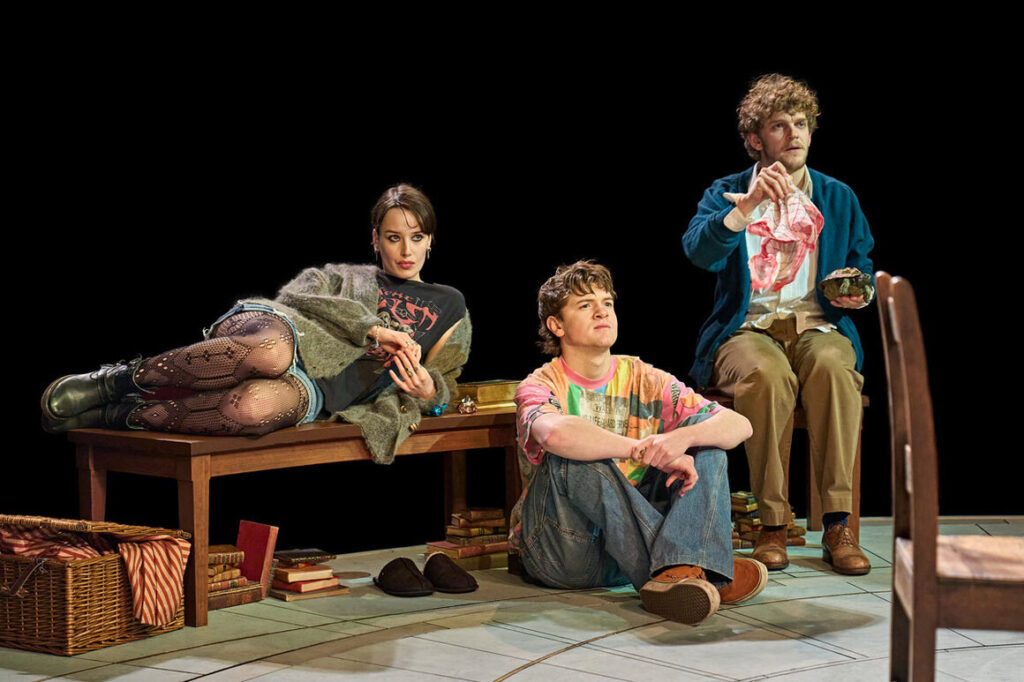
Holly Godliman (Chloë Coverly), William Lawlor (Gus Coverley) and Angus Cooper (Valentine Coverly). Photo Credit: Manuel Harlan
1993’s challenge is to engage as much. It nearly does. It takes a descendant to explicate the same concepts Thomasina glimpses to someone he loves. Valentine Coverley (Angus Cooper, his Val as warmly eloquent as he’s blasé, even arrogant) enjoys more tacit chemistry with Caroline Lamb scholar Hannah Jarvis (Leila Frazad, guardedly warm, laconically guarded) than she does with Bernard Nightingale (a magnificently bumptious Prasanna Puwanarajah). Puwanarajah is a random who introduces chaos (the plot abounds with chance collisions), chasing a Byronic hare so Valentine and Hannah jug the real prize.
Puwanarajah’s firecracker arrogance is the mirror of Dillane’s light rapier, and Nightingale’s brilliantly debased. Though Thomasina asks questions, and Hannah parries Nightingale, and daughter Chloë Coverly (a joyous Holly Godliman) chases him, it’s still men who get speeches; bar Frazad’s elegant rebuttals and Hainsworth’s sallies. No-one wants Bernard to win Hannah, so Puwanarajah’s and Frazad’s chemistry seems charged without the attraction. As it would be after “silly cow” and worse bestowed by a 70s anachronism as realised here.
Dillane’s Septimus telling Thomasina knowledge marches so “what we let fall will be picked up by those behind” is beautifully realised; and guyed by his farcical Shakespeare/North crib of translating Plutarch to infuriate her. A little later Valentine’s speech on fractals is also undercut by his dismissing that Thomasina could have thought of something before its time (so contradicting himself). Cooper manages to render Valentine appealing despite blinkers, his realisation that he’s wrong and Thomasina’s “iterated algorithms” have been coming at him from the opposite end. The delicacy of his youthful appeal to Frazad – tacit analogue to Septimus and 1812’s Thomasina – is potentially as important. With such whirling, it’s a pity Stoppard couldn’t develop it as far.
As mute latterday Gus Coverly, and Thomasina’s frolicsome younger brother Augustus Coverly, William Lawlor gestures eloquence; and in brief succession shows aplomb in a surprising waltz, standing in curiously for his brother, and a courtly bow. One fleeting witticism of Suzanne Cave’s period costumes at this point is where Chloë rushes in with period “Jane Austen” 1812 fancy dress which we see garish compared with what we’re experiencing. It extends the play’s conceit, which pulses more vibrantly. The clarity of Cracknell’s production clears Arcadia’s lines to feeling too, as manifested by this exquisite cast. A faint caveat over Bernard and Hannah notwithstanding, this is as bright as those waltzing spheres, warm as the filament Thomasina reaches for: outstanding.
Casting Serena Hill CDG, Voice Nia Lynn, Associate Director Anna Ryder, Props Supervisor Zoe Wilson, Costume Supervisor Peter Todd, Hair, Wigs & Make-Up Supervisor Dominique Hamilton, Movement & Intimacy Katherine Hardman for EK Intimacy.
CSM Ben Delfont, DSM Megan Charlton, ASM Pippa McLauchlan.
Seamus Dillane as Septimus Hodge and Isis Hainsworth as Lady Thomasina Coverly, and the Company. Photo Credit: Manuel Harlan