Review by Simon Jenner, February 6 2026
★ ★ ★ ★ ★
Strindberg for laughs? As laughter continually rocks the Orange Tree’s intimate space, you’d be forgiven for thinking Strindberg, like Ibsen, had written one play with a cheery ending. Tom Littler’s policy of inviting directors – this time Richard Eyre – to propose a play has meant two Strindbergs in five months. In September it was Creditors helmed by Littler himself, who’s directed more Strindberg than anyone else recently. After a year’s run and more of solid gold productions, it’s not even a risk to stage Dance of Death shortly afterwards, directed by Eyre till March 7.
Persuasively transposed from 1900 to 1918 during the Spanish influenza outbreak, nothing needs updating, though as in his revival of Ibsen’s Little Eyolf at the Almeida in 2015, Eyre makes the sexual simmering more explicit. Though by first night he doesn’t follow every salacious detail of his own direction.
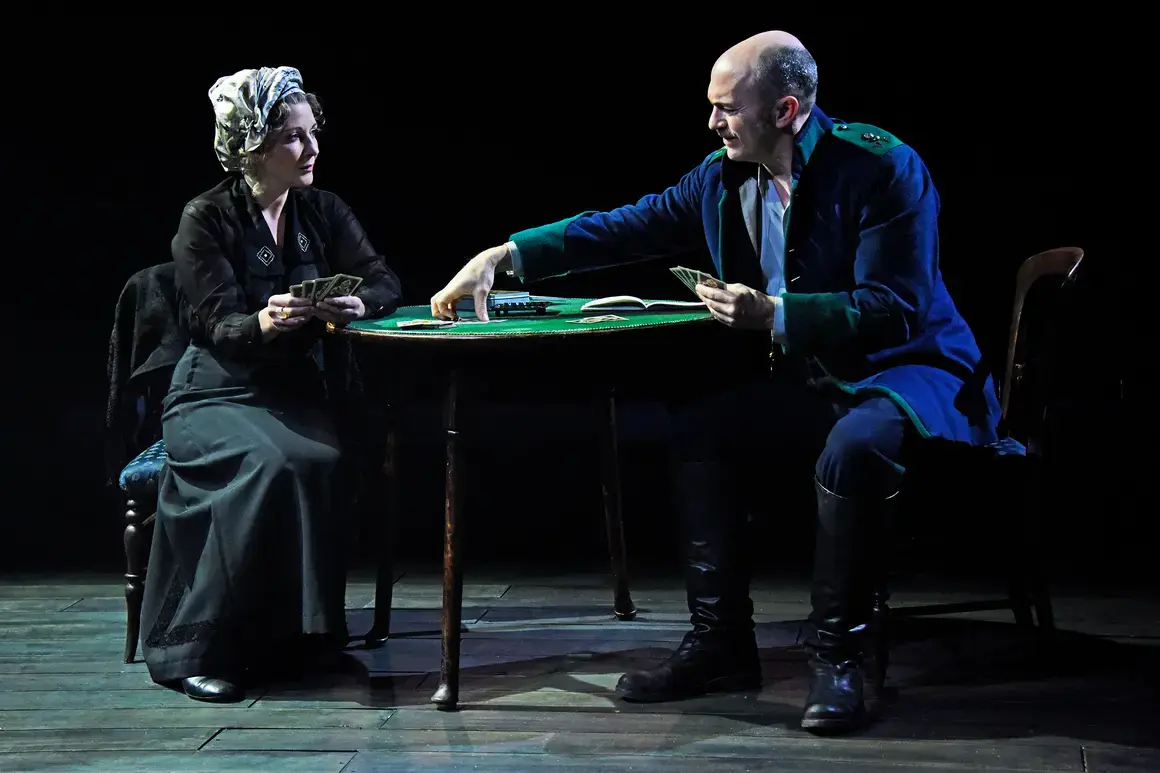
Lisa Dillon and Will Keen. Photo Credit Nobby Clark
With Littler’s help, perhaps Strindberg’s time has come – yet again. Like Kierkegaard’s storm petrel, in interesting times. Particularly though the Dance of Death. In 2022 the Arcola’s Dance of Death in a version by Rebecca Lenkiewicz toured. In 2023 Norway’s Nationaltheatret played at the Coronet, with an existential ferocity that remains unmatched in versions I’ve seen. Days later Radio 3 broadcast Conor McPherson’s version.
In Eyre’s own translation, there’s more air and light – with expletives and heightened humour. It’s an atmosphere reflected in the staging. Peter Mumford’s lighting steals in murky afternoons, deceptively bright mornings and claustral dawns with a ruthless piercing through one door of two. The air, unusually, includes an interval two-thirds through, meaning the play runs two hours; tension is relaxed just slightly. More viscerally, the air blasts those doors open as storms rage. Several times. Overhead and around the balcony, a glowering cerulean-blue glimmers the seascape.
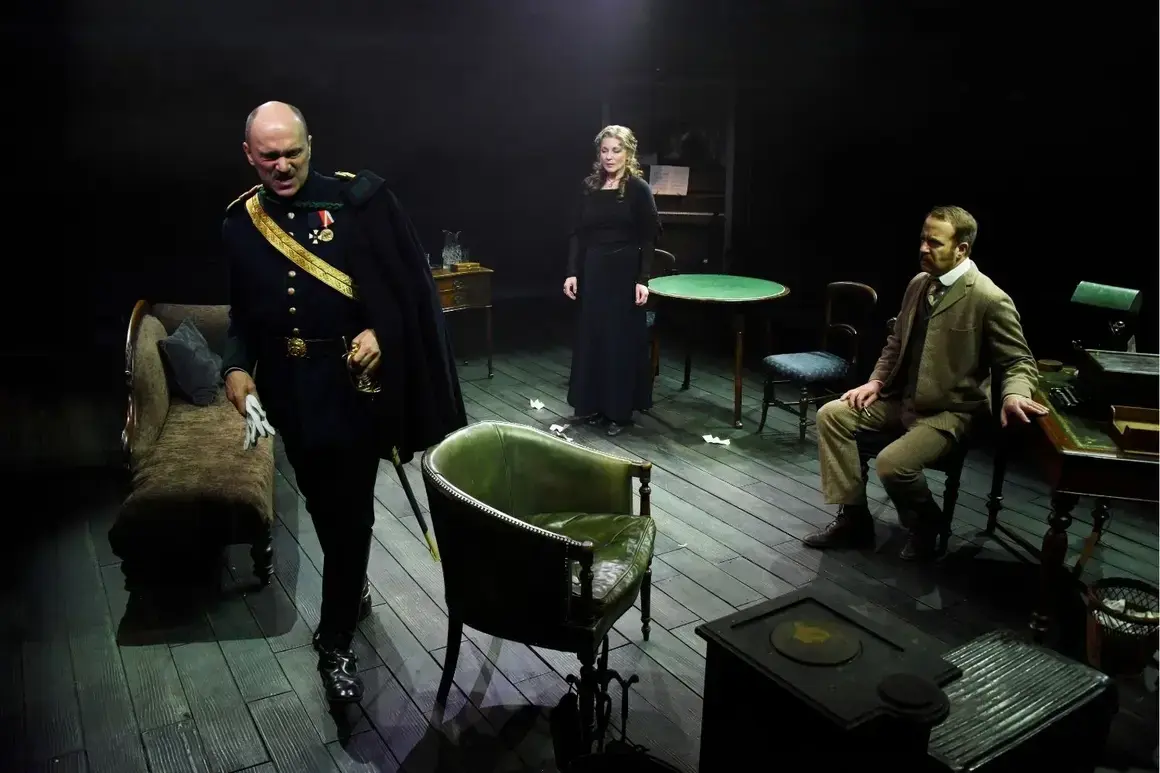
Ashley Martin-Davis’s set of faded eggshell blue-greens gone greyish counters claustrophobically-compressed furniture: including sofas and an all-important telegraph poised on the desk. Props embrace an ever-tapped barometer and wrought-iron hatstand. Martin-Davis’s costume design features a peacock captain’s dress uniform and marginally less dressy one; soft browns and light greys for the visitor and quiet glamour for Alice, often in black. John Leonard’s sound design involves that Boyars’ dance on the piano (played by Tom Attwood) and relatively gentle music upstaged by whirling storms, whistling and banging through.
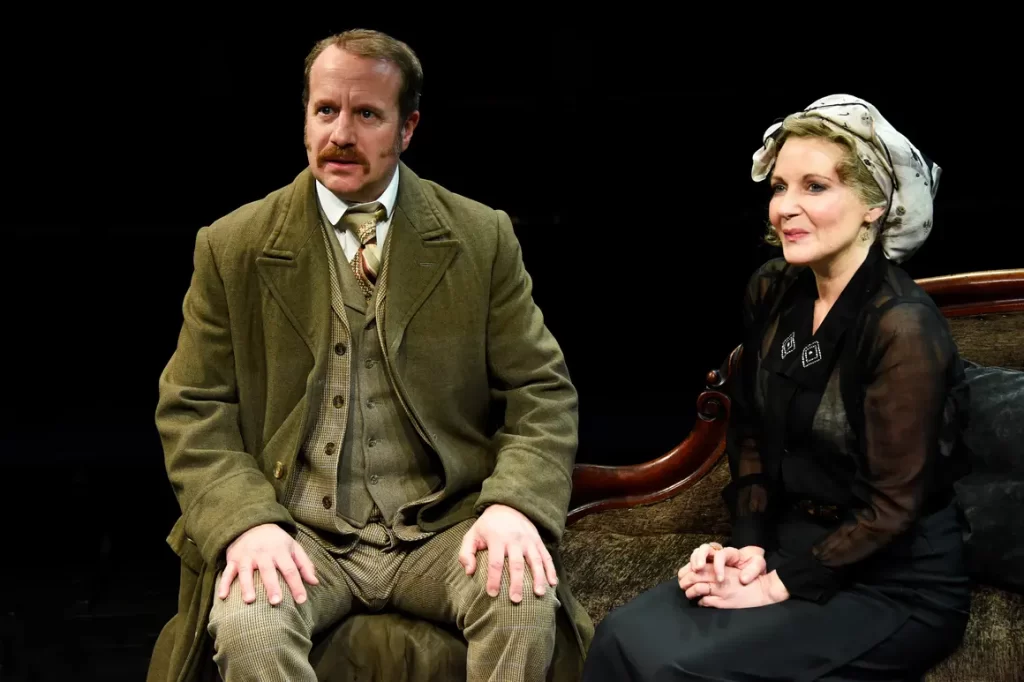
Opening at cards unsheathes the play’s claws gently. Lisa Dillon’s former actress Alice is trapped in a hate-love-hate marriage approaching twenty-five years: to Will Keen’s Edgar, an unpopular captain whose career’s stalled as he commands an island quarantine station. Anti-social, the couple have even set their surviving departed children against them both. Ten years Alice’s senior Edgar suffers from heart trouble he privately knows will kill him. “She’s angry with me because I didn’t die yesterday” states Edgar after one of these bouts that leave him as oblivious as in an epileptic fit; allowing vicious jibes to fly about him. “I’m angry that you didn’t die before I met you!” Alice delightedly ripostes.
Using Alice’s theatrical memory-muscles, Dillon’s gimlet-eyed with small telling flicks of the head. This poise fuels her every move: scornful, sexual, scabrously funny. Keen’s at once lean and draws Edgar as abrupt, wired, living on his nerves’ capital; capable of feral switchbacks and ambush. Yet he’s more rampant than some Edgars, theatrically romping with every faux or real heart attack. His performative little deaths might have acted his wife off the stage. Certainly Keen’s burlesque gestures in the Boyars’ dance wrongfoot everyone else. Scarlett Mackmin’s choreography here and elsewhere enlarges this tight space. But that of course underestimates Dillon’s feline exultance, her silken pounce. Dillon’s quiet, often still, till she isn’t.
Geoffrey Streatfeild’s Karl, whose rumpled grey-browns unfurl from his mask and overcoat, is someone played out of his depth. What Streatfeild conveys isn’t so much in innate vampirism (as in the Coronet’s) as one borrowed. It reveals itself as he and Alice make explicit what other productions play with. Here there’s consummate motives as to why necks are bitten and Karl humiliatingly obeys Alice. Strindberg stripped bare beyond his language, even.
There’s intimacy too; as they spar and declare hate they entwine, kiss necks, writhe in a sheet of old flame that might be heaven recalled in hell. “You make me into a beast” Kurt tells Alice. “Why did Kurt have to come and seduce me?” Alice complains later to Edgar, flagrantly lying.
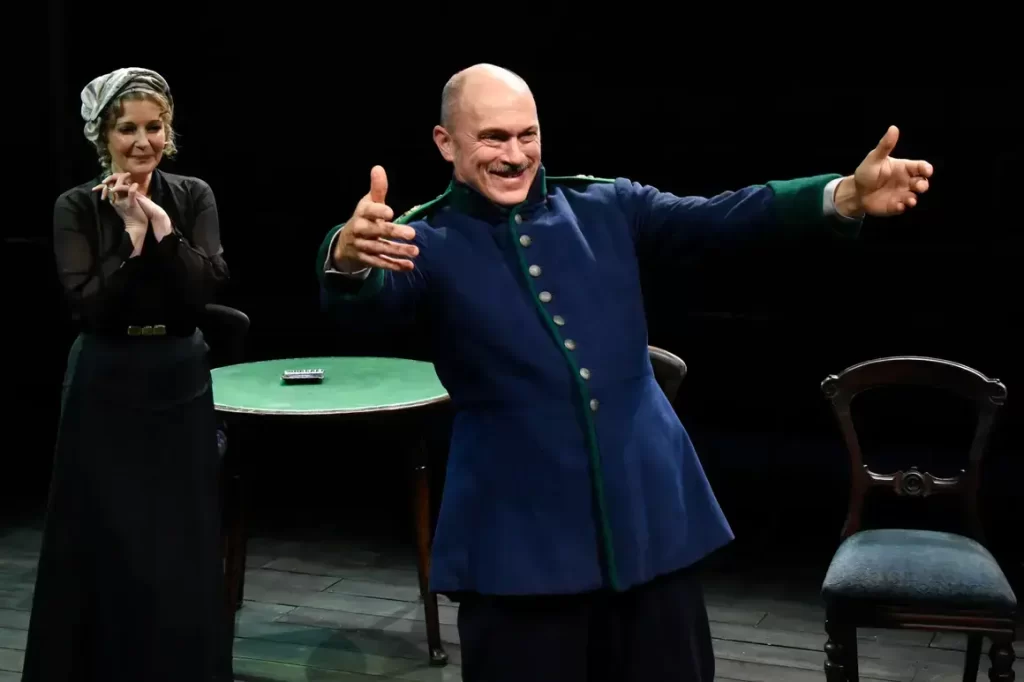
Lisa Dillon and Will Keen. Photo Credit Nobby Clark
In this production Streatfeild’s Kurt is more palpably the compound these two catalysts – unchanged in themselves – act upon, charge with their own love-hatred. As the couple feint and counterplot, Streatfeild’s reabsorption in Kurt’s and Alice’s former attraction bursts out in at first as fascinated sexual dance; replayed as disgust. You see Streatfeild’s head droop, darkened with poison like litmus paper. Often Kurt’s straight-man palpably takes on the couple’s vengeance as he discovers how much they’ve acted on Kurt, his marriage and children over the years. Or have they? Streatfeild’s response is more self-loathing, though passive: his final act one of two decisions he’s taken, and the only free one. Alice’s expletive (one Strindberg never used) follows him. Again it’s hilarious, and absolutely right here.
Over who the greater monster is Strindberg remains ambivalent. Yet it’s Edgar’s pronouncement repeated several times that wins out as epitaph; rendered by Eyre like a leitmotif: ”You just have to rub things out and move on.” As the performance fades to black the gleams in the couple’s eyes swivel to face each other exactly as at the start. A kind of huit clos. A production punctuated with frequent laughter is also aerated with the interval: so the Greek tragedic mode recedes and a kind of comedic circular hell distils itself. Mesmerising, with an unmatched British cast, it’s also provocative. Perhaps not the last word in a traditional Dance of Death – taut, existential and ferocious – it must be the most humane and comedic in recent memory: indeed a revelation. Strindberg to live with? Who’d have thought of that?
An outstanding must-see. If you can’t get there, tune in to the livestream. This demands a wider audience.
Assistant Director Freya Griffiths, Costume Supervisor Deborah Andrews, Wigs & Hair Supervisor Sharon Pearson, Head of department for Wigs Hair& Makeup Paul Paintin, Production Manager David Pritchard, Costume Work Placement Ashleigh Ridding, DSM Honor Klein, ASM Josette Shipp.
Production & Technical Director Phil Bell, CSM Jade Gooch,
Production Technicians Andy Owen Cook, Priya Virdee.
Geoffrey Streatfeild and Lisa Dillon. Photo Credit Nobby Clark