Simon Jenner, December 13 2025
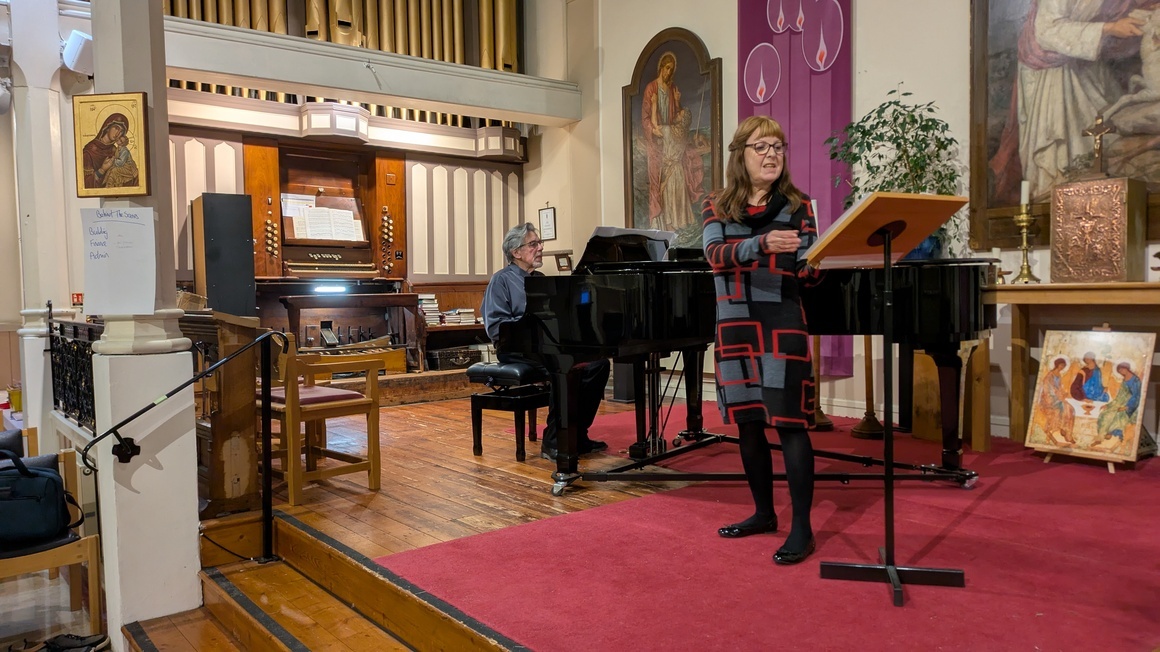
The final Sussex Musicians Club (SMC) meeting of the year at the Chapel Royal on December 13 got off to an unusual corner of Mozart’s repertoire: his lieder. And French ones too. Carol-Anne Grainger has a pleasing soprano voice, ably accompanied by Kevin Allen, not often seen in such repertoire!
The two Mozart songs ‘Dans un bois solitaire et sombre’ and the autobiographical ‘Als Luise de Briefe’ (Gabriele Von Baumberg) are close to the poet’s experiences. Being punished into eternal hopeless love for waking Cupid, and burning a faithless lover’s love poems; but not the fire in her heart. Mozart’s writing is as Allen put it, astonishingly concise for the keyboard, and the lyric line clean and incisive. French lent Mozart an even keener elegance and jewel-like precision, unencumbered, dare one say it, by German.
Afterwards came two Robert Schumann lieder. ‘Die Lotusblome’ by Heine is a figurative and gorgeously described piece involving the sun.. The Ruckert ‘Wilding’ is a declaration so close to Robert’s love for Clara that it’s no wonder “my better self, my guardian angel” is set so memorably.
Poulenc’s ‘Les Chemin de l’amour in its swaying nonchalance is so mid 20th century it’s odd to think this was written in 1940. Dramatist Jean Anouilh’s poem is piercingly elegiac, and Poulenc knew a thing or three about past love. Yet its insouciance turns it into – almost – a cafe chanson; as if the feeling belied the words, and the regret is mild. It is though utterly memorable. It’s deliciously swung here. With a long-held final note from Grainger.
Next pianist Sarah Luong played two Scarlatti Sonatas and a Prelude by Rachmaninov.
The two Scarlatti’s are well known from his oeuvre of 555, mostly composed shortly before his death aged nearly 72 in 1757. .The processional Sonata in E major K380 is brought out here with pageantry and a sense of occasion, including the almost bird-like chirruping notes at the outset.
The more tenebrous B minor K27 is one of those published earlier on London in 1742. It’s at roughly at the same Allegro ma non troppo speed, and spun on a legato as its reflective material is spelt out till it develops. It’s thoughtful rather than melancholic, a fine and switch-backed piece full of tricky tempo changes and surprises.
Rachmaninov’s Prelude in E flat major Op 23/6 from 1903 isn’t as well-known as some others in the set: most notably it’s immediate predecessor No 5 in G minor. It’s a rolling almost undulating piece that exudes a rare content and with less distracting fireworks. Really welcome.
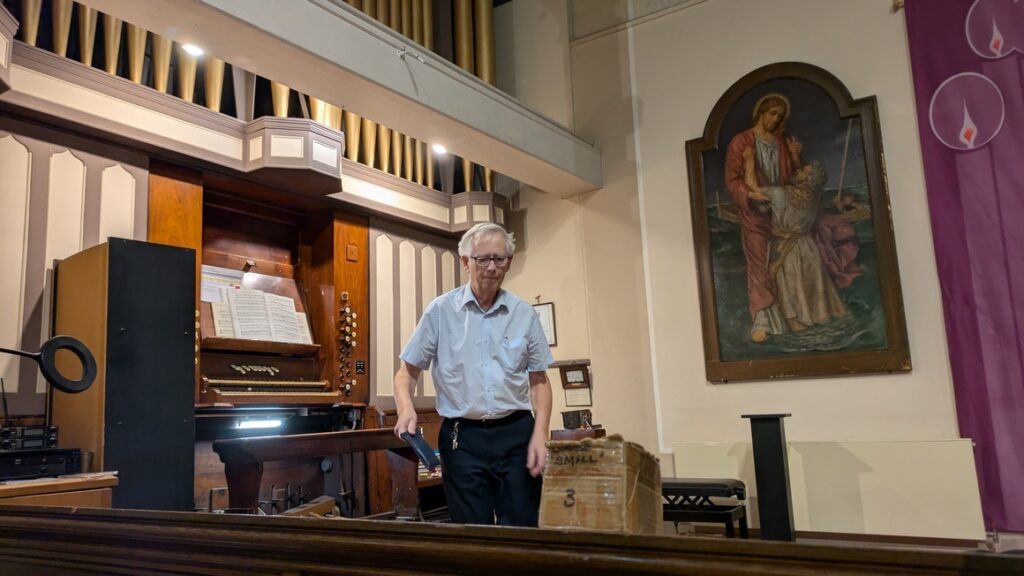
Finally a rare foray to the organ loft or at least the Chapel Royal one where recently John Collins gave a memorable recital. Hugh O’Neal, known for his pianism, here essayed two baroque chorales and one contemporary piece. We’ve not heard O’Neal on the organ: yet he’s played at his local church for at least seventeen years, and possesses a small pipe organ of his own to practice on. We really have been missing a performer’s skill here.
Johan Pachelbel ((1653-1706) known for that Canon in D (he wrote 80 Canons) wrote much vocal work being rediscovered and keyboard music too. 1653 saw the birthday too of Corelli and Georg Muffat.
This setting of chorale Vom Himmel Hoch is memorable and a perfect example of where German music was by the later mid baroque. It’s a flowing evocation of the chorale.
Back 32 years younger wrote many cantatas sometimes with opening sinfonias. These have been transcribed for keyboard. The one from Cantata No 106 Gottes Zeit ist die allerbeste Zeit describes it all. God’s time is the best and indeed all. The slowly unfolding and unhurried chorale proves it too, on delicate flute stops and an underlying pulse that beats out a quiet rapture.
Ashley Grote born in 1982 is new to me. His transcription of The First Nowell is a perky one of the famous Carol employing trumpet stops and a thundering bass pedal. It’s a paraphrase on some verses and ends in a paean. A superb seasonal conclusion in the only instrument possible under the circumstances.
A brief concert reflecting the following celebratory goodies, a memorable end of year concert.
Next Concert Saturday January 10.


Chapel Royal SMC Ensemble Brighton Photo Simon Jenner
Oboist Alex Pearson and pianist Stephen Engelhard present two items each by Handel and Bach. Handel’s Oboe Sonata in G minor Op 1 No. 2 is a plaintive aria-riven piece that might date from his time at Cannons, residing with the Duke of Chandos 1717-19. Or earlier. The movements are typically slow-fast-slow-fast here telescoped into two. It’s like two early Italian arias yoked together, full of wintry resolve.
Before the next Handel Oboe Sonata, Engelhard plays two Bach Preludes in the keys of the Handel: G minor and A minor respectively. The G minor BWV 885 is famed for its tragic measure and tread in a two-note tied fashion. The A minor BWV 889 despite its equally steady tempo this is a spikier more harmonically challenging work. A fantastic spiral of false notes unwinds and cascades out. Quietly gripping.
Handel’s Oboe Sonata in A minor Op 1 No.4 is a more pastoral affair than the G minor. We leave grieving, G minor’s baroque key for the subject, into the melancholy pastoral of A minor. It’s more instrumental in feel with a more complex slow movement and a resolute fast section. Again tunefully insistent it takes on the character of a heroic aria. The gentler aria that follows is a little bit “parlando”, that is as if speaking. Finally a more upbeat finale still wedded to the minor. Again bold and resolved. Immensely satisfying.
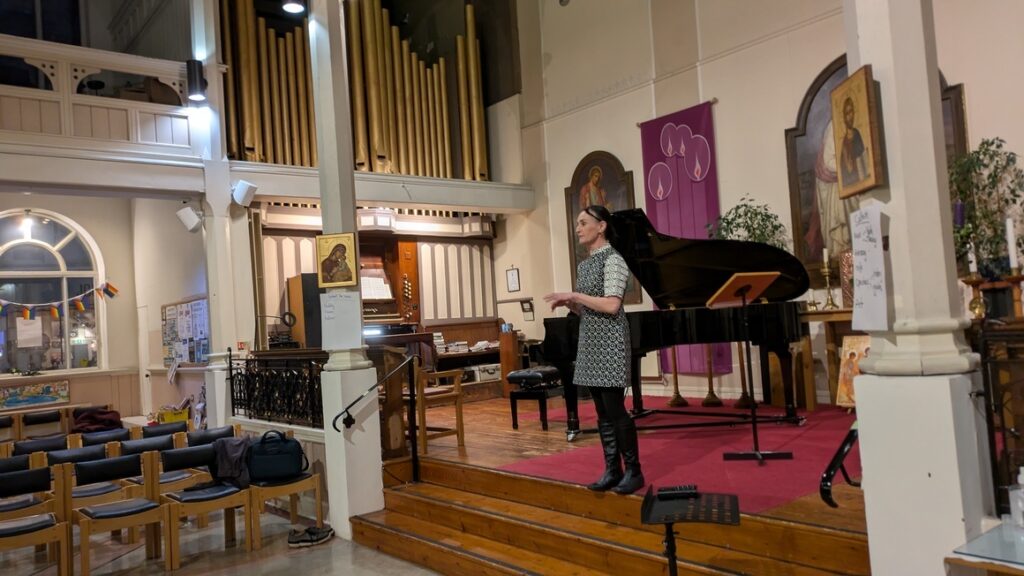
Sarah Luong, Chapel Royal Photo Simon Jenner
Kevin Allen returns to play Arnold Schoenberg (1874-1951). He’s an inspired exponent of Schoenberg and modernism, as well as Brahms.
First the ‘Massige Achtel’ Op11/2 from 1909 is still just tonally rooted. It’s an elegiac piece reflecting personal turmoil. Its rocking rhythm on a two-note introduction is stressed by an overarching right hand melody that crossed over into Purr expressionism. Ewartung wasn’t far away and Pierrot Lunaire too looms. It’s still a recognisable struggle with the bounds of what might be said. It’s moody and powerful. Were it not associated with Schoenberg people wouldn’t be so afraid of Op.11. It ends on a crisis and a dissolve. Several times. Just after Allen finished a bell chimed eight. It recalled the bells heard in the last of the six Op 19 piano pieces.
The five Op 23 pieces from 1923 break a creative impasse and the last really managed to move into the 12-note system. Not as celebrated as Op 11, 19 and 25, they’re more interesting, Allen suggests than the latter, with their more skeletal material, if with a more thorough-going 12-tone system. Op 23 is more transitional, more engaged and troubled with the sheer material of music and its extra-musical gestures.
The first ‘Sehr langsam’ quite slow, is a more complicated world than Op 11. It fleets by as an introduction of several unsettled themes and we’re into ‘Sehr rasch’ a spikier match like theme. After a pause, there’s a crazed jack in the box of leaping themes splintering time. It finally winds down.
‘Langsam’ isn’t as slow as its title suggest. It’s more a waltz. keeps the pulse while subverting it with cross rhythms and various themes entering a variants of their predecessors. Oddly Hindemith’s Waltz finale from his ‘1922 Suite’ came to mind. Otherwise this is a world that takes additive rhythms and themes and rejects then into space. It’s a haunted territory.
The ‘Schwungvoll’ is more capricious and less consistent with an artic thrust that just suddenly stops.
The 12 tone Walzer’ is less waltz-like than the ‘Langsam’ with more cross rhythms and details that flicker in and out. Recognisable tone rows introduce themselves but this extraordinary piece is unclassifiable to the naked ear. You need to hear it and the subsequent pieces the Suite Op 25, more celebrated but Allen suggests “more skeletal, less interesting” and the gnomic brief Op 33) over and over. Stunning.
A superb baroque/modernist recital all round.
Hugh O’Neal. Photo Credit Simon Jenner