Simon Jenner, November 8 2025
Sussex Musicians (SMC) met at the Chapel Royal on November 8 to discover a change of programme. The evening began impressively with Max Bruch’s. Concerto for Clarinet and Viola in E minor Op 88 from 1911 in a reduction for piano. Evelyn Harrison rather a star clarinetist of the south coast was Jones by Beatrice Sales on viola and Zhanna Kemp in piano. A rock-solid team performing a work that’s become increasingly popular (just like Bruch’s recently unearth String Quintets written in 1918 two years before his death).
The opening Andante con moto is redolent of Brahms’ Clarinet Sonatas, Clarinet Trio and above all Quintet of a decade and a half earlier. The opening melancholic theme drenched in E minor with the homophobic world of clarinet and viola add to the distinct autumnal feel; though with Brunch there is a countervailing aspiring theme though it at he’s perhaps to tragedy or hidden sadness. It’s a distinctly nuanced movement, full of rubato and eddies; and the reduction allows us to hear a lot more detail and glinting musical thought.
The contrasting Allegro moderato ripples along led by the piano then clarinet swelled by the viola in an intermezzo. One is reminded of Carl Frühling’s only well-known work, his 1900 Clarinet Trio in A minor Op 40 from 1900. It’s again more memorable in this reduced guise. Brahmsian piano figuration – Bruch wasn’t a huge piano composer – is intriguing. It moves from Intermezzo to elegy, lightly held and back to the Intermezzo-like qualities associated with Brahms.
The Allegro molto runs off with a rousing piano introduction that was originally an orchestral tutti. Another impressive theme rises immediately decorated by the clarinet and only later augmented by the viola. There’s finally a degree of resolution and energy. This upsurge continues uncomplicated but thrilling till the final coda a delightful work and really worth hearing on the website.
Illness forced a change of programme and Sue Mileham stepped in despite recovering from a cold to sing – with Nicola Grunberg on piano – a mini recital of magical songs, in keeping with tonight’s theme.
First Humperdinck’s Handel and Gretel from 1893. And another reduction to piano from the operatic score. The two fairies. Sandman and Dew Fairy put the children to sleep and wake them respectively. A shimmer on the piano indicates again a string section. The melody is couched in a major key lullaby for the Sandman. The corresponding reveille shows the same song sharpened by rising an octave and with sharp interjections. But there a soaring and radiant development Mileham holds with warmth and affection.
Thomas Linley the Younger (1756-1778) the second of three musical geniuses (according to other geniuses) born that year. Haydn red Martin Kraus. Mozart read Linley who drowned perhaps self-induced aged 22. From the great Linley family, his death was a huge blow to them and British music.
He loved The Tempest and his incidental music includes ‘O bid your faithful Ariel fly’ is very post-Garrick in its bardolatry. Mileham essays the Haydn-esque song that reminds us this was written 20 years before Haydn’s English songs. There’s a touch of Arne too but Linley really sounds, even so young, like no-one else. His ‘merrily merrily’ predates Haydn though echoes Arne. Theatrical and beautifully airborne like Aerial it shows us how much we’ve lost.
Rutland Broughton (1878-1960) later became not only the great instigator of the Glastonbury Music Festival as well as becoming very left-wing. Before this in 1914 he wrote his most popular work, the opera The Immortal Hour. The Fairy Song ‘How beautiful they are the lordly ones… they laugh and are glad and are terrible..’ There’s Keatsian menace in this work and in the opera. It’s a stunning song, one of the greatest British melodies of the time – one rich in them.
Granville Bantock (1868-1946) is underrated despite a revival. His shimmering orchestration and a handful of great Symphonies (all named, like Hebridean. Pagan, Cyprian, Celtic) and orchestral tone poems like Fifine at the Fair establish him as a powerful melodist. His ‘Seal Song’ from 1930 (from Songs of the Western Isles) is a delightful miniature invoking deals on an almost unchanged and barless-seeming melody. It’s refrain is hypnotic in Mileham’s hands.
We return abroad for Dvorak’s opera Rusalka from 1900 and the celebrated ‘Song to the Moon’. Mileham really soars with this good standard sing and Grunberg accompanied not just with sensitivity but a delicate invocation of the pauses and hush in the original full score.
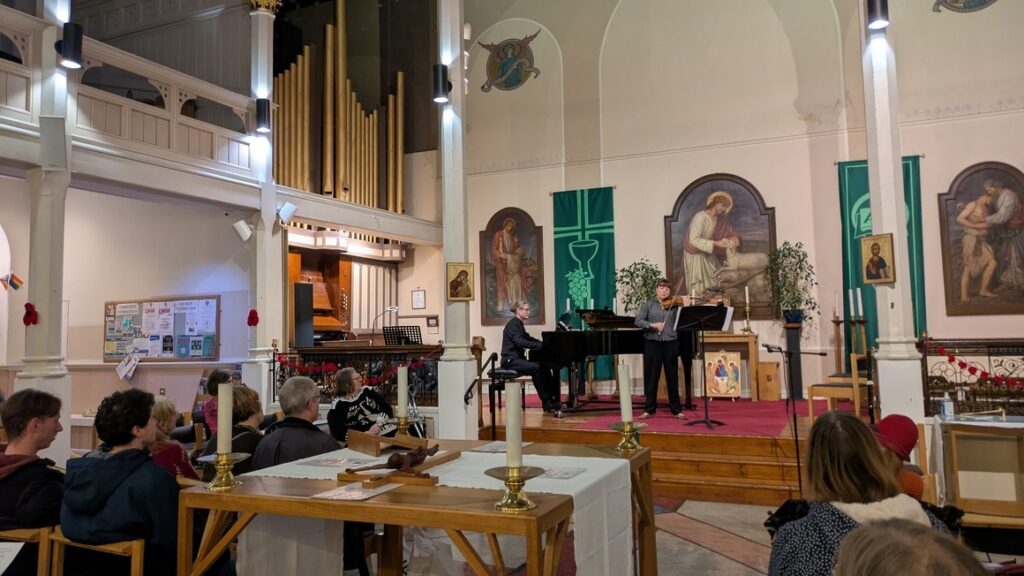
Myths and Legends continues in a violin and piano recital by violinist Sophia Bartlett the and pianist Benjamin Rous.
They lead off with Cyril Scott (1879-1970) whose long career (starting with four friends, the Frankfurt Five, who eschewed English RSS. Including Percy Grainger) embraced atonal and experimental music as well as study if herbal medicine and the occult. His heady Lotus Land Op.47/1 is the kind of piece he wrote that earned Debussy’s admiration. Late Romantic in a British vein it’s also unlike anyone else. And not so much like other Scott either. It’s soaring faux Asian melodic curve informed by pentatonic and other elements is certainly more modern sounding and strange than his contemporaries were then composing. Frank Bridge and others would steal a match. But here is a small jewel of the land of lost content that is Edwardian England.
A reduction from Rimsky-Korsakov’s Scheherazade Op 35 from 1888 naturally gravitates to the violin solo opening each movement. Here it’s the second the story of the Kalendar Prince. Using the lower reaches of the violin with double stopping Bartlett moves from the high introduction to these gritty sororities then back to a high register as Scheherazade herself. Bartlette and Rous relish the rhythmic drive and the challenges of a reduction from a famous and fabulously orchestrated score.
Amy Beach (1867+1944) is now receiving her due. Part of the Boston group she wasn’t allowed after 18 to perform – by her much older husband. She composed instead. When he died she performed again as well. Her Romance Op 23 an early work is increasingly performed. It’s a work that doesn’t sound quite European bit it’s melodic opening has something faintly of the parlour and lighter musical about it but is altogether larger in scale and ambition. Nothing at all perjorative in that. By the time of her Op 150 Piano Trio where shimmering atonality is heard, she has travelled a long way including through her Gaelic Symphony. It’s a piece at least as memorable as say Elgar’s works for the same forces.
Antonio Bazzini (1818-97) tends to be known for his one ‘Dance of the Goblins’. With itself double stopping it’s become a virtuoso calling card. It’s melodically memorable and still one of the finest show stoppers of all time. The scurrying of the gnomes and faintly comic faintly sinister enharmonic slitherings are a delight as handled here by Bartlette, sliding right off the scale and near the bridge. Edgy and a portal every five violinist still has to bow through. Rous is absolutely an equal partner in these moments, and supportive elsewhere; as well as taking up almost orchestral sonorities.
Bazzini went on to compose six highly praised string quarters – they really are fine. But he lived in an age where Italian music wasn’t supposed to be instrumental. A thrilling end to the evening.
Real discoveries and delight here. And all so easily to be heard on the website in a few days. Next Concert Saturday December 13.


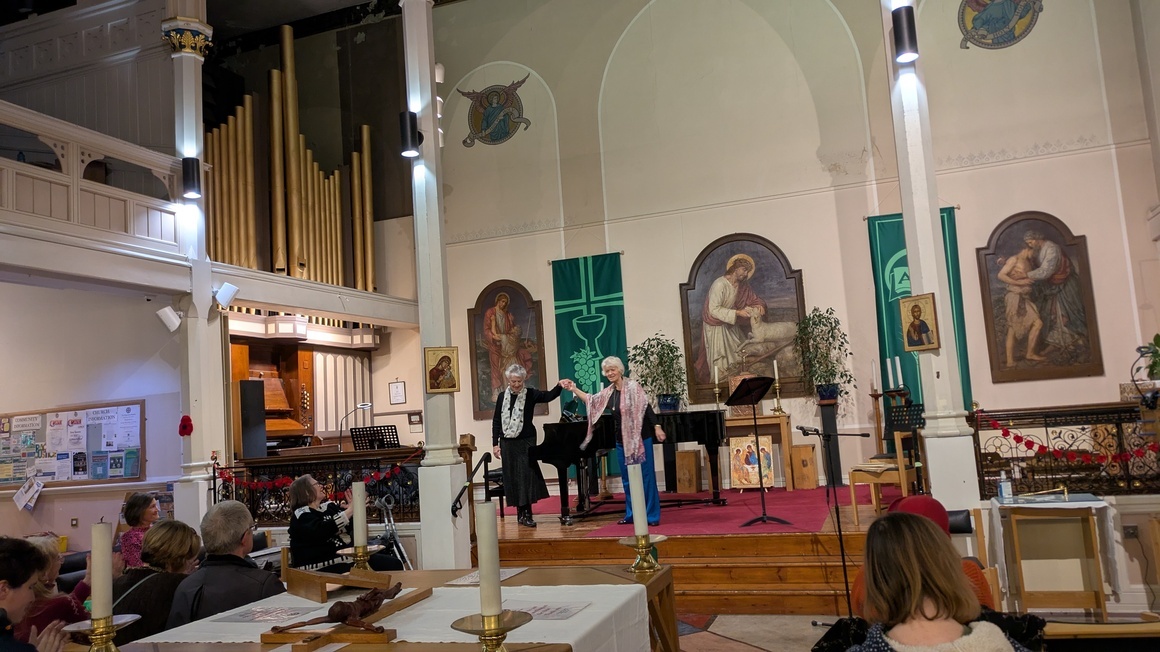
Chapel Royal SMC Ensemble Brighton Photo Simon Jenner
Oboist Alex Pearson and pianist Stephen Engelhard present two items each by Handel and Bach. Handel’s Oboe Sonata in G minor Op 1 No. 2 is a plaintive aria-riven piece that might date from his time at Cannons, residing with the Duke of Chandos 1717-19. Or earlier. The movements are typically slow-fast-slow-fast here telescoped into two. It’s like two early Italian arias yoked together, full of wintry resolve.
Before the next Handel Oboe Sonata, Engelhard plays two Bach Preludes in the keys of the Handel: G minor and A minor respectively. The G minor BWV 885 is famed for its tragic measure and tread in a two-note tied fashion. The A minor BWV 889 despite its equally steady tempo this is a spikier more harmonically challenging work. A fantastic spiral of false notes unwinds and cascades out. Quietly gripping.
Handel’s Oboe Sonata in A minor Op 1 No.4 is a more pastoral affair than the G minor. We leave grieving, G minor’s baroque key for the subject, into the melancholy pastoral of A minor. It’s more instrumental in feel with a more complex slow movement and a resolute fast section. Again tunefully insistent it takes on the character of a heroic aria. The gentler aria that follows is a little bit “parlando”, that is as if speaking. Finally a more upbeat finale still wedded to the minor. Again bold and resolved. Immensely satisfying.
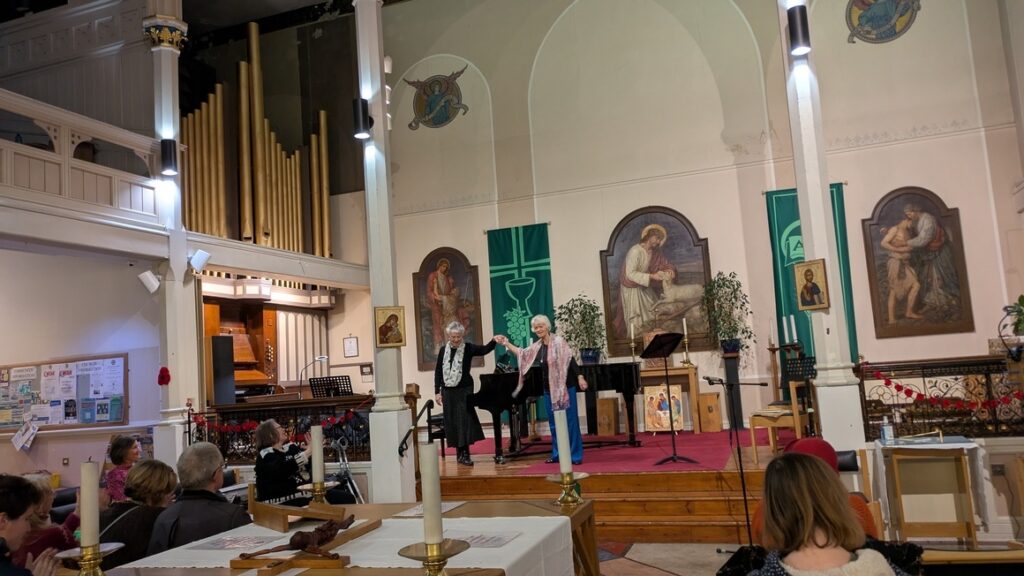
Chapel Royal Photo Simon Jenner
Kevin Allen returns to play Arnold Schoenberg (1874-1951). He’s an inspired exponent of Schoenberg and modernism, as well as Brahms.
First the ‘Massige Achtel’ Op11/2 from 1909 is still just tonally rooted. It’s an elegiac piece reflecting personal turmoil. Its rocking rhythm on a two-note introduction is stressed by an overarching right hand melody that crossed over into Purr expressionism. Ewartung wasn’t far away and Pierrot Lunaire too looms. It’s still a recognisable struggle with the bounds of what might be said. It’s moody and powerful. Were it not associated with Schoenberg people wouldn’t be so afraid of Op.11. It ends on a crisis and a dissolve. Several times. Just after Allen finished a bell chimed eight. It recalled the bells heard in the last of the six Op 19 piano pieces.
The five Op 23 pieces from 1923 break a creative impasse and the last really managed to move into the 12-note system. Not as celebrated as Op 11, 19 and 25, they’re more interesting, Allen suggests than the latter, with their more skeletal material, if with a more thorough-going 12-tone system. Op 23 is more transitional, more engaged and troubled with the sheer material of music and its extra-musical gestures.
The first ‘Sehr langsam’ quite slow, is a more complicated world than Op 11. It fleets by as an introduction of several unsettled themes and we’re into ‘Sehr rasch’ a spikier match like theme. After a pause, there’s a crazed jack in the box of leaping themes splintering time. It finally winds down.
‘Langsam’ isn’t as slow as its title suggest. It’s more a waltz. keeps the pulse while subverting it with cross rhythms and various themes entering a variants of their predecessors. Oddly Hindemith’s Waltz finale from his ‘1922 Suite’ came to mind. Otherwise this is a world that takes additive rhythms and themes and rejects then into space. It’s a haunted territory.
The ‘Schwungvoll’ is more capricious and less consistent with an artic thrust that just suddenly stops.
The 12 tone Walzer’ is less waltz-like than the ‘Langsam’ with more cross rhythms and details that flicker in and out. Recognisable tone rows introduce themselves but this extraordinary piece is unclassifiable to the naked ear. You need to hear it and the subsequent pieces the Suite Op 25, more celebrated but Allen suggests “more skeletal, less interesting” and the gnomic brief Op 33) over and over. Stunning.
A superb baroque/modernist recital all round.